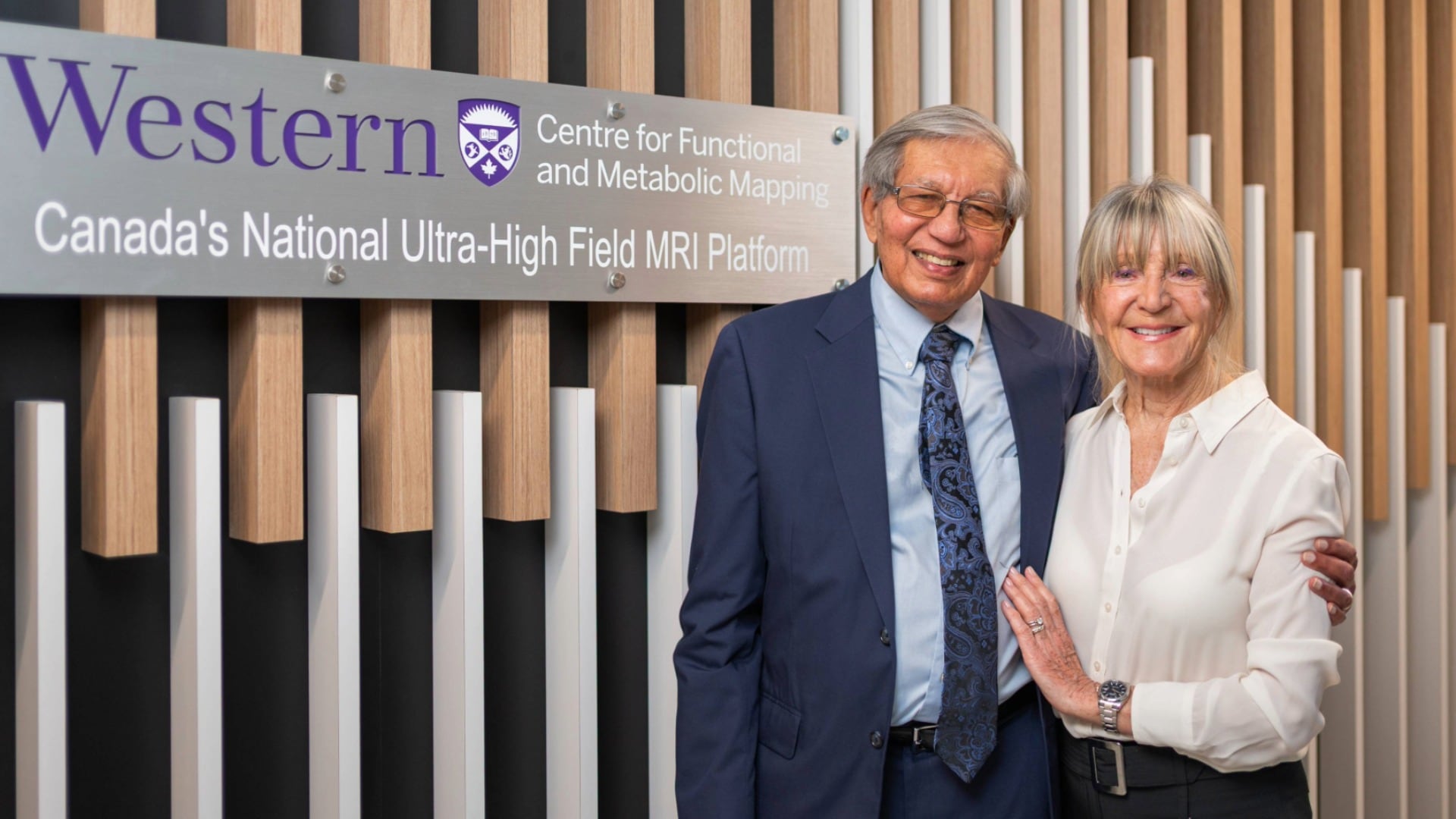
An Oakville, Ont. couple is turning personal loss with neurogenerative disease into hope following a multi-million donation to Western University.
According to a news release from London’s Western University, Frank and Janice Lochan are donating $4.1 million to advance the study of neurological disease, with a goal of improving daily life and long-term outcomes for families like theirs.
Generations of Janice’s family – including her mother and grandmother – lived with Huntington’s disease.
The inherited disorder causes the progressive breakdown of nerve cells in the brain, leading to severe physical, cognitive and emotional decline.
Frank has also been impacted by the hardships of neurogenerative disease, as his first wife was diagnosed with frontotemporal dementia, a progressive brain disorder that causes severe changes in personality and behavior.
“We’ve gone through terrible losses,” said Janice. “We’ve come through them all and realized what we can do to help others – give back.”
Their gift – combined with matching funds from Western – will establish the $8-million endowed Frank and Janice Lochan Chair in Neuroimaging for Brain Health in Schulich School of Medicine & Dentistry.
The chair will strengthen Western’s ability to recruit leading researchers and advance innovative imaging techniques to better understand, detect and monitor neurodegenerative diseases such as Alzheimer’s and Huntington’s, according to Western.
Western says the donation will continue to foster the university’s work on imaging and neuroscience, “accelerating discoveries that improve outcomes for patients and families.”
The gift also includes $100,000 to create the Lochan Postdoctoral Fellowship Fund in neuroscience to support postdoctoral research within the Schulich School of Medicine & Dentistry, using state-of-the-art imaging equipment to analyze complex brain imaging data.
“We are deeply grateful for the Lochans’ generosity stemming from their personal experiences with these devastating diseases,” said Western President Alan Shepard. “Their remarkable investment will enable Western researchers to pursue discoveries that will offer hope, improved quality of life, and better care for individuals affected by neurological diseases.”
Researchers at the Centre for Functional and Metabolic Mapping (CFMM) use advanced magnetic resonance imaging (MRI) scanners to map how the brain develops in childhood, how it changes with healthy aging and what goes wrong in neurodegenerative and mental health disorders.
Research has shown that many brain disorders share similar symptoms, risk factors and biological pathways, which for the Lochans has further cemented the importance of neuroimaging.
The couple says they are committed to and inspired by the neuroimaging work at Western, especially following a tour of the research facility and a meeting with Robert Bartha, vice-dean (research and innovation) at the Schulich School of Medicine & Dentistry.
“We couldn’t help but feel excited when we saw their [the researchers’] excitement. It’s easy to get caught up in negativity these days, but being at Western opened up the sunshine,” said Janice.
Neurodegenerative diseases are a leading cause of disability in Canada, which makes scientific advances a lifeline for families.
“All the worst things you can imagine are thrown together with Huntington’s disease, but we’ve come so far with promising research. If our giving can help accelerate progress towards new solutions, then it feels deeply worthwhile to give,” Janice said.
This sense of urgency is why the Lochans chose to make their donation now. The couple says they had initially planned a more modest estate gift but instead decided to make their largest donation now while research momentum continues to build.
“We want our gift to be used now,” Frank said. “That will help people who are suffering feel they have supporters behind them.”

