When David Young had a stroke in April 2025, he never imagined himself returning to the same Brantford General Hospital ward as a volunteer.
“Originally it felt like that was it. I thought my life was over,” Young recalled. “But having someone to talk to, someone that has been through what I’ve been through really helped me the most. Now, I’m hoping to do the same thing for someone else.”
Young is one of two stroke survivors from the hospital who has returned to help recent stroke patients through their journeys.
“It was hard for me originally to come back, just in knowing that the last time I was here, what I had been through,” Young told CTV News.
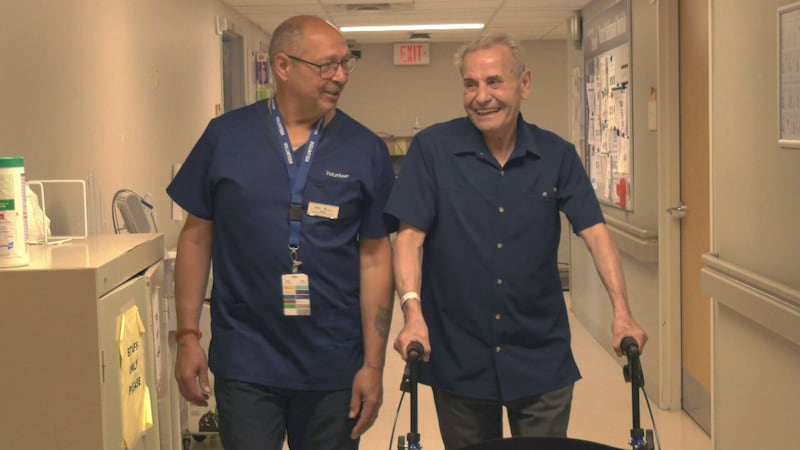
The hospital initiative is run by March of Dimes Canada through its peer connection program.
“We actually started in Kitchener-Waterloo in 2008 under Stroke Recovery Canada. From there, we blossomed and now we’re in 33 different hospitals across Ontario,” said Michelle Foster, the volunteer engagement coordinator with March of Dimes.
The program in Brantford launched at the end of March and volunteers have worked with dozens of patients going through similar circumstances.
“I’m not going to live like this”
One of the most recent patients is John Recine, who had a stroke on May 25.
“Around two o’clock in the morning, I thought I had cramps so I just slid off the bed,” Recine recalled. He was rushed to the Brantford hospital, where he learned had had suffered a stroke.
“At the beginning I said, ‘I’m not going to live like this. I don’t even want to live,’” Recine said.
Four weeks later, the 70-year-old is preparing to be discharged following intense physical therapy. But the mental rehabilitation also helped him get through his toughest days.
“I met David and he told me his experience and then I just worked on it, and I was just determined after that to move my legs and I’m getting a lot better,” Recine exclaimed.
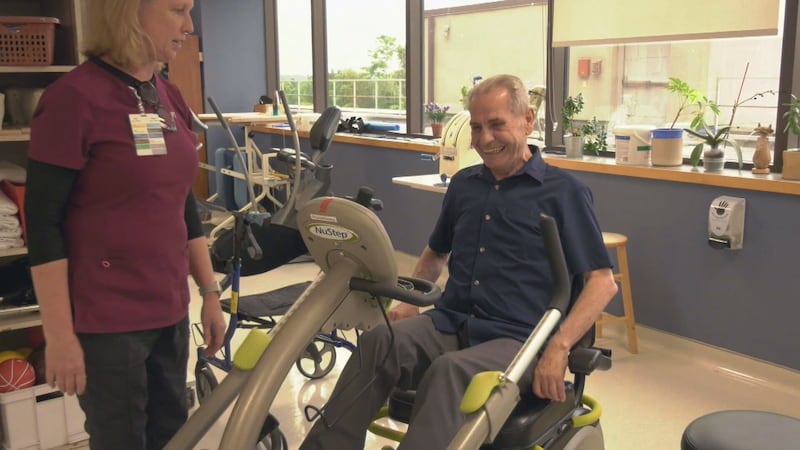
Those involved with the program say that suffering from a stroke can be an extremely isolating experience and it’s reassuring to know that you’re not alone in the recovery journey.
“We’ve heard from the patients how meaningful it is to interact with somebody who has walked in their shoes,” said Anastasiya Verrall, the district stroke coordinator for Brant, Haldimand and Norfolk counties.
Young said he plans to continue volunteering for as long as he can and is grateful to be part of so many people’s recovery journey.
“He encouraged me quite a bit,” Recine said. “I just kept on working in my bed and getting my legs moving and arms and everything. Here we are almost four weeks later and I’m going home.”
Stroke prevalence in Canada
June is Stroke Awareness Month, and according to the Heart and Stroke Foundation, roughly 100,000 people have a stroke every year in Canada.
“It’s the leading cause of disability in Canada with about one million people currently living with a stroke,” Verrall said.
“They estimate that a person is having a stroke every five minutes.”
The Brantford hospital has a 21-bed integrated stroke unit and last fiscal year, staff served almost one thousand patients.
While experts still struggle to pinpoint what causes a stroke, the symptoms begin when a blood vessel carrying oxygen and nutrients to the brain is either blocked by a clot or ruptures.
“[Patients] are getting younger and younger. I’m not exactly sure what caused my stroke and I know for a lot of these people I’ve spoken with, they really have no idea either,” explained Young.
He added that it can be an isolating experience, which is why he’s even more grateful for the March of Dimes program.
“Emotionally, I’m feeling a lot better. I still have some small issues. There are still times when I find myself wondering ‘why me?’ But it’s just nice to look forward to coming in and helping other people that are going through what I’ve been through,” Young said.
“We can provide excellent medical care and rehabilitation at our community health care system, but there’s something uniquely special and meaningful about speaking with somebody who has lived through that experience themselves,” Verrall added.
She continued to say that the most important thing about strokes is identifying the symptoms early and getting immediate medical attention.
The acronym FAST is a benchmark used for recognizing stroke symptoms:
- F – Is your face drooping?
- A – Are you able to raise your arms above your head?
- S – Is your speech slurred or jumbled?
- T – It’s time to call 911

