A bright fireball that streaked across the sky over Lake Erie Friday night was part of a busy week for meteor sightings in southern Ontario.
The object was also spotted by hundreds of people in parts of the U.S.
Eyewitnesses saw it above western New York around 7:27 p.m. as it travelled southeast and broke apart over Pennsylvania.
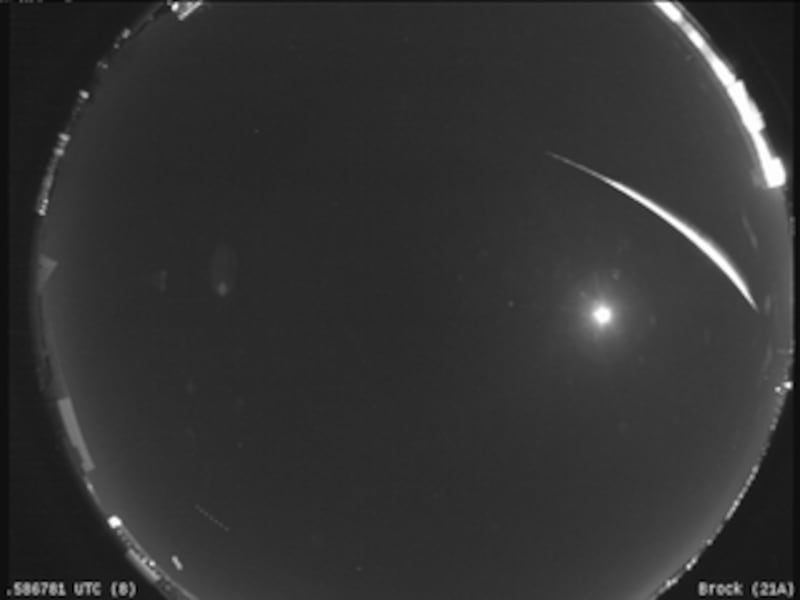
NASA cameras caught the phenomenon, along with several other cameras operated by Western University on behalf of the Southern Ontario Meteor Network.
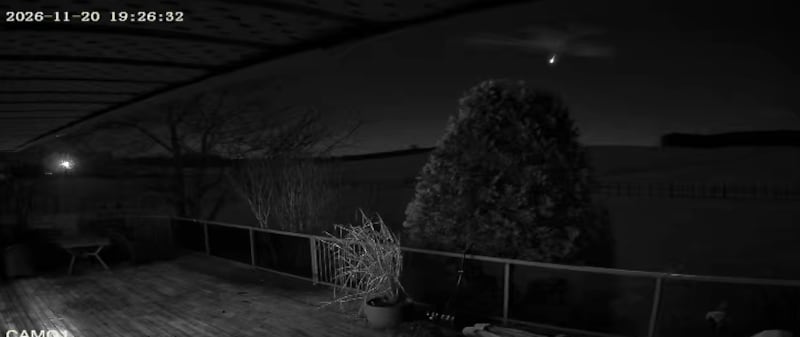
Home security cameras in South Bruce, Ont. also recorded the flash.
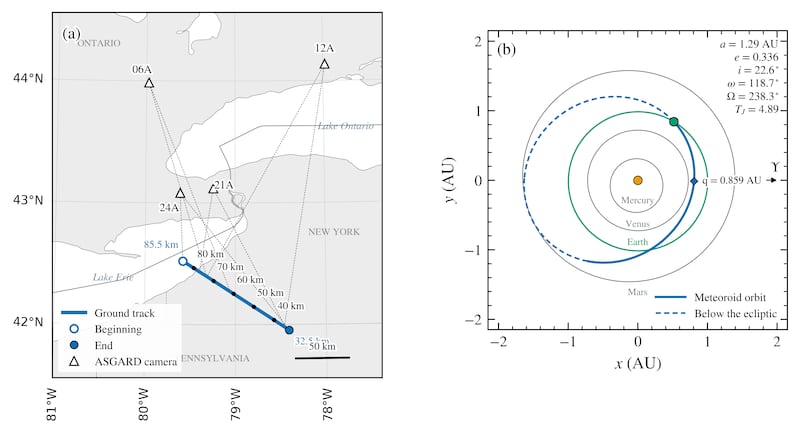
“An analysis of the available video data shows that the meteor – caused by a piece of an asteroid about a foot [approximately 30 centimetres] in diameter and weighing roughly 65 pounds [or just under 30 kgs] – was first detected at an altitude of 52 miles above Lake Erie, moving to the southeast at 38,500 miles [or 61,960 kilometres] per hour,” said NASA. “It disintegrated 20 miles above the Pennsylvania town of Eldred, just south of the New York/Pennsylvania border.”
The Leonid meteor shower puts on a celestial show every November. The debris from 55P/Tempel-Tuttle comet is known to create fast and very bright fireballs in Earth’s atmosphere.
NASA ruled it out as the origin of Friday night’s fireball.
“There actually have been a number of fairly bright meteors over southern Ontario in the last week,” Peter Brown, a professor at Western University’s department of physics and astronomy.
The Leonids peaked around Nov. 17 and 18, he said, while another meteor shower, the Taurids, has also been producing bright meteors.
“What was interesting in this event on Friday night is that it wasn’t related to any meteor shower,” Brown said. “But it did almost certainly drop some meteorites.”
Most of the object’s mass was consumed as it travelled through the atmosphere. Brown said researchers believe small fragments may have survived and reached the ground in a rural area of the United States.
“Probably only pebble-sized to maybe a golf ball-sized object,” he explained. “So, not a whole lot to find. No big objects, certainly.”
There is no indication any fragments landed in Canada.
Brown said recovering meteorites can provide scientists with valuable material to study, because researchers can use the object’s recorded trajectory to learn more about where the material originated in the solar system.
“We try to track these things because they’re pieces of debris from other parts of the solar system. If we can recover material, there are tangible objects that we can study in the lab... it tells us something about the geology of the solar system.”
The meteor cameras operated by Western and NASA produced similar estimates of the object’s path, helping researchers determine where it entered the atmosphere and where it broke apart.
Brown said fireballs of this brightness are detected by the Southern Ontario Meteor Network a few times a month.
Brown said the object entered at a relatively shallow angle, which allowed it to remain visible for more than five seconds.
“What does make this a little more unusual is how deep it penetrated in the atmosphere,” he said. “Things that produce meteorites that we see in the network - that’s probably once a year.”
He added that the timing of Friday’s event helped make it particularly noticeable. The fireball appeared on a clear Friday evening, when more people were outdoors.
Although the event was not exceptionally bright compared with some previous fireballs, Brown said it would likely have been a memorable sight for those who witnessed it.
“It would have taken many seconds to move, would have been quite spectacular. There were small fragments coming off... it would have lit up the surroundings. The background light would have been noticeably increased.”
The last known meteorite-producing fireball in the broader southern Ontario region occurred in June, when meteorites were recovered on Coburn Island in the Bruce Peninsula area, Brown said.

