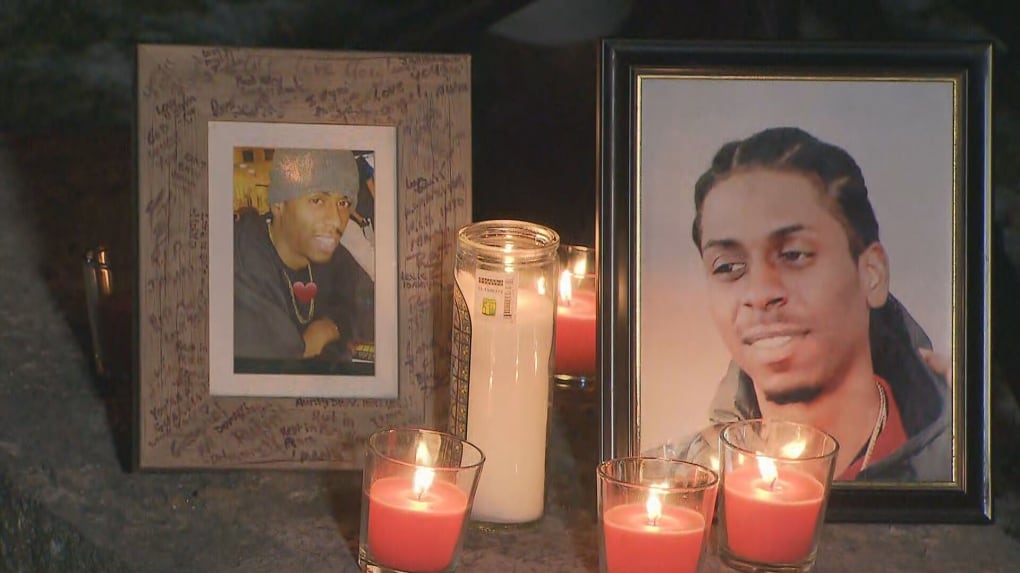
The parents of a man shot in the head by police in Mississauga, Ont., nearly seven years ago told a coroner’s inquest into his death Friday that while nothing can bring back their beloved son, they hope the proceedings will provide some much-needed answers about what happened that day — and what could have been done differently.
Derek Francique and Ann-Marie White each delivered tearful messages to the jury on the first day of the inquest into the death of Jamal Francique, sharing memories of the man they described as a smart, considerate son and devoted father whose loss forever shattered their lives.
“He always was the glue to our family,” Derek Francique said of his son.
“Our family is destroyed without him. Our family hopes to gain a fuller understanding of police tactics... and the role that anti-Black racism may have played in the police decision-making,” he said.
“Everything should be investigated ... I would like to know how many different non-violent ways this could have turned out.”
White said she still struggles with the reality that her son is no longer there.
“I am not simply grieving an event that happened in the past. I am living with this loss, this pain every single day,”
“No outcome can undo the pain ... and personally I’m consumed by agony and grief and I hope through this inquest the circumstances surrounding my beautiful son’s death will be examined carefully and that the questions that remain will be addressed.”
Jamal Francique’s partner and the mother of his children, Isabel Meira, also expressed her enduring grief in a statement read by her lawyer, saying Francique was ripped out of their lives too early and “did not deserve this ending.”
In his opening remarks, inquest counsel Roger Shallow stressed that Francique was not an incident or a file number.
“He was a grandson, a father, a brother, a member of a family, and a young man whose life ended in circumstances that have had a profound effect on many people and will continue to,” he said.
“Nothing that happens at this inquest will change what happened to him.”
Francique, a 28-year-old Black man, was shot during an attempted arrest outside his home on Jan. 7, 2020, and died in hospital days later.
An agreed narrative read at the inquest said Francique was living with his mother and stepfather at the time. Both were acting as his sureties while he was on bail from drug trafficking and firearm charges he faced in Guelph, the narrative said.
Francique was on house arrest with conditions that allowed him to leave the home only in the company of his sureties, for work or school, for medical emergencies or for prearranged appointments with his lawyer, doctor or physiotherapist, the inquest heard.
Peel regional police had recently received a tip through Crime Stoppers that Francique had a gun and was trafficking drugs, so they secretly observed him over three days, the inquest heard.
By Jan. 7, however, they had found no evidence to corroborate the tip, according to the narrative. Still, the officers believed that Francique was breaching one of his bail conditions and a briefing was held that day to plan his arrest, it said.
Around 5 p.m., not long after sunset, a team of plainclothes officers in unmarked cars made their way to the townhouse complex where Francique lived, the inquest heard. They placed a tire-deflating device behind one of the tires of his car and waited for him to emerge, the narrative said.
At 7:44 p.m., Francique left the home and made his way to his car, an Acura, about 200 metres away, it said. The officer who was supposed to block in the car was late, and Francique reversed out of his parking spot then accelerated around the unmarked cruiser, the inquest heard.
At that point, several officers on foot and in unmarked cars were trying to contain the Acura, the inquest heard. One of the officers on foot fired his gun four times, and one of the bullets hit Francique on the left side of the head, leaving him with what was later deemed an “unsurvivable” injury, jurors heard.
His car veered sharply and crashed into the pillar of a nearby garage, where it came to a stop, jurors heard. The officers notified dispatch and requested a tactical unit. An ambulance was also called to the scene.
The tactical unit arrived at 8:05 p.m., and the ambulance minutes later, the narrative said. Francique was removed from the car and seen by paramedics, then taken to the trauma unit at Toronto’s St. Michael’s Hospital. He was declared brain dead shortly before noon on Jan. 9, jurors heard.
Ontario’s police watchdog later cleared the police officers of wrongdoing, saying the officer who opened fire reported fearing for his life when Francique drove toward him.
The Special Investigations Unit said there were aspects of the officer’s behaviour that gave rise to questions, however, including the decision to place himself near a fleeing vehicle.
The inquest will look at Peel regional police procedures and training, including on use of force when a vehicle is involved, oversight of preplanned arrests, medical care for suspects who are incapacitated and anti-Black racism, among other topics.
Its scope does not include the investigations carried out by various watchdog agencies.
The inquest was initially scheduled to start Thursday but was pushed back by a day. As a result, the schedule needed adjustment, and the first witness is expected to testify Monday.
The inquest is expected to hear from about 12 witnesses over 10 days, including four of the seven officers involved in the operation, police supervisors, a police instructor and a forensic pathologist.
Jurors in coroner’s inquests do not assign legal responsibility but may make recommendations meant to prevent similar deaths in the future.
This report by The Canadian Press was first published Nov. 13, 2026.
Paola Loriggio, The Canadian Press

