A police officer who helped pull a critically injured Black man from a wrecked car after a police shooting nearly seven years ago faced questions Wednesday about the time it took to call for medical treatment.
Const. Marc Charlebois, then a member of Peel regional police’s tactical unit, arrived at the Mississauga, Ont., townhouse complex about 20 minutes after the shooting, he told a coroner’s inquest into the death of Jamal Francique.
Charlebois heard an officer had shot at a car during an attempted arrest, and that nobody could see inside the vehicle because it was dark outside and the car’s windows were tinted, he said.
The constable told the inquest earlier this week that he knew after he broke the car’s rear passenger window that there had been a “traumatic incident” requiring intervention. He saw blood and could hear Francique’s agonal breathing, a type of laboured breath that indicates serious medical distress, he said.
Charlebois also wrote in his notes that he saw signs of trauma to the right side of Francique’s head at that time, the inquest heard.
After watching videos from the scene on Wednesday, however, Charlebois said he now believed he did not realize Francique had suffered a traumatic injury until he broke a second window, the one on the rear driver’s side. He made the inference based on his body language in the footage, he said.
Several lawyers pushed back during cross-examination, arguing Charlebois would have known Francique was in grave condition based on his breathing alone. The officer told Ontario’s police watchdog that he could immediately hear Francique was in respiratory distress after breaking the first window but wasn’t sure if the man was faking it, they noted.
Karifa Magassouba, a lawyer for the Black Action Defence Committee, argued Charlebois had other information that suggested it was a medical emergency, including the damage to the car and the knowledge that an officer had shot at the vehicle.
“You knew that for 20 minutes, he’s received no care,” Magassouba said.
“Yes,” Charlebois replied.
“And you understand that he is on his last breath of life,” the lawyer continued.
“Yes,” the officer said.
“So you had more to go on than just agonal breathing, would you agree with me?”
“I do.”
The officer also faced multiple questions on unconscious anti-Black bias, which he said played no role in his beliefs and actions that day.
Charlebois recalled receiving training on anti-Black bias around 2013, but couldn’t give specifics on the training, such as any stereotypes mentioned. He rejected the suggestion that he had not retained much of the training.
Several videos showing the officers around Francique’s car were played at the inquest Wednesday.
In one of the videos, an officer can be seen making a kicking motion near Francique as the critically injured man lays on the ground after being removed from the car. It’s not clear whether the officer’s foot connected with anything as the end of the motion is blocked from view by another officer’s body.
Charlebois testified Monday that an officer at one point kicked rubble to make space for a stretcher.
A lawyer representing Francique’s mother later suggested the officer was kicking Francique, which Charlebois said was “completely untrue.”
The inquest did not sit Tuesday as the presiding officer considered the submission of new videos not previously provided to the inquest.
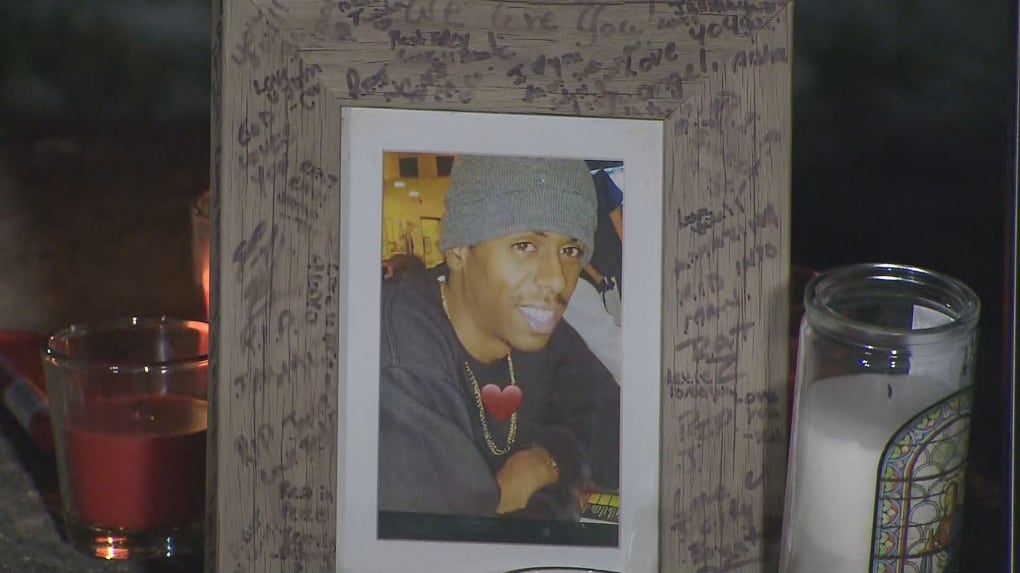
Francique, 28, was shot during an attempted arrest in Mississauga, Ont., on the evening of Jan. 7, 2020. He died in hospital days later.
A group of plainclothes officers in unmarked cars staged an operation to arrest Francique for allegedly violating one of the conditions of his bail, the inquest heard.
Police had been surveilling him for days after receiving a tip that he had a gun and was dealing drugs, but had not been able to corroborate that information, the inquest heard.
Francique left his home and headed to his car around 7:44 p.m., but the officer who was meant to block his car was late, jurors heard.
As officers moved to contain his car on foot and in unmarked vehicles, one of the officers on foot fired four shots at Francique’s car, they heard. One of the bullets hit Francique in the head.
His car plowed into the pillar of a nearby garage, the inquest heard. Photos of the scene show bricks and debris in the area.
Francique did not receive medical care until after the tactical unit arrived at the scene around 8:05 p.m., the inquest heard.
Someone called for a medic after Charlebois opened the front driver’s side door, and the officer reached for what he thought was the seatbelt, he testified. It turned out to be a satchel, and its weight led Charlebois to believe there was a gun inside, he said. He called out “gun” and handed the bag over to a colleague, he said.
Charlebois and another officer then took Francique out of the car and placed him on the ground, he said. Francique was later placed on a stretcher and into an ambulance. After that, Charlebois checked the bag and found a gun, he said.
This report by The Canadian Press was first published Nov. 18, 2026.
Paola Loriggio, The Canadian Press

