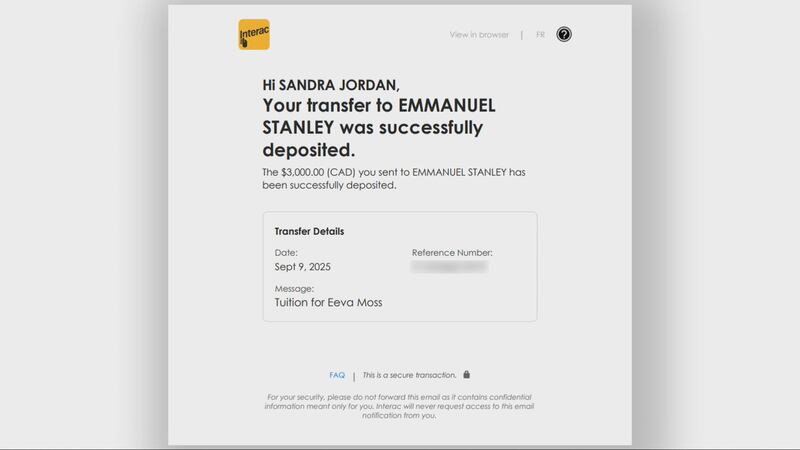
A Mississauga mother is out $3,000 after sending money to what she thought was the University of Toronto, after her daughter received an urgent request for her tuition to be paid off.
Sandra Jordan’s daughter, 18-year-old Eeva Moss, was excited to start her first fall semester at the University of Toronto.
Earlier this month, however, Jordan said her daughter thought she received an email from the university claiming a tuition payment was immediately due and if she failed to pay, she would be kicked out of her program.
“It stated that she will be de-enrolled from her courses if they did not get a $3,000 deposit by the end of the day,” Jordan told CTV News.
The email appeared to have similar formatting to other correspondence from UofT. So, concerned for her daughter’s education, Jordan said she immediately sent an e-transfer.
Not long after sending the money, Jordan said she grew concerned.
“After I sent the funds, I had this weird feeling that something didn’t seem right. So, I went to the university website,” said Jordan.
Online, UofT warned of an ongoing tuition scam, outlining what the phishing attempt looked like, but it was too late for Jordan as she had already sent the money.
“It’s very unfortunate that online scammers have defrauded this family. We are in touch with the student and providing guidance,” a University of Toronto spokesperson told CTV News.
The university says it never asks students for e-transfers or other private means of payment.
“For those unsure whether electronic outreach that appears to come from the University of Toronto is legitimate, there are extensive educational resources and programming to support the online safety of students, faculty, staff and librarians, which includes reporting mechanisms, guidance and examples for members of our community to identify and report phishing, fraud and other security incidents, including this one,” the statement reads.
“I’m very dedicated to my daughter’s education and that’s the reason I sent the money, because I didn’t want her to be de-enrolled from her courses,” said Jordan.
In a statement from CIBC, Jordan’s bank, a spokesperson says scams where fraudsters impersonate trusted organizations, like UofT, are “on the rise.”
“This unfortunate situation highlights how fraudsters use deception and urgency in their scams. Clients have a role to play in recognizing fraud and protecting themselves against it,” the statement reads.
The bank says it is hard to recover whatever money has already been deposited and urges anyone who receives unexpected requests for money to verify the request is legitimate by reaching out to the trusted organization directly.
“Whenever it comes to making a financial transaction, if you’re unsure, hit the pause button and take a breather,” advised Ritesh Kotak, a cybersecurity expert.
Kotek told CTV News that those involved in a financial scam will create a sense of urgency, and make it feel like money needs to be sent immediately.
He says to slow down, ask questions, and ensure the request is legitimate.
“Sometimes, a lot of these high-tech crimes have low-tech solutions. Just pick up the phone, call the university, validate, and verify before you send your hard earned money over,” said Kotak.

