
Ontario is boosting its minimum wage this October, but various experts say it is not enough to sustain daily life costs in large urban centres like Toronto.
The annual hike goes into effect on Oct. 1, rising to $17.60 per hour, reflecting a $0.40 increase from the current rate.
“This increase is part of our government’s plan to help families keep pace with the cost of living while ensuring predictability for both workers and businesses,” a spokesperson for the Ministry of Labour told CTV News Toronto in a statement.
Ontario increases the rate by factoring in the Consumer Price Index (CPI), which reflects a basket of goods, like eggs, various fresh or frozen meat, and coffee.
Anil Verma, professor emeritus at the University of Toronto’s Rotman School of Management, tells CTV News Toronto that Ontario calculates inflation by computing the rise in cost of these goods reflected in the CPI.
“Now, this only tells us how to increase it from one year to another, but, if you unpack it and you go backwards in history, there was a time when it was fixed at some weight and that was arbitrary, because there’s no formula for saying that, ‘Let’s start from today—our minimum wages should be $10 an hour,’” Verma said.
Ontario’s Minimum Wage Advisory Panel, which Verma chaired, was created 12 years ago, in June 2013, and was tasked to advise the provincial government how to determine future minimum wages that were both “fair to workers and predictable for businesses.”
“Prior to that, there were years in which minimum wages were increased and there were years during which they were not increased,” Verma said.
At the time of the panel’s creation, the province’s minimum wage was $10.25, something that had been frozen for three years. In 2014, the panel recommended tying wages to the inflation rate and by June 1 that year, the Liberal government raised the hourly wage to $11.
“(The Consumer Price Index) is calculated by Canada, so it’s not a partisan or political decision, and it takes this decision of when to increase and how much increase out of the hands of government of the day,” Verma said.
For this year’s pay bump in Ontario, the annual increase is based on the CPI of 2.4 per cent. So, if a minimum wage worker clocks 40 hours each work week, they will see an $835 raise to their yearly salary.
How many working Ontarians are making minimum wage?
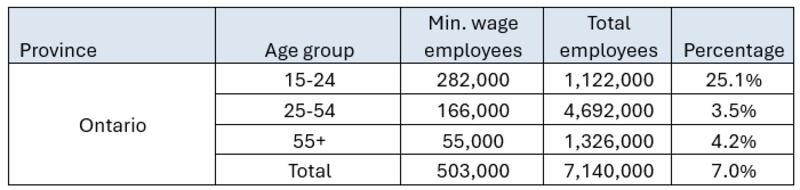
Based off data from Statistics Canada this past August, when Ontario’s minimum wage was $17.20, the national statistical office says there were 503,000 working Ontarians earning that much, or even less. After all, student wages in Ontario were $16.20 per hour at that time (this rate is also increasing to $16.60 on Oct. 1).
“This represents seven per cent of the 7.1 million employees working in the province,” Jasmine Emond, of StatCan, said in a statement, noting this data is not seasonally adjusted.
More than half of those workers are aged 15 to 24, reflecting a total of 282,000 people, with StatCan noting just more than one in four employees in this age group earned minimum wage or less in August.
The second highest number of Ontarians who were making the same kind of money at that time was those aged 25 to 54, with 166,000 workers making that amount, according to StatCan. The data also shows there were also 55,000 Ontarians at least 55 years old making minimum wage or less in August.
In Verma’s view, minimum wage acts as a “bridge” to advancing in the labour market. The professor adds this can help young people, people with limited skills, new immigrants to Ontario to “acquire some skills, acquire some experience, and gradually then move out of minimum wage.”
He points to how Singapore structures its minimum wages with its progressive wage model—developed by workers unions, employers and the government—to uplift lower-wage workers’ wages in select sectors by increasing them when workers upgrade their skills and productivity.
“That is what government policy, public policy, should try to do, is create minimum wage jobs and policies surrounding it so that people can use it to get in. They don’t have to spend their entire life on minimum wage, because minimum wage is not enough to raise a family on or to provide basic comforts of life.”
Is this year’s increase enough?
“Even after the increase, there’s actually nowhere in the province where you can work a minimum wage job full-time and be able to make ends meet where you live,” Craig Pickthorne, director of communications for the Ontario Living Wage Network (OLWN), told CTV News Toronto in an interview.
In OLWN’s latest findings, published last November, a “living” wage for residents in the Greater Toronto Area was priced at $26 per hour—an $8.40 difference from the new annualized rate in 2025. What’s considered a living wage, according to the OLWN, is the minimum pre-tax income a working adult or family needs to make to cover their bills for basic necessities, like food, transportation and shelter.
“So certainly, even after the increase, there’s just no way you can make ends meet in Toronto working minimum wage,” Pickthorne said.
Laura Walton, president of the Ontario Labour Federation, tells CTV News Toronto they have been calling for higher minimum wages for years.
“We were calling five years ago, we were calling for $20 minimum wage and we’re still not there,” Walton said in an interview.
Walton says there are several factors that should be looked at when considering minimum wage increases outside of the Consumer Price Index.
“I think what we need to be looking at is, does it adequately address where we are with rent? Are we addressing where we are with food? Are we addressing where we are with energy, or even transportation, and these are really all key things that play into it,” Walton said.
The living wage even pales in comparison to the “rental wage” for Toronto, a phrase coined by the Canadian Centre for Policy Alternatives (CCPA), which reflects the hourly amount needed to afford rent working a 40-hour week and spending 30 per cent of income on housing. For the city, the report found Torontonians need to make nearly $38 an hour to afford a one-bedroom apartment.
The Toronto Regional Real Estate Board rental market report for the second quarter of 2025 revealed the average rent for a one-bedroom apartment in the city was $2,326. While it reflects a 5.1 per cent year-over-year decline in price, the annual total would set one back $27,912.
Assuming minimum wage employees work 40 hours each week, and factoring in October’s pay raise, that would be roughly $33,790 pre-tax annual income. That would mean more than 80 per cent of their salary would go toward housing costs, assuming they are living alone in a one-bedroom apartment in Toronto.
“They’re certainly not going to own a home on that, and it’s still going to be very difficult for people to live in large urban centres when they’re paying in excess of 50 per cent of that salary on housing,” Rotman School of Management Associate Professor Richard Powers told CTV News Toronto.
“If the ultimate goal is to have a sustainable work-life balance, they’re not going to be able to do it on just that minimum wage. Now, it’s certainly an improvement, but we know that it’s hardly keeping up with inflation as well.”
That said, Powers said increased wages can pose a strain on businesses, particularly smaller ones, who may already be struggling.
“It’s a two-sided argument because, on one hand, we’ve just made the argument that that’s hardly a living wage, but on the other hand, the implementation does pose a strain on other parts of our economy, particularly small business that don’t have the variety of resources that they can use to offset that increase,” Powers said.
“We want to pay our employees more so they can have a living wage. We also want to maintain a customer base who don’t want to pay higher prices.”
In Ontario, Pickthorne says there are currently 645 certified living wage employers, but noted employers have struggled with increased costs.
“To be honest, we’ve experienced some attrition, some closures of businesses, unfortunately, which is not a surprise, a lot of economic indicators are showing that so we’re going to be no different,” Pickthorne told CTV News Toronto.
“But we are continually adding, we’re replacing employers that we lose with new ones that come aboard, and we’re hopeful that it’s going to turn up again in the future.”
Ontario is one of four other provinces raising its minimum wages in October, with Nova Scotia and Prince Edward Island boosting its rates to $16.50 per hour, Manitoba pushing it to $16 per hour and Saskatchewan rising its rate to $15.34 per hour.
With files from CP24’s Joshua Freeman

