Hundreds of thousands of Highway Traffic Act (HTA) charges that were dropped last year are a sign Ontario’s justice system is failing to live up to its basic functions and puts Ontario on the road to “lawlessness,” said the province’s opposition justice critic.
NDP MPP Kristyn Wong-Tam urged that the provincial government provide more funding of the court system at a news conference outside the Toronto courthouses on Monday, to avoid further impacting road safety.
“Ontario’s justice system is failing its basic promises of fairness, timeliness, and public safety,” Wong-Tam said. “If there are no consequences to offenses, if there are no consequences to crimes committed, we become a land of lawlessness.”
- READ MORE: Thousands of charges against drivers withdrawn in Ontario as critics decry system in ‘shambles’
Wong-Tam was responding to numbers uncovered in a CTV News and W5 investigation where more than one in ten HTA charges were dropped before trial.
That number rose from about 57,000 charges withdrawn in 2019 to about 253,000 charges withdrawn in 2024 – around 10 per cent of all charges.
In her news conference, Wong-Tam also added in charges that were dropped at trial for a grand total of 338,000, amounting to 13 per cent of all charges laid under the Act.
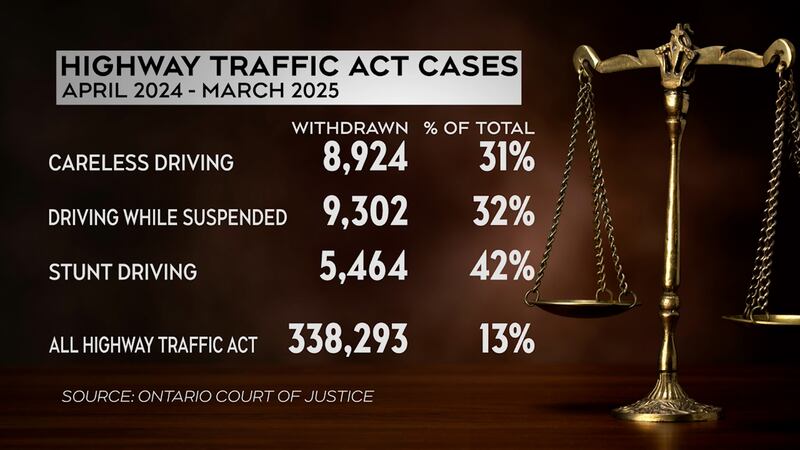
Some serious charges were withdrawn at greater rates, including: about 8,924 careless driving charges withdrawn, around 31 per cent of the total; 9,302 driving while suspended charges, or about 32 per cent of the total; and 5,464 stunt driving, nearly 42 per cent of the total.
One of the charges dropped include a driver running a stop sign on Shaw Street in Toronto and colliding with a cyclist. That such incident was caught on video with clear evidence, said Biking Lawyer David Shellnutt.
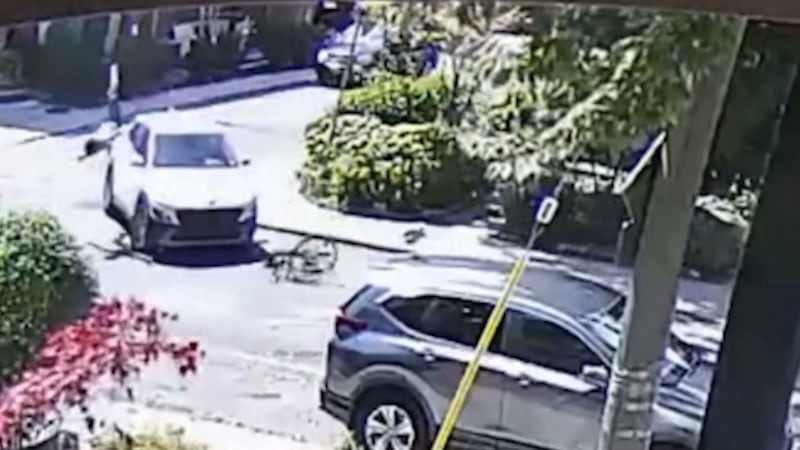
“The simple slap on the wrist of the Highway Traffic Act ticket and penalty is not even administered. How crushing is that to somebody who remains off work after being injured by someone?,” he said at the news conference.
Another of Shellnutt’s clients, Anna Pratt, said she had been hit while on her bike in 2022.
“I was really badly hurt. I had multiple fractures to my pelvis, in my sacrum, (and) I had a concussion,” Pratt said.
Pratt said she followed the charges laid closely, representing a “sliver of justice that was really important.” But the charges were dropped, she said, without warning.
“I really was beyond disappointed. I was upset. I was angry. And I really felt that I had been completely, completely ignored by the system.”
Trish MacKenzie, the CUPE Local 79 representative for the city’s prosecutors, said part of the problem is a “staffing crisis” in the prosecutors’ offices.
“We’re very concerned about this,” MacKenzie said, adding that there are unnecessary barriers to hiring more people.
“It’s been devastating to the morale of the office. Of course, people feel extremely burdened and overworked and stressed out. There has been difficulty with being able to simply get all the work done.”
An Ontario court judge also pointed the finger at a lack of a file management system to keep track of the volume of cases, saying that was why the system is in “shambles.”
A spokesperson for the province’s attorney general said in a statement that it is investing millions to build court capacity and address backlogs.
“In May, our government announced the appointment of 42 new justices of the peace to the Ontario Court of Justice (OCJ). They join the 45 new justices of the peace we appointed in 2024. But our work doesn’t stop here - by 2027-28, Ontario will have invested more than half a billion dollars to address backlogs, including by allocating up to 52 new judges to the OCJ and hiring nearly 700 more Crown prosecutors, victim support and court staff,” the spokesperson said.

