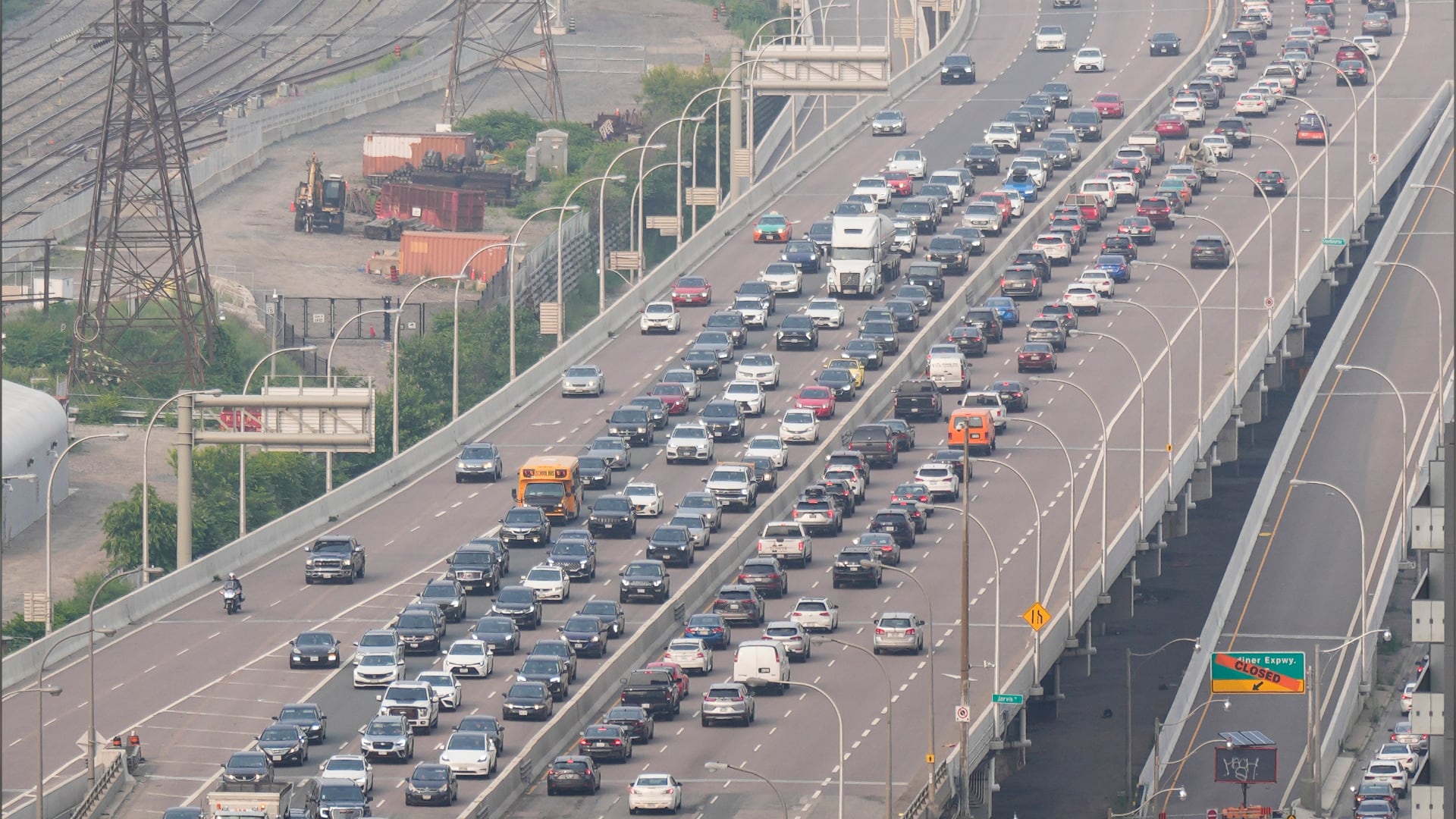
Both the TTC and Metrolinx say they are planning service adjustments to account for the fact that many workers are being required to comply with more stringent in-office policies, as the latest data show commuters are facing worsening gridlock.
Toronto continues to have the longest average commute, according to recently released data from Statistics Canada. That commute was up 1.6 minutes in May, compared to a year earlier, for an average of 34.9 minutes. That compares to a national average of 26.7 minutes.
Statistics Canada noted that the increase coincides with an increased share of time workers are spending in the office.
With many employers now requiring workers to be in-office four or five days a week, commute times are expected to continue ticking upward.
The TTC confirmed to CP24 Monday that it will be making service adjustments to account for the increased number of commuters returning to the office fulltime and said it will be sharing more details about its plans later in the week.

Meanwhile Metrolinx said it will be boosting rush hour trips across its network starting on Oct. 27. The regional transit agency said key service enhancements will include more trips on the Lakeshore West, Lakeshore East, Barrie and Stouffville lines.
“These changes reflect Metrolinx’s commitment to improving service reliability, meeting the needs of commuters and building a connected region, where customers have easier access to jobs, education and experiences,” the agency said in an email.
The Ministry of Transportation did not respond by deadline to a request for information about its plans to deal with growing congestion as more workers return to the office fulltime. Treasury Board President Caroline Mulroney announced in August that thousands of workers employed by the province and its agencies would be required to be in office fulltime starting January 5, 2026.
For its part the city said it will be monitoring travel patterns on roads and transit to see where adjustments are needed.
“We encourage commuters to take transit when travelling into and out of the downtown core,” the city said in an email. “The City of Toronto will continue to monitor travel patterns and will adjust congestion management strategies in collaboration with transit partners to keep people moving efficiently.”
A chance to attract more transit riders
With an expected boost in daily commuters in the coming months, experts say there is an opportunity to lure some of those people out of their vehicles.
While it might not seem like it from the gridlock, Toronto already has the lowest share (69.4 per cent) of commuters using a car across Canada’s 15 largest census metropolitan areas.
But the proportion of transit users could be even higher – and the amount of gridlock therefore lower – if transit services offered a more attractive option, says Matti Siemiatycki, director of the Infrastructure Institute at the University of Toronto.
“This is a moment for the TTC to reintroduce itself to people,” Siemiatycki says. “But it has to be top notch.”
Statistics Canada noted that those who use public transit had the longest average commute time, at 44.1 minutes nationally.
“There’s too many times where the trip is much longer by public transit than it is by car, and the offshoot of that is clear,” Siemiatycki says. “We have parts of our city where the majority of people are taking cars and it’s very hard to provide effective public transit.”

He notes that there have also been concerns with safety and reliability for GTA transit riders. For example, a recent work car fire shut down subway service on lines 1 and 2 for several stations around Bloor-Yonge Station last week during the morning rush hour. TTC CEO Mandeep Lali apologized to customers and vowed to review the incident and double check the work car fleet. But it wasn’t the first time that such an incident has hampered service.
“We already know that the roads in this city and the traffic congestion are terrible, and if people coming back primarily choose to take their cars, we’ll be completely swamped and overwhelmed,” Siemiatycki says.
Some of the challenges in improving service could in fact be mitigated by the return to office policies, he adds, providing more clarity about when the system will be busy so that service can be adjusted accordingly.
If some workplaces retain some of the flexible thinking that was adopted during COVID, varied start times could also help take pressure of the system at peak times – a strategy known as “peak spreading.”
“So this is a moment for transit to really re-engage with why people choose transit, and the reason is; quality service, safety, reliability, predictability and speed. And at various times over the last few years, each of those has been a challenge, and so I think this is a moment where they need to redouble the efforts to make transit a truly viable option for people.”
Will you soon be returning to the office five days a week? Are you concerned about the amount of time you will now have to spend commuting? CTV News Toronto wants to hear from you.
Email us at torontonews@bellmedia.ca with your name, general location and phone number in case we want to follow up. Your comments may be used in a CTV News story.

