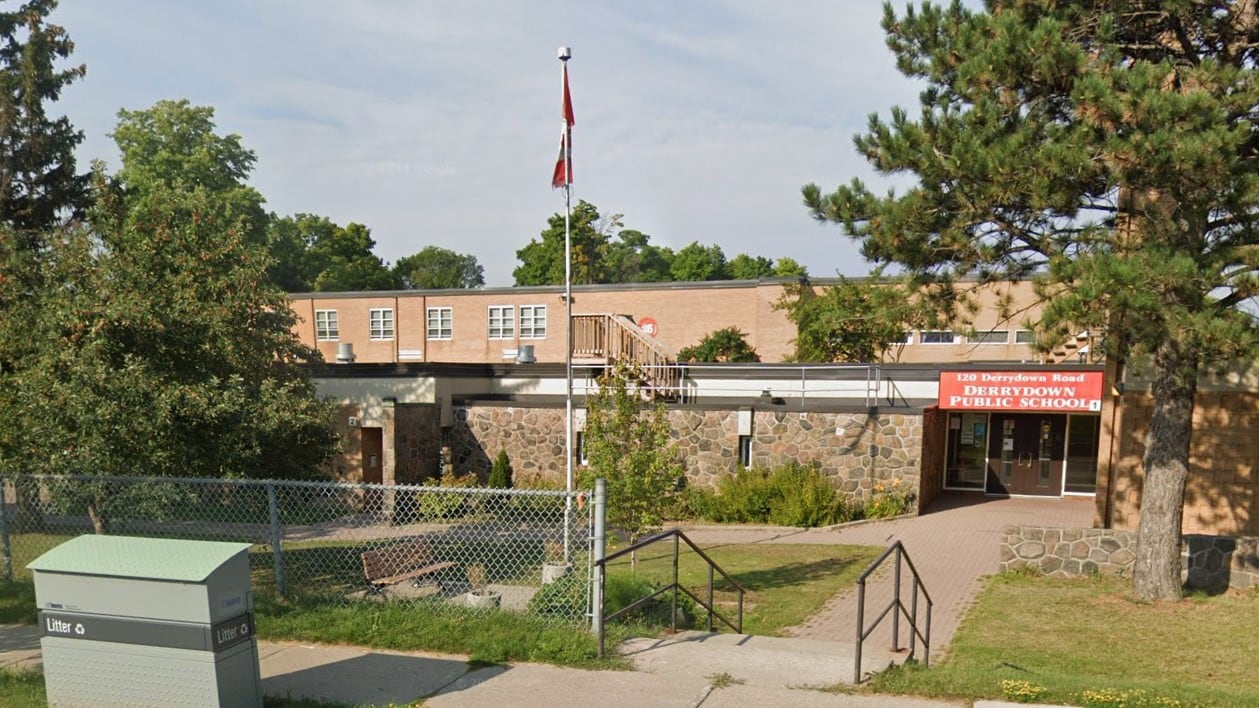
Parents at a North York elementary school are speaking out after three grades were combined into a single classroom taught by a single teacher following a recent reorganization process.
The Toronto District School Board reshuffles classes in mid-September to bring them into alignment with ministry guidelines and account for any changes between its actual and projected enrollment.
This year, the process resulted in some Grade 3 students at Derrydown Public School near Keele Street and Finch Avenue being transferred into an existing split grade classroom made up of Grade 1 and 2 students.
While split-grade classrooms are relatively common across the TDSB, parents who spoke with CTV News suggested that the now three-grade split goes too far and is “unheard of” at Derrydown.
The TDSB, for its part, tells CTV News that the use of three-grade classrooms has declined but is still relatively commonplace. There were 713 such splits as recently as 2016 but the number has mostly been in the 300s the last few years, the TDSB says.
“I knew that there was a reshuffling as they do every year. However, I did not know it would be to the capacity of there being three grades in one class assigned to one teacher. No (teaching assistant), no help, no nothing,” Moya Rodriguez, whose daughter was moved from an existing Grade 3 classroom into the combined classroom, told CTV News.
Rodriguez said that her daughter had been in a split classroom with Grade 2 students as a first grader and then remained in that same split class for Grade 2.
She said that while the teacher “did an amazing job handling the split classes,” she was looking forward to Grade 3, where her daughter would be in a single-grade classroom with a teacher she loved.
She said that the reshuffling of classrooms came as a shock to her and other parents and that the school hasn’t been particularly responsive to their concerns.
“Everything that was sent to the parents, the phone calls, the emails, it was like a slap in the face,” she said.
Another parent of a Grade 3 student who was moved into the combined classroom, Michelle Mitchell, told CTV News that she is worried that older students won’t get the same level of attention.
“I feel like with the Grade 3 students, they might be left to like be used as the teachers assistant,” Mitchell said. “The grade three kids who are going to be eight to nine years old, I feel like they’re like the teachers. Attention is going to be more towards the younger kids.”
The TDSB tells CTV News that actual student enrollment in the fall was approximately 3,000 students below projections board-wide “requiring adjustments to (be) made” at many schools, including Derrydown.
A spokesperson said that “triple combined grades are not new to the TDSB” and “occur across the system in all grade ranges, as well as in many of our Special Education and ESL classes.”
“In some cases, there are too many students for one class/teacher but not enough to fund two or three single-grade classes with a dedicated teacher. In these instances, schools are required to create combined classes with students from two or three consecutive grades with one teacher,” Emma Moynihan wrote.
Moynihan said that “principals and staff consider learning styles, social skills and academic needs when grouping students into classes” and that “all classrooms, whether single-grade or combined, include students with a range of skills, abilities and achievement levels.”
However, Helen Victoros, the president of the Elementary Teachers of Toronto, called the three-grade split at Derrydown a “money issue”, saying that “it’s purely about the ongoing cuts and lack of funding to our schools.”
A total of four parents who spoke with CTV News also expressed concerns that students in a three-grade split will not receive the same level of tailored learning as some of their peers in single-grade classrooms.
“The problem is that having a one, two and three class together doesn’t benefit or foster for kids in learning,” Parent Crystal Davis, said, “They are cutting teachers. They leave all of the work for this one teacher that has to navigate (grades) one, two and three, they are all at a different level of learning.”
“Kids and parents are complaining. Kids, our kids, are coming home crying because the class is full. They can’t learn what they need to learn,” Parent Mavis Brown added.
A TDSB fact sheet states that split classrooms have been used in Ontario “since at least the early 1950s.”
The TDSB’s website does say that three-grade splits are only used in “limited instances, such as in very small schools and programs.”
It also says that research shows that “students in combined grade classrooms achieve as well academically as those in single grade classrooms.”
Todd Cunningham, an associate professor at the University of Toronto, said that there’s “no really inherent” downside to split grade classrooms.
In fact, he says that split grade classrooms can give teachers the chance to “move students around so that they’re actually getting the right type of instruction.”
“Do you have some really weak grade three students? Well, you can actually move them down into your Grade 2 or Grade 1 class like within your actual classroom,” and vice versa with strong first grade students," Cunningham said.
For students, Cunningham says that split classes can also help them refine their social skills.
“(Students) can actually take on a leadership role,” he said, noting that there are opportunities for “those grade three leaders (who) can help mentor the grade one students,” and that the grade one students can have role models to look up to.”
In its statement, the TDSB said that it “understands that changes such as receiving a new teacher or moving to a different classroom can be unexpected” and that it is “committed to supporting students and families through the process.”
It did not provide specific details about why the three-grade split at Derrydown was necessary, only noting that classrooms must be “organized in ways that meet Ministry of Education requirements.”

