More than 100 people have come forward to share their experiences with being dumped by their banks after CTV News reported on RBC cutting ties with a decades-long customer with no explanation.
Tomas Nassab, of Alliston, told CTV News last month that he received a letter from RBC informing him that they were ending their banking relationship with him and that he would be given 30 days to close his accounts and move his money out of the bank.
Following the publication of the story, CTV News heard from dozens of individuals who had similar experiences with their banks.
Various customers with credit cards, lines of credit, savings, business and chequing accounts all said they received a debanking letter in the mail from their respective banks and that it offered no explanation for the decision.
Some questioned why this happened when they felt like they were exemplary banking customers who paid their bills on time and had no overdraft while others wondered why they were being booted after voicing what they said were reasonable complaints with their bank’s service.
Carol Khan, 73, told CTV News Toronto the Bank of Montreal gave her two weeks’ notice that they would be closing her accounts, which she said didn’t give her enough time to notify the government that her pension cheques would need to be redirected.
In the letter Khan received, she says they provided her with a number that she could call if she had concerns. When she dialed in, she was told there was nothing that could be done.
“I started shaking and I figured, ‘What’s going on?’ I mean, almost 50 years (with BMO), house is mine, TFSA was there, I never had a communication that I had defaulted on anything, nothing triggered it,” Khan said.
BMO did end up giving her an extension so her pension cheques would be deposited into her new account with Scotiabank but Khan says the whole experience felt “very degrading.”
For Rob Palfrey, 62, he said he had one chequing account with BMO that he opened about five years ago, when he started working at Canadian Forces Base Borden. Palfrey says he primarily used that account to make payments to his estranged wife and pay his rent.
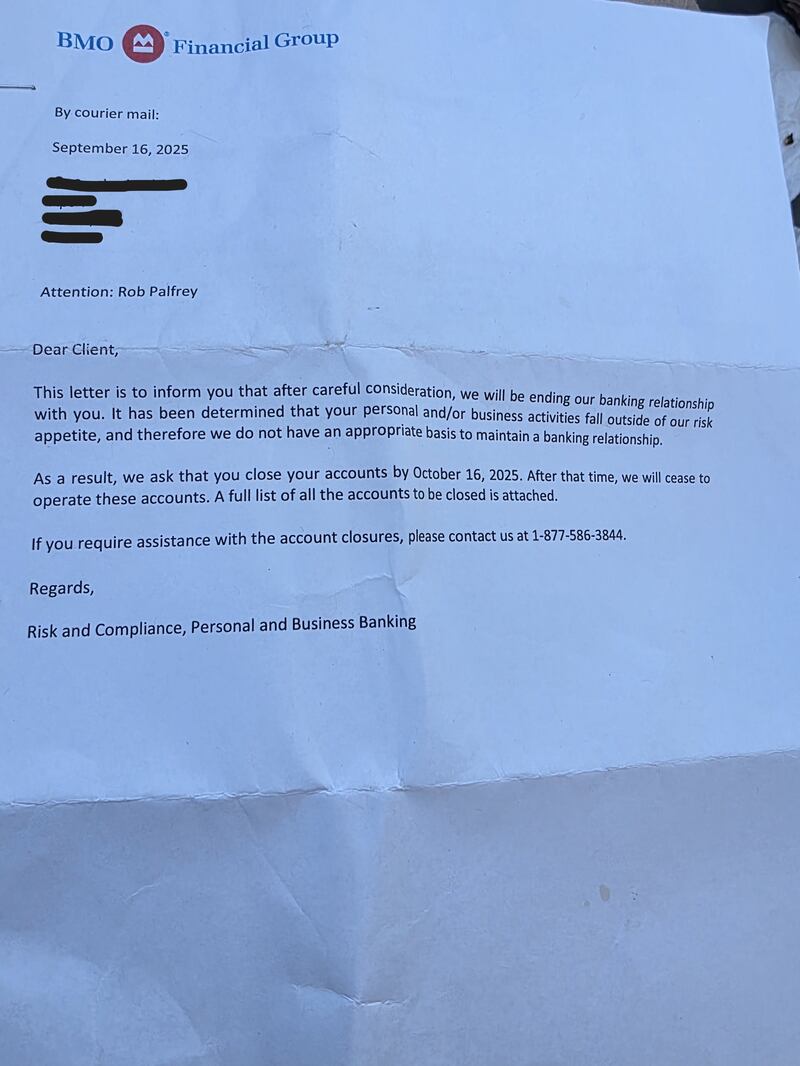
In mid-September, Palfrey received a letter from BMO saying they would be ending their banking relationship with him by Oct. 16.
“It has been determined that your personal and/or business activities fall outside of our risk appetite, and therefore we do not have an appropriate basis to maintain a banking relationship,” the letter reads.
Palfrey wishes the bank would be more forthcoming as to why exactly he is being let go.
“Is it because I only have the one vehicle, I don’t have credit cards or loans or lines of credit, ‘Oh, so we’re not making any money off of him,’” Palfrey questioned.
“I don’t give a s*** about closing the account, close the account, but I want to know why.”
When reached for comment, BMO did not directly speak on Palfrey and Khan’s account closures but said the following:
“Our decision to provide banking services to any prospective client takes into consideration regulatory guidelines as well as our own risk appetite.”
Why does this happen to some banking customers?
Unlike romantic relationships where one person, hopefully, shares why they are parting ways, the relationship with one’s bank is ultimately a professional one and they are not required to disclose their reason why they are closing an account and debanking a customer, according to Canada’s banking services ombudsman.
“You can cancel your bank account, or the bank can cancel your account if they feel like this is not a relationship that benefits them anymore,” Andreas Park, professor of finance at the University of Toronto, said in an interview.
A customer can get debanked for a multitude of “simple” reasons, Park says, like if they yell at or mistreat a bank employee.
Park also said there could be increased sensitivity from Canadian banks after TD was fined billions of dollars for its failures in its anti-money laundering program, potentially prompting them to keep more of a watchful eye on how their customers are spending their money and where that money is coming in from.
“They have to create a risk profile of their customers and if there’s a customer that is particularly risky—gets funds from abroad, often from countries with lax rules around money laundering—then you could become a suspect,” Park said. “That may not reach the threshold where they have to report you or investigate you or the like, but you become a risk for them.”
Park says spending time at casinos and receiving funds from cryptocurrency exchanges could also wave red flags to banks.
How a bank determines a customer’s risk portfolio stems off of data points they feed through a computerized system, Park explained, and if that person exceeds a threshold, it may cause a bank to look further.
Since a bank is intrinsic to a person’s daily life, Park says banks have a level of responsibility to communicate why they would debank a customer.
“In my mind, the right way to do it is, because of the position that banks are in and that privileged position that they’re in … they have a responsibility to you to tell you why and there needs to be a way how you can reconcile this,” Park said. “Unless you misbehave, then that’s a different story.”
However, Ombudsman for Banking Services and Investments (OBSI), an independent organization that resolves disputes between customers and financial institutions across Canada, says banks are “not required” to explain why they are closing an account—and generally do not provide a response.
“Most account agreements state the bank can close the account without giving a reason,” the OBSI said online. There are some account agreements, however, where the bank will inform a customer if they are shuttering their account if it has been overdrawn or if they suspect it’s being improperly used.
How many debanking cases has the OBSI investigated?
Relationship-ended cases, or “debanking” cases, are among the top five banking issues that the Ombudsman for Banking Services and Investments has had reported to them since November of 2019, according to the OBSI’s data cube.
Based off its data, there have been a total of 419 cases in the past near six years. Of the reported debanking complaints, roughly 60 per cent reflected closed personal savings and chequings accounts and slightly more than 27 per cent impacted credit cards.
In 2024, the OBSI told CTV News Toronto that it opened 94 cases, representing 3.68 per cent of total cases. This is a slight drop from the number of cases the OBSI investigated in 2023, where there were 108 relationship-ended (“debanking”) cases. This represented 4.53 per cent of total banking cases.
According to the OBSI, banks typically provide 30-day notice when they intend on ending their business relationship with a customer to provide enough time for the consumer to transfer accounts to another bank.
It is rare, but the OBSI says there are times when banks do not provide notice, suddenly close accounts and send the customer’s money to them.
Mark Wright of the OBSI tells CTV News Toronto that, typically, the ombudsman finds banks have given reasonable notice when they are ending a relationship with a customer. To consider if reasonable notice was made, Wright says they look to see if the bank’s decision to close fell in line with policies and procedures, carried out in a fair manner depending on the customer, and lacked bias.
“In rare cases, we may recommend a refund of fees or compensation if not enough notice was given,” Wright said.

