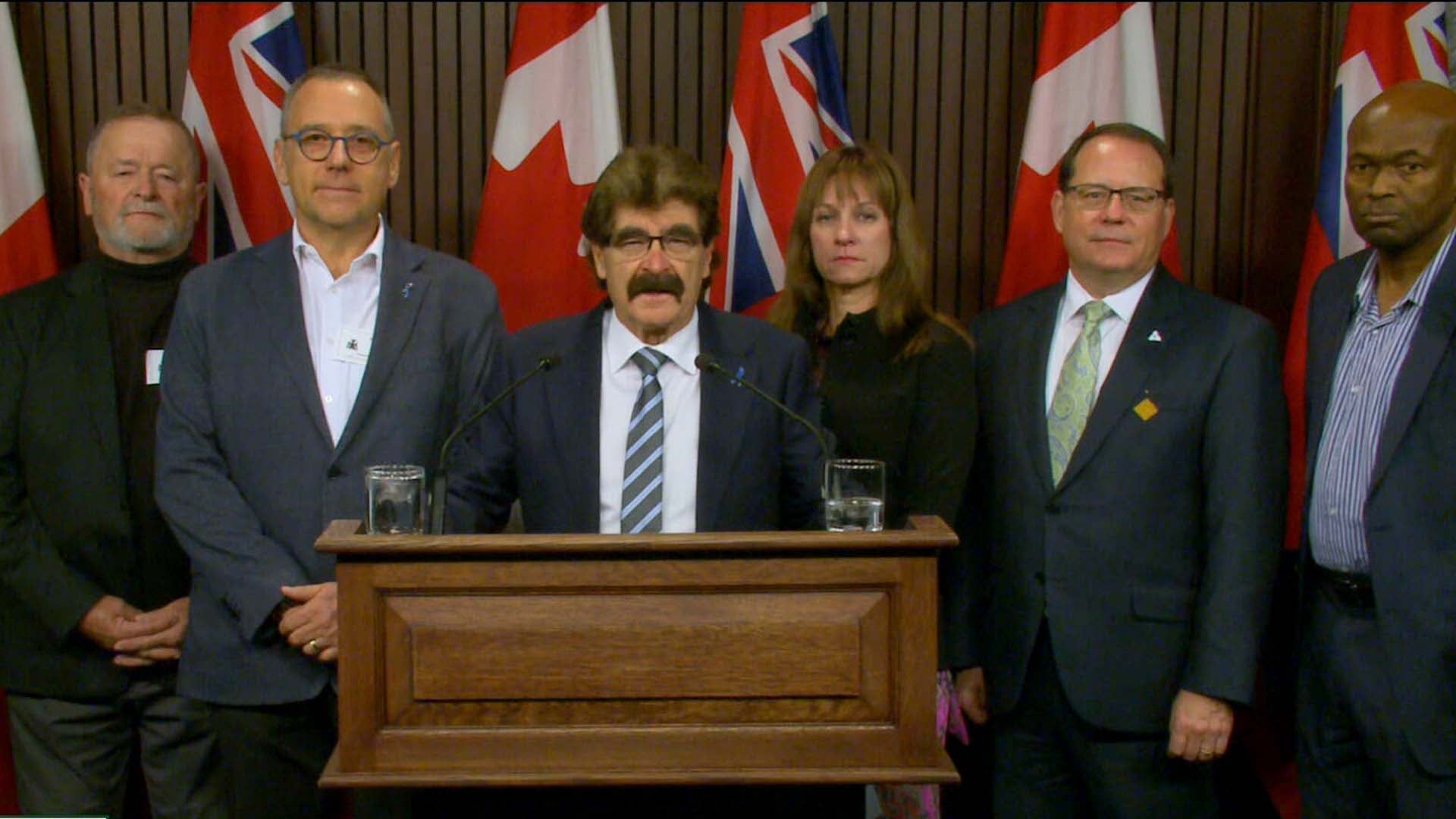
Opposition parties at Queen’s Park are renewing calls for the government to cover a simple blood test that helps detect prostate cancer in men.
In a news conference Tuesday, Niagara MPP Wayne Gates said he is once again pushing to make Prostate-Specific Antigen (PSA) testing free for men under OHIP.
At the moment, the test costs around $40. It’s covered by OHIP only if your doctor or nurse suspects you already have prostate cancer. Otherwise you have to pay out-of-pocket.
“That might not sound a lot to some, but for many, it’s enough to delay or avoid getting tests altogether,” Gates said, adding that his motion is “not about politics; it’s about saving men’s lives.”
Prostate cancer survivor David Flus said he’s only alive because he made a promise in 2013 to a friend dying from the disease that he would get a PSA test.
“I made an appointment with my doctor and asked if I could have a PSA test. He questioned whether prostate cancer ran in my family, and I told him no,” Flus said. “He said the chances of me having it were very low. However, he agreed to honor my request in order to test. He also informed me the cost of the test would be around $40.”
To his doctor’s surprise, Flus said, his test results came back showing that his PSA was elevated far above the normal level. A subsequent biopsy revealed he had an aggressive form of prostate cancer. Flus said his urologist told him his “outcome would have been very different” had his prostate cancer been detected a few years later.
According to Statistics Canada, prostate cancer accounts for roughly 20 per cent of cancer diagnoses among men in Canada, “by far” the leading type, with an estimated 5,000 men dying annually from the illness.
However the net five-year net survival rate is approximately 100 per cent at the first three stages, making early detection important. If prostate cancer is only detected at Stage 4, the net five-year net survival rate drops to around 41 per cent.
“That’s 13 men a day (dying). That’s dads, grandpas, friends, husbands, brothers, neighbors, and early detection is key,” Gates said.
In a statement, a spokesperson for Health Minister Sylvia Jones confirmed the test is only covered at the moment in certain circumstances.
“OHIP covers PSA tests when a physician or nurse practitioner suspects prostate cancer and provides a referral, when a patient is undergoing treatment for a confirmed diagnosis, or during post-treatment monitoring,” the statement read. “Individuals without a referral from a qualified healthcare provider are responsible for the cost of the test.”
Ontario Green Party Leader Mike Schreiner spoke alongside Gates at the news conference and said covering the cost of the test could in fact save the health-care system money by reducing the cost of having to treat patients with more advanced and complicated cases of prostate cancer.
“We know that screening and early detection saves lives, and quite frankly, it saves money for the health-care system as well,” Schreiner said.
He added that having a cost barrier for getting the test also sends a message that might deter people from getting it.
“For some it just isn’t affordable. For others, even if it is affordable, and they’re told, ‘well, maybe you should consider getting a PSA test, but it’s not covered by OHIP,’ it sends a message that it’s not a government priority,” Schreiner said.
Government sources site the prevalence of false positives from PSA tests as one reason the test is not more widely available, saying other factors aside from cancer could raise a man’s PSA level and that the test is not reliable enough as a general screen for the population.
According to the National Cancer Institute in the U.S., some jurisdictions have moved away from PSA tests for routine prostate cancer screening due to the high incidence of false positives. However some organizations still recommend that men with a higher risk of prostate cancer – including those with a father or brother who had the disease, as well as Black men -- do get the test.
The Canadian Cancer Society also acknowledges that false positives can occur frequently with PSA tests, in some cases leading to unnecessary invasive testing and stress. The organization says age, genetics and family history should play a role in deciding to get a test.
However Liberal MPP Adil Shamji, who is also a doctor, said there may be many considerations around whether to get a test after a discussion with a doctor, but cost shouldn’t be one of them.
“The reality is that some of the people who are most vulnerable to getting prostate cancer and succumbing from prostate cancer, in many cases, come from communities that will have the most difficult time paying for that test,” Shamji said.
“So what we are asking for today, under the leadership of MPP gates, is to make sure that Ontarians get their money’s worth, to ensure the Ontarians get the care that they deserve.”
Gates pointed out that in Canada, eight provinces and three territories already cover PSA testing.

