
For many Toronto parents, lower fees haven’t brought relief when it comes to child care. The real crisis is finding a space at all.
A new report by the Canadian Centre for Policy Alternatives (CCPA) found that while Toronto’s overall coverage has increased from 41.5 to 46.5 licensed spaces per 100 children since 2021, “more than half of the city’s children still lack access.”
The analysis, based on the CCPA’s Child Care Licensing and Accessibility by Region (CLAR) database, found 14 of Toronto’s 158 neighbourhoods fall far short of the “adequate” threshold of 60 child care spaces per 100 children.
Nearly all neighbourhoods with adequate coverage, are found in affluent downtown or midtown areas.
The worst-served communities — primarily in Etobicoke and Scarborough — fall below the 30 per spaces for every 100 children line. Researchers say these neighbourhoods are effectively “child care deserts” and highlight deep and growing inequity in access to care.
Etobicoke, Scarborough hit hardest
The 14 neighborhoods are found primarily in the west end and parts of the east in Scarborough.
Eight of the worst off neighbourhoods for child care are concentrated in Toronto’s west end, four in Scarborough, and two are in the southern portion of Toronto.
Kingsview Village–The Westway located by Dixon Road and Islington Avenue was found to have the lowest coverage at just 23 spots per 100 children.
Neighbourhoods such as Kennedy Park, Rexdale–Kipling, Weston, and Birchcliffe–Cliffside all have fewer than 30 spots per 100 children.
“What we see right now is that the only adequate coverage of Toronto is located in higher income areas,” said CCPA Ontario researcher Carolina Aragão. “We do not have any neighbourhoods with lower median incomes that have adequate coverage yet. At this pace, it will certainly take many years to achieve that equality.”
‘Much more affordable’ but not available
Aragão said that the national child care system has succeeded in reducing costs for families — but that lower prices have also exposed deeper shortages in supply.
“Child care in Toronto is now much more affordable,” she said. “But now it must also be available to all.”
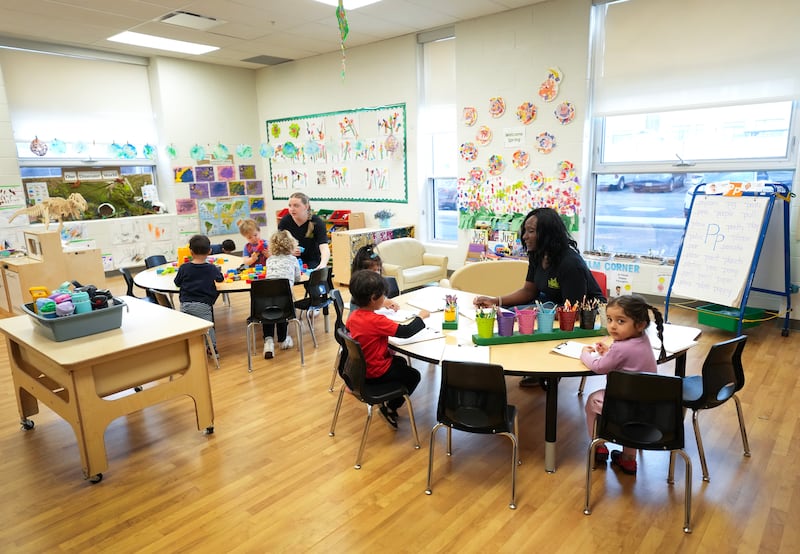
According to the report, the number of licensed child care spaces in Toronto grew by a net total of 3,943 between 2022 and 2025. While that represents a five percentage point increase in average coverage, it has not kept pace with rising demand, Aragão emphasized.
“Part of what has become a bottleneck for child care expansion is that the cost has decreased substantially, and now we have more demand — but we are lacking space creation,” Aragão said.
A system strained by workforce shortages
Researchers point to two primary barriers to expanding child care in the city: insufficient physical spaces and a persistent shortage of qualified early childhood educators.
“The issue that we have right now really comes to two main problems,” Aragão said. “First, having enough spaces — in the sense of having buildings that can be transformed into child care centres. And the second one is related to workforce. Sometimes even when buildings and spaces are available, you do not have enough child care workers.”

She added that retention remains a major concern, as child care workers continue to face low pay and high stress.
“A key issue with child care workers is that it tends to be an occupation that is underpaid,” Aragão said. “It’s a tough job that requires a lot of attention and education. They tend to be underpaid as jobs that overrepresent women and racialized folks. So it’s tougher to attract workers to this profession, and also difficult to retain them, because sometimes when people get another opportunity, they just move on.”
‘We need a systemic solution’
The CCPA’s findings come as Ontario’s Auditor General warns the province is falling behind on its child care commitments. Her office found that Ontario has created just 36,000 of the 48,000 new spaces it promised under the $10.23-billion federal–provincial agreement signed in 2022.
The program is set to expire in March 2026, and uncertainty over renewed funding has raised questions about whether the city can maintain progress — particularly in low-income areas.
“We need a systemic solution and governments of different levels working together to get us to that space,” Aragão said. “If we want to address this in the coming years, we’ll need to speed up the process in the areas that are most in need.”
Despite the gains since 2021, Toronto’s child care map remains uneven. Adequate coverage has nearly tripled since 2022, but the city’s most vulnerable families are still the least likely to benefit.
“Child care is much more affordable — but now it must also be available," Aragão said.

