Toronto’s mental health has deteriorated so rapidly over the past decade that the number of residents who say they are doing well has collapsed from nearly three quarters to barely half, a situation that at least one expert says is “unprecedented” and “crazy.”
A report, released by ThriveTO in partnership with the Canadian Mental Health Association, CAMH, the City of Toronto and other organizations, found the percentage of Torontonians who describe their mental health as “very good” or “excellent” fell from 73 per cent in 2015 to 52 per cent in 2022.
The report is based on a compilation of publicly available data over the years from Stats Canada, CAMH, Ontario Health and The Toronto Mental Health and Addictions Access Point.
“This is unprecedented. This is crazy. We’re going from three quarters of people saying they had good mental health to just about half… That is something that we should be really worried about,” said Dr. Kwame McKenzie, CEO of Wellesley Institute and one of the report’s lead researchers.
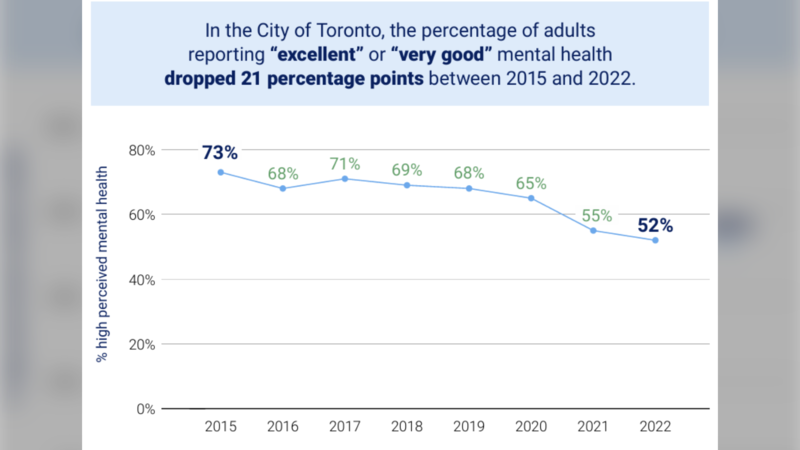
The release coincides with “Blue Monday,” a day often described as the most depressing day of the year. But the data suggests Toronto’s mental health challenges run far deeper than what residents endured during the pandemic.
“There was a steep decline in mental wellness in the early years of the pandemic, but declines were evident pre-COVID-19 and continue to be reported across Canada,” the report highlighted.
“It’s easy for people to say, ‘Oh, our mental wellness is just worse because of COVID.’ Oh no, this was happening well before COVID… They accelerated,” McKenzie said.
A sharper struggle among young people
The report found that mental health is not declining evenly across the population.
Younger age groups were significantly less likely to report having good mental health. People who reported experiencing discrimination or adverse childhood experiences were also far less likely to say they were doing well.
Among young people, the pressures are piling up.
At a closer glance, 55 per cent of respondents said the pandemic had a moderate to extreme negative impact on their mental health. Meanwhile, nearly half (46 per cent) said they feel depressed about the future because of climate change.
“Young people are looking to the future, and they are saying, ‘Hey, this doesn’t look good,’” McKenzie said.
Financial insecurity another concern
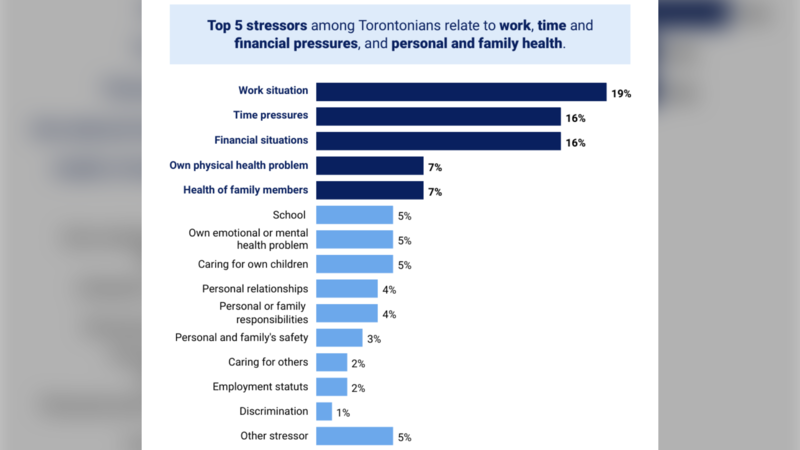
McKenzie explains that financial insecurity is inseparable from mental well-being.
“One of the things that is exquisitely linked to your mental health is the feeling of financial insecurity,” he said. “Is there a difference between affordability and health? Probably not that much difference. The more affordability problems we have… the worse your health is.”
For those who do manage to access care, the system is often effective.
The report found that 76 per cent of needs identified for clients receiving community mental health services were being met.
But demand is now rising much faster than the system can absorb.
Between 2020/2021 and 2022/2023, the number of people waiting for support services nearly doubled.
“That’s the real danger sign,” McKenzie said. “Unless we start taking this seriously and start thinking about ways of driving a mentally well flourishing society… we all end up losing.”
Loneliness on the rise in Toronto
Frontline clinicians also report similar findings, telling CTV News that the emotional texture of the city is changing.
“We’re definitely seeing an increase on loneliness across the city, whether you’re a young adult, a newcomer or remote worker… winter often amplifies this, particularly in large urban cities…” said Christina Gallo, a registered psychotherapist with the Canadian Mental Health Association.
At the same time, she said, something important is shifting.
“Society is slowly becoming more aware of how lonely we are.”
A political test for 2026
The report was authored by Dr. Sophie Baker and Dr. Kwame McKenzie and is the first in what is intended to be a recurring series of mental health “report cards” tracking Toronto’s progress under the Thrive Toronto Mental Health Plan, released in 2023.
“This first-ever report card offers the baseline information from which future reports will measure success or identify problems,” McKenzie said.

He believes the findings should become a central issue in the 2026 municipal election.
“I would think anybody who wants to win the hearts and minds of Toronto would be taking these sorts of reports to heart, because the information we’ve got is reflecting the experience of people in Toronto,” he said.
“If we’re going to make a difference here,” McKenzie added, “we have to start taking this seriously.”

