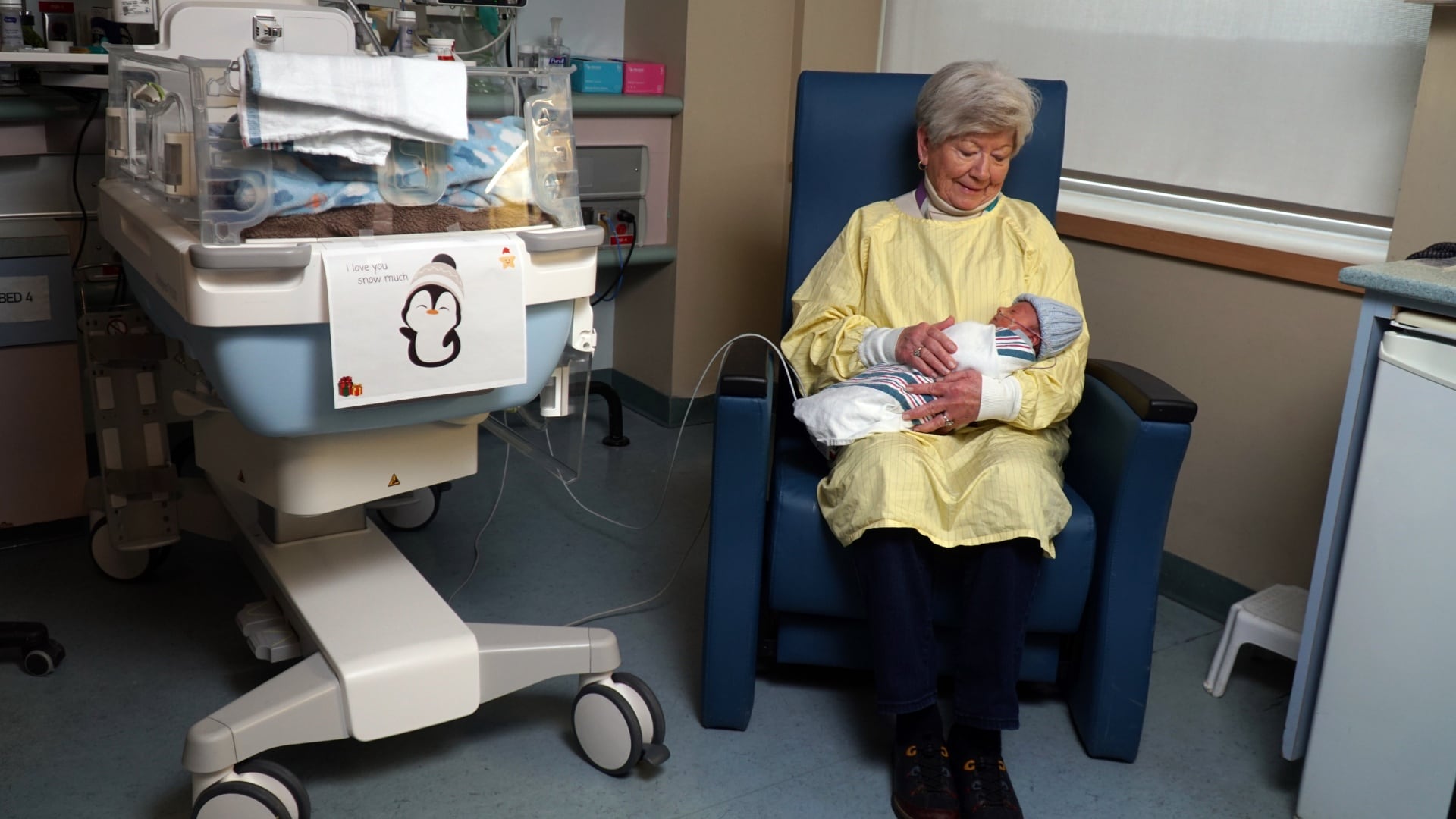
The day typically starts with Carolyn Acker slipping on a gown, putting on a mask and washing her hands before she steps into the neonatal intensive care unit at St. Michael’s Hospital and asks which infant is in need of a cuddle.
Once a nurse places a baby into Acker’s arms, she will sit down and cuddle the child, and sometimes she will sing or talk to them.
“You’ve got to be very, very careful that you don’t do anything that you’re not supposed to do. This is an intensive care unit, so our role is cuddling, and that’s what we do,” the 75-year-old told CTV News Toronto.
Acker, a retired registered nurse, is just one of 15 volunteers with St. Michael’s infant cuddling program, one of the first of its kind in Canada, which runs daily between the hours of 8 a.m. and 4 p.m. She goes every Wednesday right from when they open until around noon.
“St. Michael’s is an inner city hospital that serves pre-term babies from across the GTA with a diverse range of medical needs, including those impacted by prenatal opioid use,” Marisa Cicero, senior clinical program director of women and children’s health at St. Michael’s Hospital, said in a statement.
“Our nurses have been the heart of the volunteer cuddler program since it started ... and work closely with families and volunteers to make sure every baby in the NICU feels safe and connected.”
The program first launched in 2015, opening to pilot a study that demonstrated babies with neonatal abstinence syndrome—who experience withdrawal symptoms after being exposed to opiates—spent less time at the NICU when they were consistently cuddled. It has since expanded to St. Joseph’s hospital.
The length of stay for these infants was reduced by around six days, as they left the NICU in 24 days on average compared to the 30 days by those who weren’t cuddled.
“The results (were) so positive that they basically extended it to all the babies in the nursery, so it wasn’t just for babies going through withdrawal,” Carol Bailey, a senior nurse at St. Michael’s NICU, told CTV News Toronto, adding parents can opt out of the program if they don’t want to be part of it.
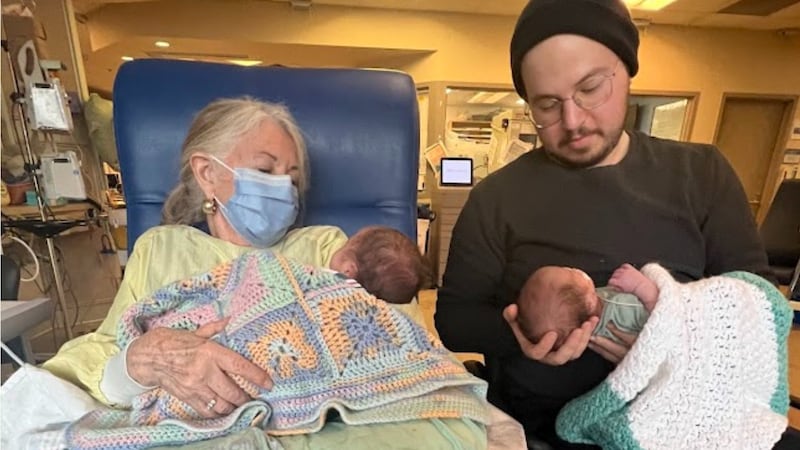
Acker says she waited for five years on the waitlist, noting the low turnover rate in the program.
“I saw a nurse, older than me, who I knew was in the cuddling program and I said to her when I was on the waiting list, ‘When are you going to retire so I can get in there?’ She said, ‘Never,’” Acker recalled with a boisterous laugh. “I understand why.”
She was let in about three years ago, after St. Michael’s restarted the program following the closures brought on by the pandemic. Acker then went through a rigorous screening process, including a criminal check and ensuring her immunizations were completely up to date.
“We went through training, we had to learn the rules, what we could do, what we couldn’t do,” Acker said, pointing to the example of how volunteers are not allowed to take an infant out of their bassinet or incubator themselves.
There are similar rules embedded within Michael Garron Hospital’s volunteer program too, which launched a couple of years after St. Michael’s.
“We must be sitting and a nurse hands the baby to us,” Betty Hicks told CTV News Toronto in an interview.
Hicks, 78, past chair of the volunteer experience council turned volunteer cuddler at the East York hospital, says she was part of the team that first introduced the program to Michael Garron’s.
“The baby cuddling program, I started to do my own research on it, and saw the advantages of it, and thought, ‘Yes,’” Hicks said. “We started the program with five volunteers—one for each day—giving two hours a day. We wanted to see how that worked, and now it has increased.”
Today, there are 14 volunteer cuddlers at Michael Garron’s.
While there are benefits to the cuddling program for infants—with research demonstrating how affectionate touch positively impacts neurophysiological development, including stress regulation—Bailey says the volunteers make a huge difference in the day of a NICU nurse in terms of the work they can focus on.
“It makes a difference. It lessens my stress to know that, OK, someone’s holding little Johnny while I’m trying to start an IV or I’m trying to run this line,” Bailey said. “On the times when we don’t have a volunteer, you know, you will hear nurses saying, ‘Where are the cuddlers? We don’t have a cuddler today?’”
Bailey notes the volunteers will also chat with the parents, sometimes even leave them a note, to let them know how their child was doing when they weren’t at the hospital.
“It’s a positive for the infant, it’s a positive for staff, and it’s a positive for the volunteers and also the families,” Hicks said.
“It’s not easy having a baby because I think there’s a lot of emotional upheaval right after and, if a mother is ill or having difficulty, they’re reassured knowing that there are arms there holding their and comforting their baby.”

