
Toronto is exploring whether a ferry could help connect its rapidly growing waterfront, but one transportation expert says the proposal is more about tourism and access than solving the city’s transit crunch.
A feasibility study, prepared for the City of Toronto, Waterfront Toronto and the Toronto Port Authority examines five potential routes across Toronto’s Inner Harbour, stretching roughly five kilometres from Ontario Place in the west to Ookwemin Minising (formerly Villiers Island) in the east, with connections to the Toronto Islands and the Outer Harbour.
That stretch is already home to more than 76,000 residents and attracts an estimated 63 million annual visits — a figure projected to rise to 115 million by 2051, alongside a residential population exceeding 119,000.
The study comes just one year after Ottawa, Queen’s Park and the city committed $975 million to accelerate waterfront redevelopment, an agreement Mayor Olivia Chow said would deliver 14,000 new homes for 25,000 people, with construction set to begin sometime this year.
What would it cost?
Depending on the route, vessel size and service frequency, annual operating costs range from roughly $645,000 to more than $4.2 million.
The most extensive option — Route D, a clockwise and counterclockwise loop connecting nine waterfront and island stops — carries the highest price tag, with monthly operating costs reaching $689,000 for 15-minute service using 75-passenger vessels.
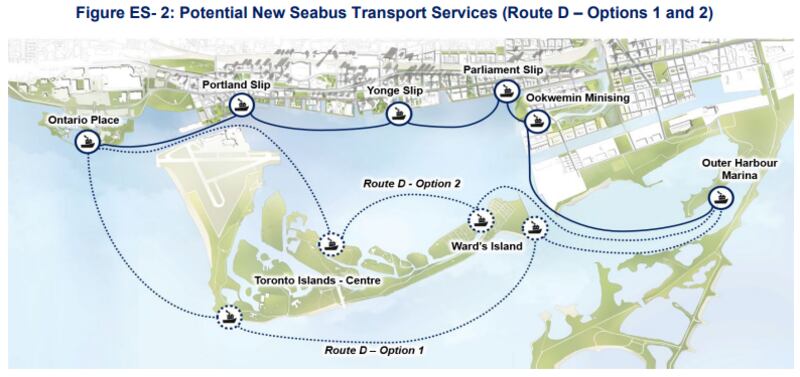
The report notes that shorter east-west routes are cheaper but come with tighter schedules and limited buffers, increasing the likelihood of delays.
“Each route was evaluated based on projected passenger demand, driven by significant existing and future landside development and attractions,” the report states.
A pilot, not a promise
Waterfront Toronto says the study was commissioned in response to decades of planned redevelopment and is meant to “complement,” not replace, land-based transit.
“The Seabus Feasibility Study focuses on the feasibility of new marine transportation services within Toronto’s Inner Harbour and opportunities for improvement of the existing marine transport system,” the agency told CTV News Toronto in a statement.
“The primary goal is to proactively manage future growth and bridge gaps in waterfront connectivity.”
As a first step, officials tell CTV News they are planning a water shuttle pilot expected to launch this summer, which would generate ridership and operational data.
“If the pilot is supported through strong ridership, it could potentially evolve into a broader, permanent sea bus operated by a private provider,” they added.
However, just last month, a separate report by the Toronto Region Board of Trade suggested that government investment in connectivity is crucial to unlocking the waterfront’s “full potential.”
It is also not the first time a ferry has been floated as a potential way to address Toronto’s gridlock. In May, officials with Hoverlink Ontario unveiled a proposal for a hovercraft that would transport riders across Lake Ontario from Toronto to Niagara Region in 30 minutes.
‘A nice to have,’ expert says
Steven Farber, director of the University of Toronto Mobility Network, says the numbers in the latest study make one thing clear.
“In terms of moving the needle, I think it’s quite clear from the figures that this, this isn’t about congestion relief… the numbers just don’t bear out as being anything more than a drop in a bucket in terms of congestion relief," he said.

Farber said the service could be appealing for tourism and recreational trips but questioned whether it should compete with other transit priorities.
“It’s a nice to have, and I’m sure it’s going to be nice for tourism, and it’s going to unlock some recreational areas to residents,” he said. “But I wouldn’t prioritize Toronto’s transportation dollars towards that project over many others that I think we would get much better returns on.”
He added that while the service could succeed on its own terms, backed by a private investor, it is unlikely to become a core part of the city’s transportation network or take a significant number of cars off the Gardiner Expressway.
“Is it going to become a significant, meaningful factor in our transportation system? I think it’s highly unlikely,” he said.
What does the mayor think?
Mayor Olivia Chow’s office said the city remains open to exploring new ideas.
“The Mayor is open to looking into any idea that could help reduce congestion and improve how people move around the city,” her office noted.
For now, the SeaBus remains just that — an idea on paper.
The study does not commit the city or its partners to building or funding a permanent service, and officials stress that any future decision would depend on demand, integration and cost.

