
Ontario Premier Doug Ford is refusing to say whether school board trustees will be on the ballot when people across the province vote in municipal elections this coming fall.
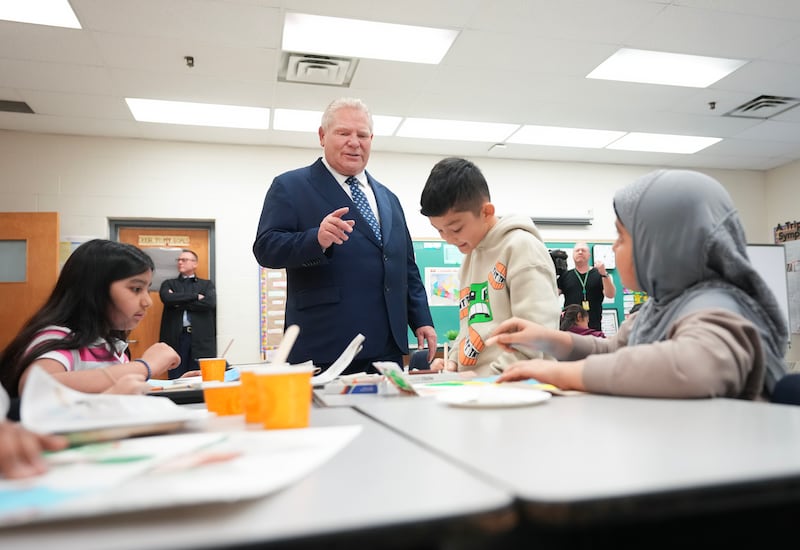
“We’ll come out with an answer on that shortly,” Ford told reporters when asked about the matter at a news conference at an Etobicoke school Wednesday morning.
When asked if his government will move to eliminate trustees altogether, he said “I can’t confirm it right at this second. Everything’s on the table.”
Eight school boards in the province are currently under provincial supervision.
Education Minister Paul Calandra seized control of the boards – including the Toronto District School Board – over a variety of allegations, including financial mismanagement, infighting, and wasteful spending.
In the fall, the government passed legislation making it easier for the education minister to take over school boards, leading some to speculate the province could be looking to make sweeping changes to the school board system.
Calandra has promised that he will give certainty around the school board model when MPPs return to Queen’s Park later this month.
He said Wednesday that a decision is still being made.
“I haven’t given the premier my suggestions yet for reform, so I’ll do that very soon – a whole host of options for the premier and then to my cabinet colleagues” Calandra said at the same news conference.
“So that has yet to be decided, where we go from there. So it depends on what we decide. But full stop; if it’s not in the best interest of students, it’s not in best interest of teachers delivering, then it is not a direction we’ll go in.”
Asked how long the supervision of boards will continue, Calandra said it will not end until the ministry is satisfied that they are back on track.
“If it takes us one year, two years, three years, 10 years, I don’t care,” Calandra said. “When they are on the right path, when they are doing what’s in the best interest of our teachers, students and parents, and if there are still trustees, we’ll turn them over (to them).
“But regardless of what happens with the governance changes, I don’t see a world in which these eight boards that we have under our jurisdiction right now are turned over anytime. There’s a lot of work that has to happen in in these in these eight boards.”
Ontarians typically cast a ballot for local school board trustees when they vote for a city councillor and mayoral candidate. Local elections are set to be held across the province on Oct. 26.
Things getting worse for students under supervision: advocates
Meanwhile, a group of public education stakeholders held a news conference at Queen’s Park Wednesday, calling on the government to ensure democratic representation in the school system.
Minister Calandra’s, decisions to place school boards under supervision have significantly reduced the authority and role of democratically elected trustees, and comments about potentially eliminating them altogether, concentrating decision making power at Queen’s Park should concern us,” said ETFO President David Mastin said.
David Lepofsky, the chair of the Special Education Advisory Committee of the Toronto District School Board, said the ministry is slowly seizing more direct control over students, cutting out local accountability.
“750,000 Ontario students now have their education under the direct management of the minister’s office with no local democracy,” Lepofsky said. “That’s over a third of Ontario’s students in publicly funded schools. This is a form of creeping takeover.”
He said that instead of things getting better at those schools that have lost trustee representation, parents have been left with nowhere to turn if they are having difficulty getting proper school supports for their children.
“What we’ve seen from the point of view of kids with disabilities and special education needs is after six or more months under their supervision, things have not gotten one bit better. In fact, things have gotten appreciably worse,” Lepofsky said.
The group called on Calandra to undertake broad consultations with education partners before moving forward on reforms on school board governance. They said those consultations should include students and parents as well as families with students who have disabilities and subject matter experts. They said they also want to see the government table a detailed plan with clear goals for the return to regular oversight for schools under supervision.

