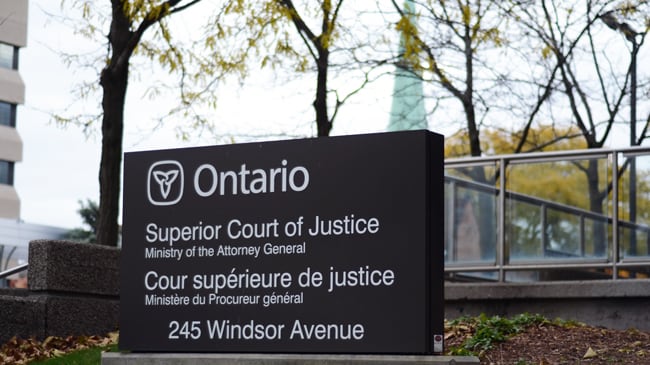
The head of the Ontario Superior Court says it would be “inappropriate and unethical” for a judge to apologize after she accused three Toronto cops of lying during a 2024 high-profile murder trial, despite calls from the premier and head of the police union to do so.
Chief Justice Geoffrey B. Morawetz’s comments come in the wake of an OPP report released this week which investigated Justice Anne Molloy’s allegations of collusion against the officers at the trial of Umar Zameer, who was charged with first-degree murder in the death of their colleague, Const. Jeffrey Northrup.
The report, which has not been tested in court, determined Molloy’s claim that Det. Cons. Lisa Forbes, Scharnil Pais and Antonio Correa lied under oath was “not supported by the evidence.” It also found that Northup was likely standing in front of, and not beside, Zameer’s vehicle when he was struck and killed in 2021, a key point of contention in the trial.
The report relied, in part, on the analysis of an independent expert who did not testify during the trial and its authors did acknowledge that “the conclusions reached by the trial judge were necessarily limited to the evidence presented during trial.”
READ MORE: Ontario police clear 3 cops accused of lying at trial that followed officer’s death
Toronto Police Chief Myron Demkiw, who ordered the report after Zameer was acquitted, said the OPP investigation was a “vindication” for the officers and both Premier Doug Ford and Toronto Police Association President Clayton Campbell have since called for Molloy to deliver an apology.
But Morawetz said that’s not how it works.
“It would be inappropriate for Justice Molloy to comment on a matter over which she presided. Out-of-court statements made by the judiciary about cases they have heard can undermine confidence in the Court’s impartiality,” he wrote.
“When judges or juries make decisions at the end of a trial, they are final, subject to a party’s right to appeal. It would be inappropriate and unethical for judges to succumb to outside pressure to modify or qualify their decisions or reasons.”
Zameer’s lawyer slams report as head of OPP stands by it
On Thursday, Zameer’s lawyer called the report and its response to it a “chilling moment in the history of the Canadian justice system,” while underscoring that no new evidence was examined in the 55-page document.
“The only apology that is owed is from the chief of police and the premier for attempting to undermine the sanctity of jury trials,” he said.
Meanwhile, the head of the Ontario Provincial Police said the force stands by its report.
During the 2024 trial, Molloy stated that Forbes, Pais and Correa’s statements did not match the physical evidence presented at court, specifically where Northrup was when he was struck and killed by the vehicle Zameer was driving.
Two crash reconstruction experts, a Toronto police officer called by the Crown and an engineer called by the defence, told the court that Northrup fell after Zameer’s vehicle made “glancing contact” with him while he was reversing, causing him to fall to the ground before he was run over.
The expert called by the defence said that Northrup would have been in Zameer’s blind spot and not visible to him as he was run over.
“When three versions of the event are wrong, and wrong in the same way, you must also consider whether there has been collusion between those witnesses. All of the officers denied collusion,” Molloy said at the time.
But the OPP said that after reviewing the reports and testimonies from those experts, they identified “significant concerns that their collision theories were not supported by the available evidence” and Northup was more than likely in front of Zameer’s car when he was struck, as Forbes, Pais and Correa had testified.
Morawetz added that if a party is of the view that a judge or jury’s decision is wrong, there is legal recourse through appeal.
“In Mr. Zameer’s matter, the verdict was not appealed.”
With files from Joshua Freeman and Bryann Aguilar

