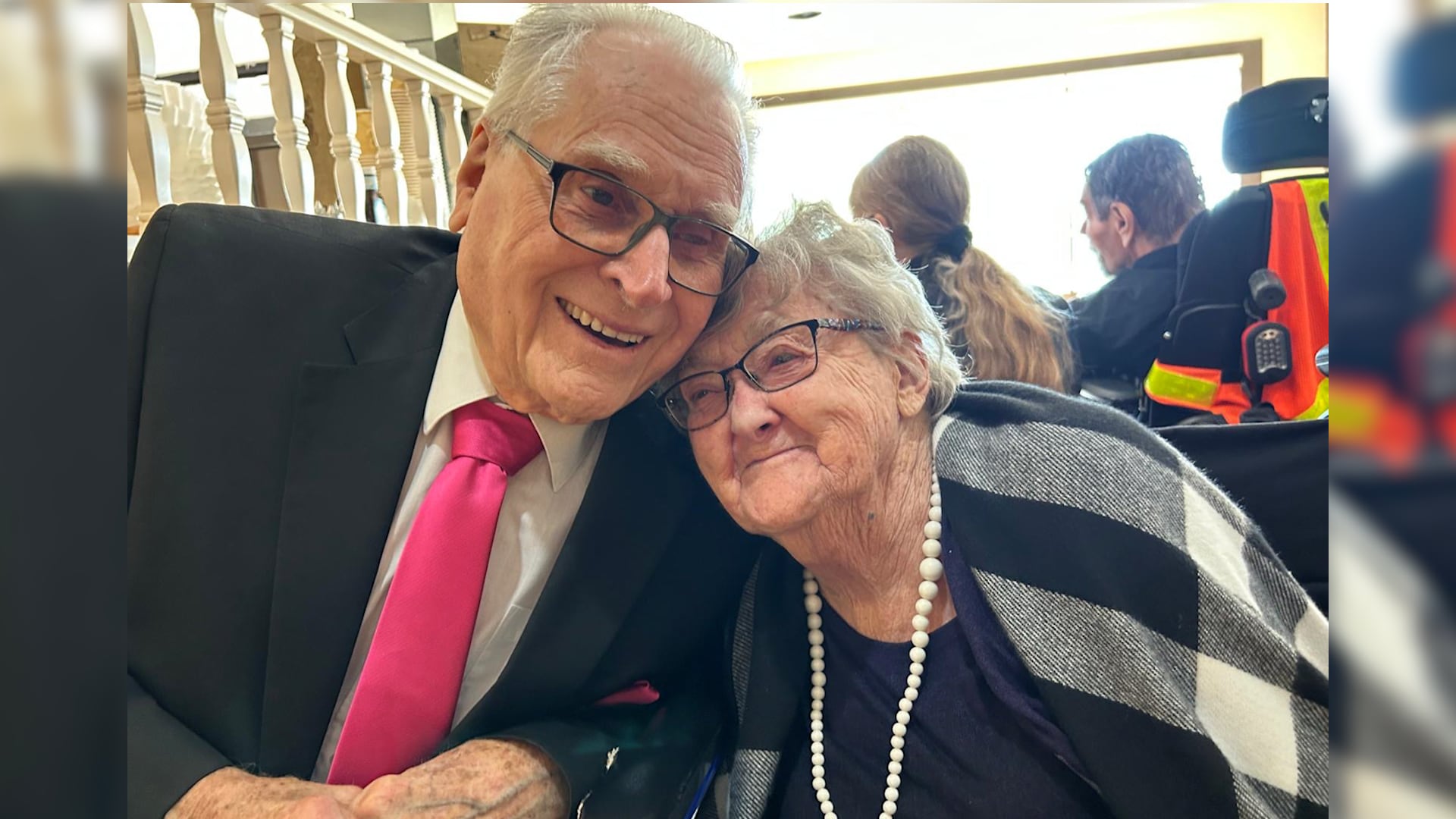
The family of a 93-year-old Ontario woman with severe dementia who was arrested and charged after an altercation with her elderly husband is asking for police to use more discretion when it comes to dementia cases.
Evelyn Patton shouldn’t have been charged with assault in December despite the Ontario Provincial Police’s mandatory charging rules in cases of intimate partner violence because she was in a delirium and didn’t have the mental state to commit a crime, said her daughter Shelley Hodgkinson.
“There needs to be some leeway for people living with dementia. She has no recollection of what she did. She didn’t know what she was doing at that point,” she said.
And her husband Charlie Jackson, a retired church minister who is also in his 90s, told CTV News that Patton shouldn’t be criminally punished for a health condition.
“I have to look at it and say, it’s not Evelyn, it’s the dementia,” Jackson said. “I love that girl so much. She’s a sweetheart.”
Patton, a farmer who retired when she was 82, met Jackson when they were both in their 80s. They later moved into Grey Gables retirement home in Markdale, Ont.
Jackson stayed with Patton even as she was diagnosed with vascular dementia in 2021 and her cognitive function declined. In mid-December, in a state of confusion, Jackson said she struck him.
‘She completely melted down’
“She was smaller and I wasn’t hurt at all,” he said. But a nurse was called, and the care home had to report the incident, he said.
That’s when the OPP were called. After officers arrived, they arrested Patton and filed charges against her. Patton didn’t know what was happening, said Hodgkinson, and that caused major stress.
There are mandatory reporting requirements in cases of abuse, neglect, improper treatment, or unlawful conduct in the Fixing Long-Term Care Act, said a spokesperson for the Ontario Ministry of Long-Term Care.
“She’s a 93-year-old woman who can’t move. She’s confined to a wheelchair. She can’t move on her own. And the police are there, confronting her, and she completely melted down,” Hodgkinson said.
Patton’s release conditions also included a requirement to stay at least 50 metres away from her husband, said Patton’s lawyer, Andrew Loucks. That meant that the care home had to separate the couple.
“It was hard on the system, hard on my nerves to think that we couldn’t be together. Because she is a sweet girl,” Jackson said.
Hodgkinson said the separation further confused her mother, making her condition worse.
“She was so disoriented and any kind of change for someone with dementia is awful,” she said.
Police officers in Ontario are required to charge suspects if they find that reasonable grounds exist to believe an offence has been committed – a policy that was added to the policing standards manual in the 1990s as authorities wrestled with how to avoid situations where failing to lay charges led to further violence.
“OPP officers have policies and procedures to follow when investigating all occurrences of abuse, including cases of intimate partner violence (IPV). These include verifying the allegations being made and laying charges when appropriate. Specifically in cases of IPV, all police officers in Ontario are mandated by legislation to lay charges where reasonable grounds exist to believe that an offence has been committed. There is no discretion to decide not to lay a charge when grounds exist to do so,” the police service said in a statement.

Loucks said Patton’s severe dementia meant she couldn’t form any criminal intent, and finding intent is a key component of making an assessment of whether there are reasonable grounds that an offence has been committed.
“Why that officer arrested Ms. Patton is beyond me,” he said. He said the notes he’d seen in the case indicated the officer himself didn’t believe the intent existed.
Crown drops charges
Loucks said he approached a Crown prosecutor with the case, who quickly moved to drop the charge earlier this year. Loucks said he hopes that officers learn from the case and exercise discretion more often.
“I think further education would absolutely be helpful and it is not the case that every incident where a police officer attends needs to have charges laid. This is a case where if there are concerns it would be more appropriate to address with the nursing home as to how they could manage people who are vulnerable and have high needs,” he said.
A spokesperson for Ontario’s Ministry of Solicitor-General, which oversees the province’s police, said the legislation doesn’t require arrests in all circumstances.
“The Ministry of the Solicitor General does not play a role in determining whether charges are laid against any individual. Every chief of police must establish and maintain procedures for undertaking investigations, and local police services are responsible for applying these procedures when determining how to proceed in specific circumstances,” a spokesperson said.
The couple have been reunited in Grey Gables, and the home has helped change medication for Patton.
“I can’t say enough about the help that we got from Grey Gables and the management. Everyone there went out of their way to help us,” he said.
Patton is calmer now – and is much closer to being the person he married, said Jackson.
“I love that girl so much,” Jackson said.

