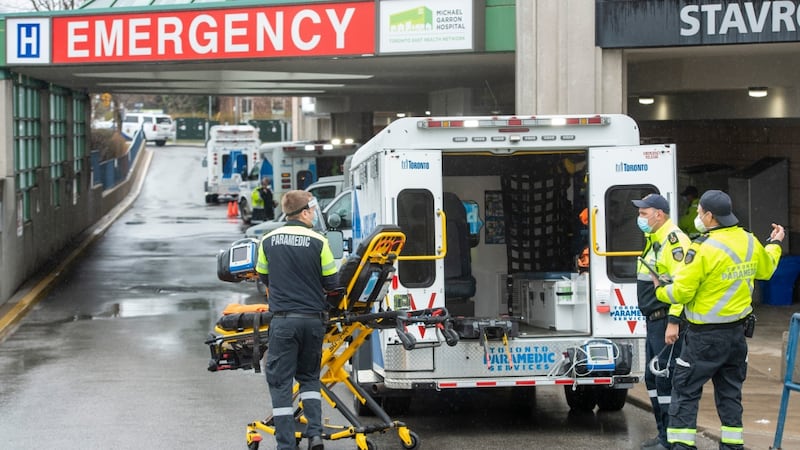
Emergency visits are surging at an east-end Toronto hospital, forcing staff to treat twice as many patients as the facility was built for.
Michael Garron Hospital tells CP24 that emergency department visits have climbed 31 per cent compared to the previous five-year average, with pediatric cases jumping 74 per cent. The spike comes as hospitals across Ontario face mounting pressure tied to funding constraints, staffing challenges, and growing patient needs.
“What we’re talking about is a hospital that was originally built to see about 150 patients a day, and is now seeing 300 patients a day,” said Dr. Carmine Simone, the hospital’s executive vice president overseeing medical and clinical partnerships.
A system under strain
The hospital, located at Coxwell and Sammon avenues, now routinely sees double the number of patients it was designed for. It’s a reality Simone says reflects the needs of the surrounding community.
“This is really because of the area that we serve. We have the privilege of serving a community that is represented by a number of patients that are newcomers to Canada, patients that don’t have previous access to care,” he said.
He added the hospital is also seeing “a significant number of marginalized communities that are dealing with mental health issues and chronic disease,” calling it “a perfect storm of individuals that need acute care.”
“What we’re seeing in the emergency department are patients that truly need emergency care… not just large numbers, but also patients that really need the care of an emergency department.”
To cope, the hospital has transformed nearly every available space, even some that may be considered unconventional.

“Many of the things that we’ve done over the last five years is basically change all of the non-clinical space into clinical space,” Simone said. “We no longer have office space or storage space… that’s all been converted to allow us to care for patients.”
Funding pressures and future plans
The pressures at Michael Garron reflect broader system-wide concerns.
Earlier reports have warned that Ontario hospitals could face worsening overcrowding and longer wait times due to funding shortfalls.
Data from a public policy think tank also found nearly 300,000 Ontarians left emergency rooms without being treated last year. That represents roughly 4.9 per cent of all visits.
The Ontario Council of Hospital Unions has also warned that planned funding increases (about two per cent annually) fall short of rising costs and could force hospitals to make cuts.
The Ford government, for its part, has pointed to long-term investments, including a $64-billion health infrastructure plan over the next decade, with funding aimed at expanding hospital capacity and adding beds across the province.

At Michael Garron, officials say expansion is urgently needed.
“We’re very excited with the opportunity to talk to government about increasing the funding that we have to our emergency department, and talk about some exciting opportunities to increase our footprint or build more emergency capacity,” Simone said.
In the meantime, the hospital is turning to technology, including artificial intelligence, to improve efficiency and reduce wait times.
“The hospital, the staff and the emergency department are also leveraging other things like technology to help be more efficient and safer.”
Despite the strain, Simone says patient care remains a priority.
“Patients will still get very good care at our hospital. They get the standard of care. It really is something that is less ideal in terms of the patient experience.”

