Elected trustees are speaking out against a slate of school board changes announced by the Ford government this week, saying it will lead to reduced accountability, particularly around possible cuts.
Education Minister Paul Calandra introduced the changes in a sweeping education bill Monday, saying the changes are necessary to avoid financial mismanagement at boards, reduce infighting and ensure trustees are focused on their mandate of ensuring student success.
Among other things, the bill would limit school board sizes, cap the amount paid to trustees, give the ministry more control over communications and establish a CEO role as the top employee at the school board.
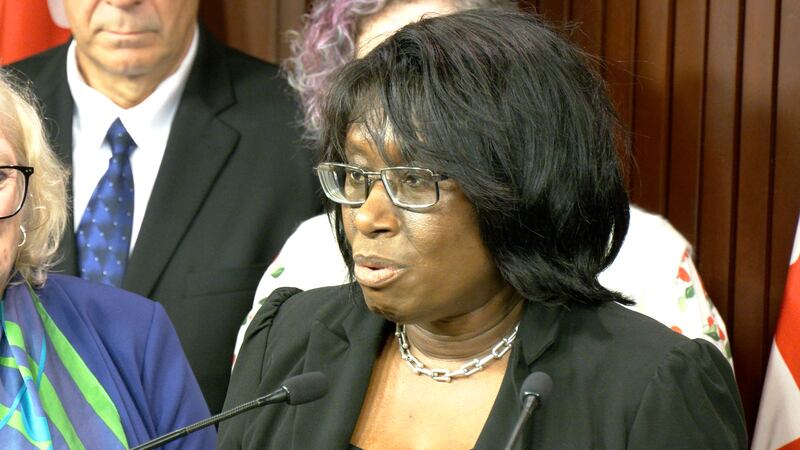
“Trustees are elected to bring forward the voices of their communities, not to be sidelined,” TDSB Trustee Deborah Williams said at a news conference at Queen’s Park Tuesday. “Any legislation affecting public education should strengthen the democratic role, not diminish it.”
Calandra has said that the intention of the legislation is to “dramatically” reduce the role of trustees and “refocus” their jobs around representing parents and students.
Williams said the major issue facing education is not the functioning of school boards, but a provincial funding gap for education that fails to account for inflation and increasing enrollment.
The TDSB is one of eight school board currently under provincially appointed supervisors, with elected trustees suspended from their roles.
At their news conference Tuesday, trustees pointed to recent cuts made by supervisors to teaching positions at the TDSB and the Toronto Catholic District School Board and said they’re concerned the changes will mean boards will have less say over where board dollars are spent.
Jill Promoli, a trustee with the also-suspended Peel District School Board, spoke at Queen’s Park as well. She said the new legislation further centralizes control under the minister, giving parents less input into decisions around education.
“The minister claims authority and control over everything from how your child can be assessed to what your child will learn to what your school board is allowed to share with you through communications,” Promoli said. “He reduces the power of trustees, making it much harder for your neighbours to work on behalf of your kids and all the kids in your community.”
Cathy Abraham, who has served as a trustee with the Kawartha Pine Ridge District School Board for over 20 years, said she’s concerned that capping the honorarium paid to trustees to $10,000 will further limit who has the ability to run as a trustee.
“I have often said that I could make more money if I got a part time job at McDonald’s, and probably with less people phoning to complain to me,” Abraham said.
“We don’t do it because we’re getting rich. What that honorarium does is allow a single mom or a single dad or somebody with a job to maybe pay daycare or a babysitter at night to come to meetings, or if I’m going to miss a couple hours work during the day, to be able to offset that loss of salary.”
Williams said she’s concerned that the community’s ability to bring forward education through consultations is being lost.
“It’s the community voice that is being diminished here, the opportunity for our school communities to engage, to bring their concerns forward so the trustees have an opportunity to advocate for those priorities,” she said.
Speaking with CP24 Tuesday, Calandra said the changes are needed to ensure kids are getting a good education no matter where they live in the province.
“Parents should expect a consistent level of education. We’re just not getting that. We’re seeing divisiveness within boards,” he said. “Some of our boards or trustees are spending more money fighting themselves than they were on some of the educational programs in the province.”
He acknowledged another government could come along and reshape the system to their liking, but said this is the best way forward he sees for the time being.
In an exchange in Question Period, Interim Liberal Leader John Fraser suggested perhaps the government could do with a supervisor to clean up its “mess.”
“Bill 101 is not going to make one child’s class smaller, it’s not going to get a child who has exceptional needs the help that they need, and it’s not going to address the mental health crisis in our schools,” he said.
NDP Leader Marit Stiles also fired questions at Calandra, criticizing the bill and saying it does little to help kids.
“There are fewer education workers, there are fewer teachers, there are overcrowded classrooms, and still there is nothing, nothing to support that child in a classroom who needs help right now,” she said.

