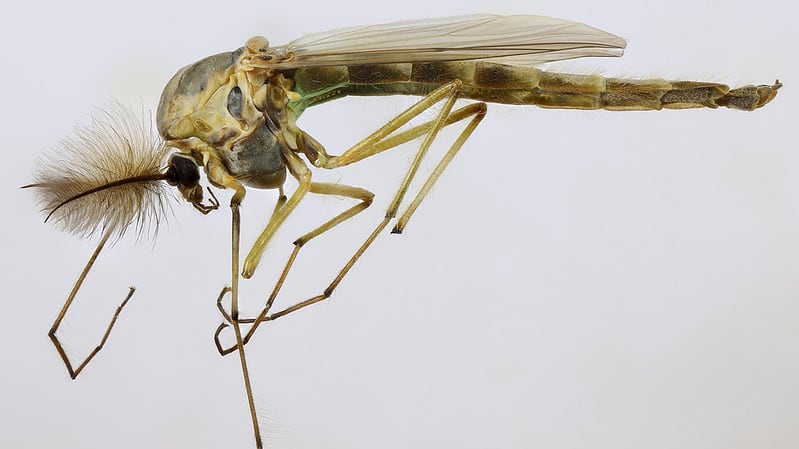
It is midge season in Toronto, which means one might spot more and more clouds of the tiny, winged insects.
There are more than 10,000 species of Chironomidae and there are nearly 800 that have been spotted in Canada, according to an entomologist at the Royal Ontario Museum (ROM).
“What we’re seeing now is big swarms of them that are emerging from the water because the midges are in the larval stage,” Antonia Guidotti, entomologist and collection technician in the Department of Natural History at the ROM, said in an interview with CTV News Toronto on Tuesday.
These bugs tend to live at the bottom of the lake (or river), as that’s where they feed, eating the organic matter found there.
“They’re really an important part of the food chain,” Guidotti said. “They are fed on by fish, by frogs, by other insects in the water and waterfowl.”
Midges emerge from the water as adults and typically live short lives, at most a week. The swarms typically seen are male midges waiting for females to come along, Guidotti explained.
“It’s one species that emerges at a time and they try to synchronize when they emerge so that there’s other members of the same species that are also present,” Guidotti said.
They are commonly found roaming near bodies of water, like Lake Ontario, but Guidotti says clouds of midges can still be spotted a few kilometres north.
This time of year, from the end of April through the beginning of May, yields a “big emergence” of midges, Guidotti said. Depending on the species, hordes of midges will be spotted periodically.
“Some of them have more than one generation a year, so about three to four times a year at least,” Guidotti said.
Though these swarms of midges might be annoying, they are completely harmless as they do not bite. Guidotti underlined their short lifespan, adding they may be more of a nuisance than a pesty problem.
Anyone looking to avoid them can turn off their porch lights, as Guidotti notes they can be attracted to the light, and keep their screen doors closed.
“You could mask up or put a scarf over your face,” Guidotti said. “Bug zappers do not work.”

