At a time when the United States has pulled funding for research programs, Canada is pushing to attract scientists to head north with Toronto’s University Health Network already recruiting dozens of medical researchers from abroad.
The Canada Leads program was launched a year ago by the hospital network, with the goal of bringing on 100 early- to mid-career scientists from across the globe. It’s part of a larger, nationwide strategy to push forward Canada’s leadership in global life sciences and medical research, according to UHN, particularly in areas that will impact health and have capacity for economic growth.
Because of that, Brad Wouters, executive vice-president of science and research at the University Health Network, says they had high standards for who they selected in the program. So far, Wouters says they have recruited 80 people, though there are hundreds more who have expressed interest in the campaign.
“It’s been extraordinary, the interest and the initial experience as part of this,” Wouters said.
There have been more than 800 people who have expressed interest in the program so far, according to UHN.
Though the program is focused on early career researchers, Wouters says funding from the federal government helped them attract a senior investigator from the United States. In the last federal budget, Ottawa set aside $1.7 billion to attract and support international researchers over the next 12 years through the Canada Global Impact + Research Talent Initiative.
Canada Leads brought in Dr. Ariel Levine, who was a senior investigator from the National Institute of Neurological Disorders and Stroke, who is researching spinal cord injury in an effort to better understand how the nervous system controls movement.
“As other countries constrain academic freedoms and undermine cutting-edge research, Canada is investing in—and doubling down on—science,” Industry Minister Melanie Joly said in a news release published shortly after the announcement.
Health Minister Marjorie Michel echoed Joly, noting how “better health care begins with better research.”
“And in Canada, we believe in science. We value our scientists,” Michel said.
‘A magnet for talent’
This campaign launched in the wake of cuts to federal grant funding at universities and research institutions in the U.S., pushing programs to either pause recruitment or the programs itself.
“It was creating a lot of uncertainty and the U.S., as you probably know, has been a magnet for talent from around the world for 50 years,” Wouters said.
“Every year there’s a cohort of talent looking for new opportunities. These are often the early career researchers looking for their first appointment or postdoctoral research training, and we thought this is a great opportunity to attract that cohort, that pool of talent to Toronto.”
One postdoctoral researcher is Dr. Sophie Twigger, who moved to Toronto from Nottingham, England, to pursue her research on cancer cell metabolism.
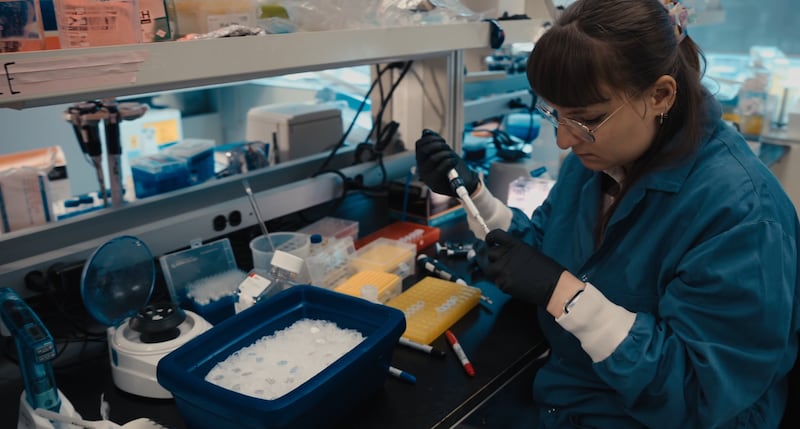
“Metabolism in cells is basically how we take the food into our body and turn it into energy for the cell to survive, and cancer cells also need to survive inside the body as well,” Twigger explained in an interview with CTV News Toronto.
“They’re hijacking our normal cell systems and they’re rewiring these in order to survive and grow inside the body, and we want to try and exploit this rewiring that causes them to be different from the normal cells of the body.”
In doing that, in exploiting that vulnerability, Twigger says their treatment could kill just the cancer cells and leave the healthy cells unharmed. She says they are trying to repurpose an already FDA-approved drug that has been on the market for years as a high blood pressure treatment for pregnant woman for this purpose, but testing is still in its initial stages.
“I’m testing it in a panel of different cancer cell lines, so we’re not specifically drawn to one cancer cell type. We’re hoping that this would be a treatment that could go for any kind of standard of care alongside this,” Twigger said.
The Toronto East Health Network says it does not have a formal program like UHN’s. However, there are a few universities in Quebec who have implemented a similar program, the Polaris Platform, to attract global scientists.
‘An experience’
Twigger moved to Canada at a time when Toronto was flush with World Series excitement, landing in the city around Halloween. She recounted how all of Toronto felt “alive,” which affirmed her decision in that Canada was, undoubtedly, going to be “an experience.”
Though it was hard to leave behind family and friends, Twigger could feel a sense of community when UHN held its anniversary event with its recruits, who were, at one point, asked to stand up. Scientists from different places in the world, researching different aspects, but united under one theme.
“You can see this central theme of the collaboration of the targeted therapy to improve patient outcome and response, and I think that’s really what the Canada Leads program is looking at,” Twigger said.
“Everyone can see that and talk about the similarities in that research was really a great part of the program for me.”

