Matt Serson can remember attending World Cup qualifying games in Toronto in the early 2000s where he would stand outside BMO Field and try to get a sense of how badly outnumbered Canadian soccer fans would be inside.
Back then, Serson was among a few dozen soccer fans who were members of a supporters group known as the Voyageurs and would travel frequently to Canada’s qualifying games.
Today that group has more than 3,000 members from coast to coast and many of them - Serson included - will be in attendance when Canada opens up its first ever World Cup on home soil in front of a crowd of 43,000 this afternoon.
“A lot of our home games felt like away games. We were surrounded by yellow when we played Jamaica and we were surrounded by blue when we played Honduras ,” Serson told CTV News during a recent interview. “I remember standing outside BMO watching fans come in whether it was Panama or Costa Rica or Honduras or Haiti and trying to get a gauge of like, ‘Once we get in there what is it going to be? Is it going to be 80-20 (in favour of the visiting team) or is it going to be 50-50.’”
Serson, who is based in Ottawa, figures that he has attended more than 50 Canada soccer games in his lifetime, with the earliest of those dating back to the first Varsity Stadium, where the national program often competed prior to its demolition in 2002.
His first memory, he says, was a failed effort to qualify for the 1994 World Cup that came down to a must-win match in Australia which wasn’t broadcast back in Canada.
- IN PICTURES: Here are the top players who could lead their team to glory
- IN PICTURES: FIFA World Cup mascots over the decades
“The day after the match I remember checking the paper, I was like 14-years-old and it (the score) wasn’t in there so the next day I had to look again and that is how I found out we didn’t qualify,” he said.
Canada qualified for its first World Cup in 1986 but failed to score a single goal during the tournament.
After that, the program went nearly four decades between World Cup appearances, only ending the draught in 2022.
Serson recalls “no shortage of heartbreak” during those years but he said a few losses do stand out, including a 2-1 defeat at the hands of Honduras in Montreal in September, 2008 in front of a sea of Honduran blue.
“Unfortunately, there was a sponsorship with BMO at the time and they handed out these blue inflatable thunder sticks so not only were the few Canadian fans there waving these blue sticks around but there was also the Honduras fans in all their blue gear,” he said. “There was momentum growing at that point and to show up in Montreal and be that outnumbered and have the Honduran fans be that much more vocal it was completely dejecting.”

‘It’s very surreal’
For years, being a soccer fan in Canada has often meant cheering for other nations.
Owing in part to the multicultural nature of the country but also the lack of success, at least for the men’s national program, fans have often chosen to support the countries they trace their lineage back to first and Canada second.
Searson said that while there was always a “vocal and passionate” group of Canada Soccer supporters, it was never particularly mainstream and $20 tickets in the south endzone of BMO Field were easy to come by.
As the program grew in popularity and so too did the Voyageurs, he said that a volunteer with the group was sometimes responsible for distributing up to 5,000 tickets via email, with a unique PDF attached to each. This was before the days of electronic tickets.
“I definitely did not think we would ever get to this point,” he said. “It is very surreal and it is almost emotional. It has really transcended from this very small slice of a supporter group and soccer community to really becoming mainstream. I have so many people in my life who are casual fans or are maybe European fans and now they are interested in Canada. They are asking me about the team, they are asking what are our chances and then the other thing is how do I get tickets? Can you get me tickets?”
Soccer has exploded in popularity
Soccer has exploded in popularity in Canada in recent years and is now played by approximately 50 per cent of young people, according to a report by Canadian Tire Jumpstart Charities.
Soccer, in fact, dwarfs hockey by participation rate (21 per cent), with more than one million Canadian youth registered with organized soccer programs.
Marco Antonucci played professional soccer for the Toronto Blizzard of the now defunct Canadian National Soccer League in the early 1990s and also represented Canada during the CONCACAF Under-20 Championship in 1991.
He says the game’s place in Canada and the attention around it has reached a level that he never thought possible during his playing days.
“Going through Canada Soccer and pro soccer in the late 80s and early 90s it was very, very grim. My father would say, ‘You have to go get work, get married and make some money.’ And I loved the game. But there just wasn’t anything there for us,” he said.
Antonucci said that when he was playing in the Canadian National Soccer League in the early 1990s the team staged its games in front of a few thousand fans at Centennial Stadium with “wooden bench seating” and a “little snack bar for game days.”
He said the environment was as “professional as it could be at the time” but a far cry from the infrastructure that now exists for promising soccer players in Canada.
“When I compare those games to today it is night and day. It is night and day at all levels,” he said. “To see these boys that grew up in all the same clubs that we sort of grew up in but with a better feeder system and with more exposure for these kids, like you know all the boys in Brampton playing for our World Cup team today, its just great to see.”
Antonucci has been a frequent attendee at BMO Field matches involving the Canadian soccer program over the years and has watched as interest exploded in the lead up to the 2022 World Cup, a breakthrough that he said still sends “shivers” up his spine.
He wasn’t lucky enough to get tickets to today’s game – ticket prices for Canada-Bosnia started at more than $1,300 each - but will be watching from home and reflecting on how far the program has come.
“To see where it is today and to think back to where we were in those days it is amazing. For guys that have been through the program, to see this, it’s going to be amazing,” he said.
‘The most important stadium in this country’
This afternoon’s game will be played in a revamped BMO Field fresh off a $146 million renovation, which included the addition of 17,000 temporary seats for the World Cup.
The stadium was built for the 2007 FIFA U-20 World Cup hosted in Toronto but has undergone multiple expansions since then, though it remains as one of the smallest venues ever to host World Cup games.
For this story, CP24 spoke with a number of fans and longtime observers of Canada Soccer and each one of them, without fail, identified the completion of BMO Field as an inflection point of sorts for the program.
“BMO Field finally gave Canada Soccer a home and that is what it remains to this day. It remains the most important stadium in this country,” Gareth Wheeler, a lead commentator for One Soccer who has reported on the national program frequently over a 20-year career in soccer media, told CP24. “Without BMO Field you probably don’t have Toronto FC and from that now we have the Canadian Premier League and a women’s league.. So you need to start somewhere and BMO Field was the start.”
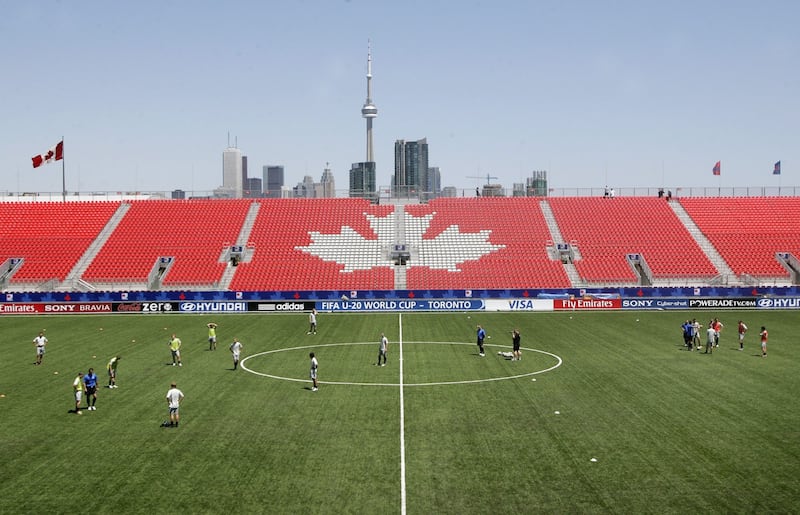
Wheeler’s soccer fandom also goes back to the qualification campaign for the 1994 World Cup and he recalls attending qualifying games for that tournament at Varsity Stadium as a child.
He said that there were lots of “dark days” when it felt like Canada “was stuck in the mud and was never going to be able to” compete among the world’s best, even after the arrival of BMO Field – losing 8-1 to Honduras “in embarrassing fashion” to end its hopes of qualifying for the 2014 World Cup is among his personal lowlights.
Wheeler, however, said that there was “always a glimmer of hope” among those close to the program who recognized that “we had the people, we had the athletes and we had the will and it was just a matter of who was going to step up and provide those pathways to opportunity” for elite Canadian soccer players.
As for this World Cup, Wheeler said that there will be a lot of pressure on Canada’s national team to manufacture the legacy themselves, given that there is limited infrastructure associated with the tournament and certainly nothing like what BMO Field represented when it opened in time for the U-20 FIFA World Cup.
“If we don’t have the brick-and-mortar, we need to have the hearts and minds so there is a lot of pressure on this team to perform and perform well,” he said. “If they can somehow go on the run that is what will make this World Cup special. They can kind of leave those lasting feelings and sentiments that can linger and last for a lifetime. That is the hope here, that memories are established and that can help continue to take the game forward.”

