Dozens of OPP officers who are injured and on leave are challenging a new way their benefits are determined, saying they are losing a lucrative tax refund and claiming that incorrect calculations have caused problems with their pensions, taxes, and even applying for a mortgage.
One accountant who has been filing appeals for them is concerned the lost tax refunds could add up to millions of dollars – though the OPP says it’s assisting any officers with any paperwork problems and hasn’t been told by Canadian tax authorities that anything is wrong.
“I filed 30 appeals for my clients based on what the OPP is doing and the whole financial situation,” said the accountant, Sheldon Rakowsky, in a recent interview with CTV News.
He said the issue appears to stem from how the OPP changed the way it calculated the benefits and salary top-ups for injured officers about four years ago, under a new system called “net average earnings.”
With the change, made after an arbitration decision, an employee on leave would get the same income as if they were working, and not more. In practice, this has meant some employees on leave are not receiving the same tax refunds that they used to, which has meant they are earning less, Rakowsky said.
Rakowsky believes the calculations of those figures in his cases aren’t following federal rules, he said.
“I’m contending a collective agreement cannot change the tax act,” Rakowsky said. “They feel they need to get rid of that refund and force these people either back to work or off the job.”
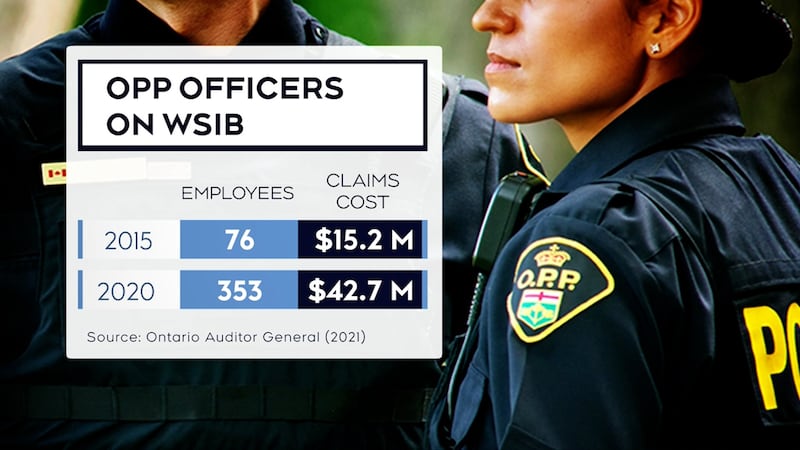
The OPP has not confirmed how many officers are on leave currently, but Ontario’s auditor general found in 2020 that number more than quadrupled in five years to 353 employees off, and its WSIB claims costs were $42.7 million, in large part to do with PTSD.
The OPP says in calculating benefits it’s just following an arbitration decision based on the OPP’s collective agreement with its members, and that’s what is showing up on the tax slips, called T4s.
“These changes were not made to negate income tax refunds, encourage members to return to work, or impact members in any way, as purported. They were implemented to ensure equivalency in the net income a member receives whether they are in the workplace or on an approved WSIB leave, and so that the non-taxable WSIB benefit amounts were not being taxed,” the OPP said in a statement to CTV News.
“We understand the CRA is in the process of reviewing, or has reviewed, the calculations. To date, there has been no direction to amend or eliminate the calculation or the reported salary on T4s,” the statement says.
At a gathering at Rakowsky’s office recently, officers on leave swapped stories about how the paperwork issues had affected them.
“There were times that I would call crying on the phone, it was so difficult,” said one officer, describing problems going to renew a mortgage because the stated income on her T4, didn’t match her employer’s letter of income.
Among the officers is retired detective Jarrod Hunter, who was on WSIB leave for the last years of his career.
“I experienced the fatalities, the child abuse, the sexual assaults,” Hunter told CTV News. “I was in a dark place. But what brought me out of it was my wife and a good support system.”
While he was on leave, he noticed something strange: his real income including benefit and top-up was about $120,000, but on his T4, the OPP declared his taxable income to be about $79,000, and about $9 in tax was deducted.
The WSIB benefit is not taxable, and so the tax refund to him previously would have been about $25,000. With the change, it was less than $9, he said. Hunter said he has heard from upwards of 60 officers with similar issues.
Hunter also complained to the provincial pensions watchdog, the Financial Services Regulatory Authority (FSRA), about how the new calculations are affecting his pension, he said.
FSRA wrote Hunter in a letter in April saying it would review his complaint. A spokesperson for the agency said it was “aware of the issue” but wouldn’t comment publicly.
“Our role is to enforce compliance with the Pension Benefits Act and help ensure members’ rights and entitlements are protected,” the spokesperson said.
The CRA also declined to talk to CTV News about its response to the complaints, citing taxpayer privacy. In a letter to Rakowsky on June 2, the agency appeared to dismiss concerns in one case.
“We understand that you feel you are entitled to a larger top up from your employer and acknowledge your ongoing dispute regarding the amounts of compensation your [sic] received. As these matters fall outside the jurisdiction of the CRA, we are unable to intervene,” a member from the appeals division wrote.
Rakowsky said he will continue the appeal in that case and others, saying the CRA dismissed the case too easily.
The OPP said it has provided letters to help any officers with problems at a bank stemming from the net average earnings changes.
“To assist our members with potential issues at financial institutions, the OPP provides letters to members with an approved claim. These letters addressed the income differential between the total T4 income and gross pay for their position. Updated letters are also provided, upon request. In some instances, the OPP was contacted for clarification. We would assist in resolving any concerns with the financial institution,” the statement said.
“We are not aware of any outstanding or further concerns to be addressed,” the statement said.

