Toronto mayoral candidate Brad Bradford says Sankofa Square was once the epicentre of the city, the “Canadian version” of Times Square and a place where people would celebrate festivals and gather with friends for a night out.
But now, he says it’s become something of a “wasteland.”
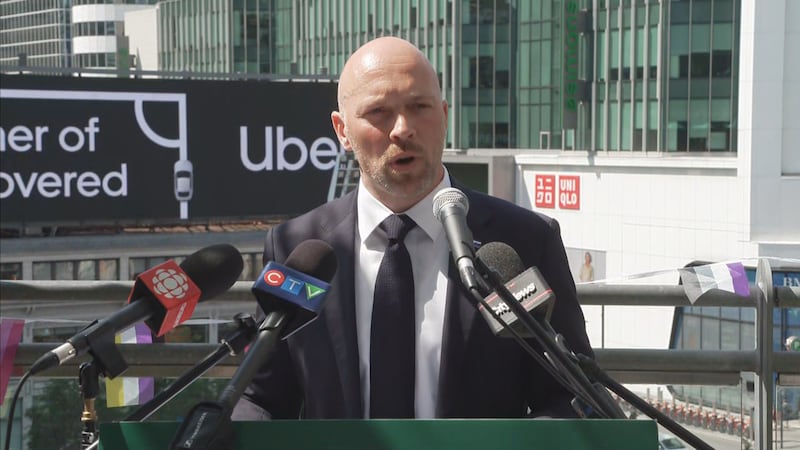
“It’s dirty, it’s unsafe. There’s open drug use in the middle of the afternoon. Tourists avoid it. Parents grab their kids by the hand and move quickly through the space, or even worse, they avoid it altogether,” Bradford said during a press conference on Monday as he pitched his plan to revamp and rename the square at the corner of Yonge and Dundas streets.
Bradford explained that — if elected — he would establish a permanent police substation at the square (similar to New York City) and publish clear cleaning and maintenance standards to keep the public space clean.
He said he would also establish a year-round programming calendar for events to draw families back to the square and feature celebrated Canadians on the space’s screens in between events and advertisements.
Bradford said he also wants to rename the space: Toronto Square.
The square officially changed its name from Yonge-Dundas Square to Sankofa Square in 2025, after city council received a petition signed by close to 14,000 people who took issue with its namesake, Henry Dundas, for his role in delaying the abolition of the trans-Atlantic slave trade. Dundas Station, which the square sits above, also changed its name to TMU Station, in reference to the nearby Toronto Metropolitan University. Dundas Street was not renamed.
The renaming of the square followed two years of “consultation, research and discussion,” according to city officials. As part of that process, a 20-member committee was formed that was made up of Black and Indigenous leaders, along with residents and business owners living and working along Dundas Street.
The name that was ultimately chosen, Sankofa, originates in Ghana and refers to the act of reflecting on and reclaiming teachings from the past, enabling people to move forward together, city officials say.
While he admitted that he voted in support of the renaming the square in 2023, Bradford said Mayor Olivia “misled” council about the changes to the space that would come with the name change.
“She gave everyone the impression that she had done the work on this, that she had worked with the board here at Young Dundas Square, that she had worked with community, and what we found out in the hours afterwards was that was in fact not the case,” he said.
Bradford said the expense of adding a police station, the name change, and the expanding of outreach and mental health supports for people in crisis at the square would be covered by “iconic” Canadian brands who advertise at the space, at “no cost to the property taxpayer.”
He also said he would skip the “expensive” consultation process of renaming the site, as the new name represents a “pretty benign” choice.
The cost to rename Dundas-Square was initially pegged at more than $300,000, but officials said in 2024 that associated costs could balloon by as much as $600,000. A survey from that year found that an overwhelming majority of residents disapproved of the decision to rename the square.
In a statement to CTV News, a spokesperson for Mayor Chow said she is focused on actions that make Toronto more affordable and safer, “not renaming things.”
“She believes all councillors should join her in focusing on these top priorities,” they said.
Torontonians will head to the polls on Oct. 26, 2026.
With files from CP24.com journalist Joshua Freeman

