


Keeping U.S. booze off of LCBO shelves has done “nothing to move the needle” on tariffs, a University of Toronto professor says, arguing that the province should drop the moratorium on American alcohol.
“The alcohol embargo has been in place at this point for almost a year-and-a-half. It has not moved the needle in any observable way,” Joseph Steinberg, a professor of economics at the University of Toronto, told Newstalk 1010 on Tuesday.
The ban, he said, was meant to “gain leverage” over the United States following a series of tariffs levied on Canada by U.S. President Donald Trump that targeted some key industries in Ontario and other parts of the country.
“There is no evidence we’ve got it,” Steinberg said.
“The only evidence that I see is that we are further behind than the closest comparable, which is Mexico. Mexico is at the table, negotiating with the United States… we are not.”
He said the ban has also given the U.S. president a “legal pretext under U.S. law for levying additional tariffs.”
The U.S. says it will charge a 50 per cent tariff on a wide range of Canadian goods, including some that are covered under the countries’ free trade agreement, later this month.
Officials in the U.S. have cited unfair trade practices, including provincial bans on U.S. booze, as justification for the move.
“This is something that I predicted would happen,” Steinberg said. “The ideal give up on this would have been months ago.”
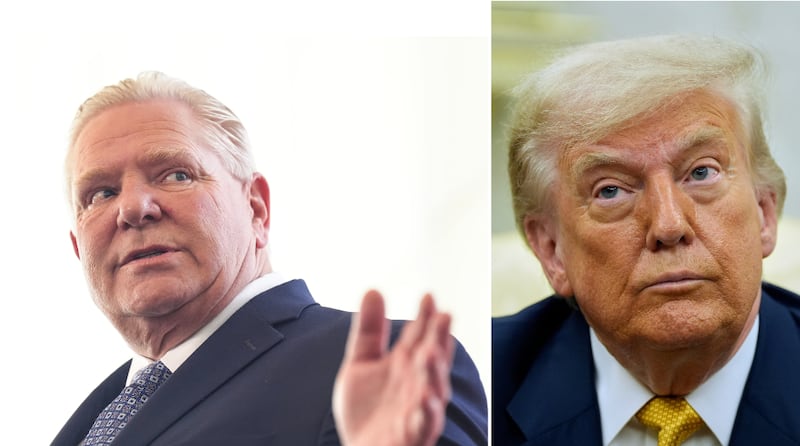
Last month, Ontario Premier Doug Ford confirmed the province had no intention of backing down on the booze ban, suggesting the province and the country need to “stand up to the bully.”
“We always seem to be on our back heels. We need to be on the offence. Not constantly on the defence with President Trump,” Ford said at a news conference in July.
“We need to hit him tariff-to-tariff, all the way across the board.”
Steinberg said the ban appears to be a policy developed based on “emotion” rather than “logic.”
“I think this is worse than a tariff in the sense that 1.) It doesn’t generate any tax revenue at all and 2.) A tariff at least leaves consumers some choice,” he added.
Ontario is not the only province to strip liquor store shelves of U.S. booze.
Both Saskatchewan and Alberta initially banned U.S. alcohol but have since returned American booze to the shelves.
Quebec and British Columbia have kept up bans on U.S. alcohol.
With files from The Canadian Press

