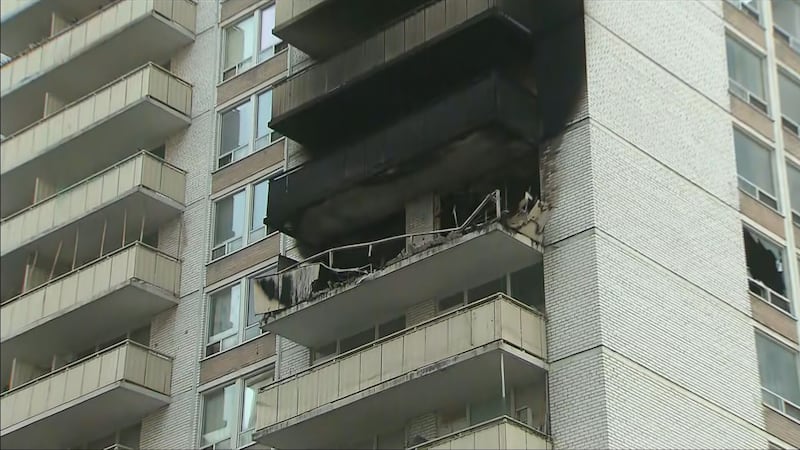
A two-alarm fire that broke out at a city-run shelter highrise in Etobicoke early Wednesday morning involved lithium-ion batteries that were charging, officials said.
Toronto Fire Services Platoon Chief Peter Rappos said crews were called to 2180 Islington Ave. at 5:30 a.m. for reports of heavy smoke.
Firefighters encountered smoke on the seventh floor, Rappos said, and with the help of the building’s sprinkler system, crews extinguished the fire shortly after.
No injuries were reported, but Rappos noted that one person was transported to the hospital with unrelated injuries.
TFS Chief Jim Jessop told CP24 the fire involved lithium-ion batteries that were charging. In a video he posted on social media, it shows burnt batteries.
Rappos later confirmed that a quantity of lithium-ion batteries was removed from the unit, although the cause and circumstances of the fire are still unknown.
Wednesday’s fire is the second reported incident in the last 24 hours related to a lithium-ion battery.
Four people, including two children, were taken to the hospital on Tuesday morning following a highrise fire in St. James Town. TFS said e-bikes were on the balcony of the unit of origin, and lithium-ion batteries were inside.
76 incidents involving batteries so far
Rappos shared on Wednesday that there have been 76 fire incidents involving lithium-ion batteries this year, reflecting a 35 per cent increase from 2025. Rappos said two have died and 14 have been injured in connection with those incidents.
“While lithium-ion batteries are generally safe, improper disposal and storage of these units, charging of these units can cause incidents,” the platoon chief said.
“Right now, it doesn’t appear that there is a bigger increase in the summer or the wintertime, but there are different factors that again can cause batteries to go into a thermal runaway. One of them could be improper charging. Some of it could be storage outside of hot and cold cycles. Improper tampering of the batteries—that’s a big concern for us—is that people don’t tamper with their batteries as well.”
Chief Jessop has been sounding the alarm about the rise of lithium-ion battery fires in the city, which appears to be on track to have at least 100 incidents this year.
That would be a nearly 250 per cent increase from 2022, when TFS responded to only 29 lithium-ion battery fires.
Jessop has said fire service investigations have found the primary reason the lithium-ion batteries go into thermal runaway, a phenomenon which results in a fire, is because they are “not required to meet a standard or a regulation, unlike your cell phone batteries or your laptop batteries.”
The chief urged residents to only choose certified batteries, charges, e-bikes, and scooters and never charge them near an exit or sleeping areas.
Chief calls for federal battery regulations
Jessop explained that when these batteries overheat and ignite in a room, it causes a flashover in less than 90 seconds, leaving occupants with less time to evacuate.
He recounted that in recent incidents, firefighters encountered e-bikes bursting into flames as they were doing primary searches.
“It is without question the most evolving public fire safety risk in Canada’s largest city, which is why we have been doing everything within our jurisdiction and our power at the City of Toronto to bring this type of awareness forward to the citizens of the risk that these uncertified batteries are having, and the risk they’re also, to be very honest, putting my firefighters at risk,” Jessop said in an interview with CP24 on Wednesday afternoon.
The fire chief said he has reached out to the province and the federal government to advocate for establishing standards for batteries, especially those being imported to Canada, as well as possible amendments to the Ontario Fire Code, including a limit on the number of e-bikes or lithium-ion batteries stored in apartments.
“We’ve actually had fires where, when the fire has been extinguished, we’ve counted over a dozen in a single unit, both inside the unit and on the balcony,” Jessop said, adding that he is hoping that both levels of government immediately address the growing issue.
“It is very challenging, and to your point, at this point there are no rules. There are no federal regulations in terms of the types of batteries that can be imported or sold. There are no provincial regulations limiting, you know, the type of storage or the amount that can be stored.”
In the meantime, Jessop said his fire inspectors are handing out information about battery safety during their annual highrise inspections. He added that TFS has also invested in public service ads.
“We’re working with the largest landlords in the city of Toronto, providing that guidance, providing those recommendations,” he said.
“But in the absence of regulations, which there are none, all we can do at this point is continue to try to educate the public on the risks and to take every step we can through public education to limit both the probability and the consequence of these fires.”
With files from CTV News Toronto’s Joshua McGinnis
Correction
This article has been updated from a previous version that misspelled the last name of TFS Platoon Chief Peter Rappos.

