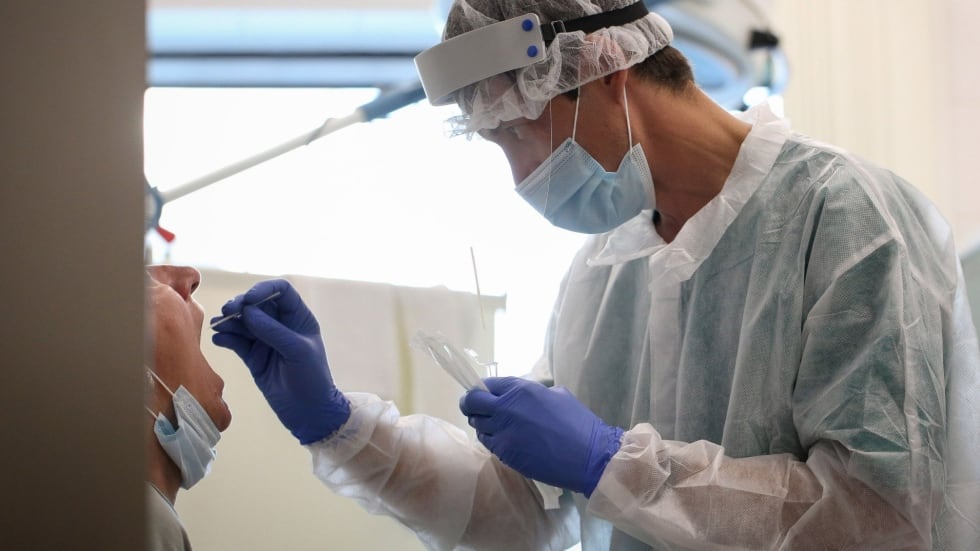
The use of rapid, on-site testing at long-term care homes in Canada could prevent 8,000 emergency department visits every year, according to the findings of a recently published trial.
After witnessing the devastating impact the COVID-19 pandemic had on long-term care facilities and their residents, the trial’s co-principal investigator said researchers wanted to explore whether point-of-care testing could mitigate outbreaks among residents or reduce emergency department visits.
“One of the things we’ve known for a while is that testing for respiratory viruses, which could include COVID, influenza, or RSV, some of the main viruses that cause resident complications each respiratory season during the late fall and winter, is really not meeting the needs of many homes, which often wait days to get results,” Dr. Jerome Leis, medical director of infection prevention and control at Sunnybrook Health Sciences Centre, said. He added that average turnaround time in the province ranges from three to seven days.
That delay stems from several factors, including high demand and the distance a specimen must travel between a long-term care home and a regional lab. Desktop rapid-testing equipment, by contrast, can deliver results in about 35 minutes.
The findings of the PROMPT-LTC clinical trial were published July 6. The trial ran from Nov. 12, 2024, to May 2, 2025, spanning the height of RSV season, and involved 20 long-term care homes. Respiratory syncytial virus (RSV) can cause infection of the lungs and respiratory tract, exhibiting symptoms like a sore throat and runny nose.
Ten used on-site PCR testing while the other 10 continued using standard, off-site testing. Polymerase chain reaction (PCR) testing takes genetic samples to determine if a specific virus is present, which in the case of this trial, is either COVID-19, influenza or RSV.
Baycrest was among the facilities that used the on-site equipment. Mide Seyi-Ajayi, executive director for Apotex Centre, Jewish Home for the Aged, said staff learned to use it quickly, without significantly changing their workload.
“They already know nasal swabs, they already know how to package samples to send out for testing,” Seyi-Ajayi said. “Rather than sending it out, they do the testing in-house.”
What were the results?
The rapid-testing system appeared to help residents: the trial saw an 11 per cent reduction in emergency department transfers for respiratory infections, equivalent to about four fewer transfers per 100 beds. Scaled up, that would translate to roughly 8,000 fewer transfers across Canada between November and March each year if the testing were adopted more broadly.
At the height of respiratory virus season, seen in December and January, the study found a 28 per cent reduction in hospital transfers or deaths per 100 beds.
The faster results also streamlined workflow for staff, allowing treatment to start sooner.
“To be able to communicate with the resident, communicate with the family, the other team members, to say it’s a confirmed case, not just suspected, you can start treatment,” Seyi-Ajayi said. “For influenza, for example, they could start Tamiflu on an earlier timeframe.”
The trial found that residents with the flu began receiving antiviral therapy within 0.5 days on average, compared with roughly three days under standard testing.
“On the flip side, if the results come back negative, there are ways to support the resident so they don’t have to be in isolation longer than needed,” Seyi-Ajayi said, noting that residents no longer have to remain isolated for days while awaiting results.
Were there fewer outbreaks?
“We weren’t able to measure a difference in the size of outbreaks themselves, but we think the reason the outbreak size wasn’t that different is because the intervention homes were actually testing more than twice as often,” Leis said.
Homes with on-site PCR testing tested an average of roughly four times per week, with a 39 per cent positivity rate. Meanwhile, homes using standard testing tested about 1.73 times per week, with a 75 per cent positivity rate.
The higher positivity rate in standard-testing homes suggests staff were testing only residents who were clearly symptomatic, the study finds. Homes with rapid testing, by contrast, could use their equipment on “suspected” cases as well.
Leis said that although no difference in outbreak size was measured, the true case count in standard-testing homes was likely underestimated. In his view, the trial’s key lesson is that the current system sets too high a bar for testing.
“At the same time a test is sent, a resident has to be isolated in their room to await the result to determine whether or not they can be cleared,” Leis said. “There may be other reasons besides slow turnaround times, but it does affect how much testing happens, which means we’re likely missing residents with less severe symptoms.”
Seyi-Ajayi noted that outbreaks can also originate outside a facility’s control. Baycrest, for instance, is open to visitors who could unknowingly introduce respiratory illness. Even though the home may not have seen fewer outbreaks, he said early identification of illness still benefited residents.
“What this study has done is actually just validate some of our assumptions in a more scientific, evidence-based way,” Seyi-Ajayi said, noting that early detection helps prevent the more severe consequences of respiratory viruses.
Leis said the benefits could justify the upfront cost of implementing rapid-testing instruments more broadly, especially since staff training can be completed relatively quickly.
“The number of avoided transfers to hospital is a really important outcome,” Leis said. “If you were to scale that benefit across the province of Ontario, there would be over 3,000 transfers to the emergency department avoided each respiratory season.”

