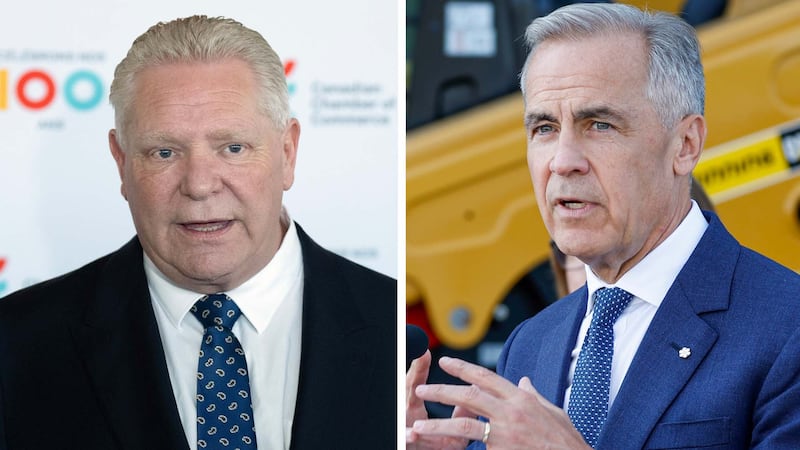
Ontario Premier Doug Ford is doubling down on Prime Minister Mark Carney’s decision to suspend trade negotiations with the United States, saying Canada must respond forcefully after new U.S. tariffs took effect Saturday.
“Team Canada needs to stand together more united than ever before,” Ford said in a post to social media late Friday. “The prime minister has my full support for a strong response — tariff for tariff, dollar for dollar.”
The comments came after Carney suspended negotiations with the U.S. just minutes before a midnight deadline, saying last-minute changes proposed by Washington were “unfair, uneconomic” and raised questions about the reliability of any potential deal.
The United States has now imposed 50 per cent tariffs on roughly US$20 billion of Canadian goods, including products such as cement and hockey sticks. Carney has pledged to match the measures “dollar for dollar.”
Here’s the latest from Ontario’s premier.
‘It was a bad deal’
Speaking to CP24, Ford framed the tariff dispute with the U.S. as an “economic war” and repeatedly stressed that Canada needs a united national response.
He says that he’s always said the country needs to fight “tariff to tariff, dollar to dollar.”
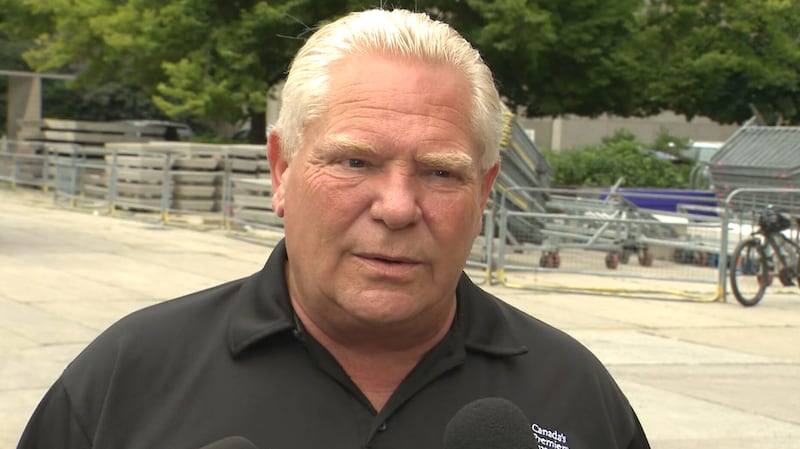
“We never started this fight, but I can assure you, we’re going to win this fight. We’re going to be united Team Canada,” Ford said.
He also defended rejecting the proposed deal as necessary to protect Ontario’s key industries: “I’m glad he didn’t sign that deal because it was a bad deal… for the auto sector, the steel sector, and manufacturing sector."
“I wasn’t prepared to put steel workers and auto workers… in uncertainty. I want to give them certainty that when we work together and we put political stripes aside, we cannot be stopped anywhere in the world," he added.
Ford’s letter to Carney
The premier had largely remained quiet in recent days as negotiations continued, but a letter sent to Carney on Monday and released by Ford’s office Saturday offers a clearer picture of Ontario’s position.
Ford told Carney that “no deal is better than a bad deal” that could encourage the United States to seek further concessions from Canada.
“We cannot allow arbitrary deadlines, shifting justifications or escalating tariff threats to weaken our resolve,” Ford wrote.
Ford also called on Ottawa to prepare for further escalation, emphasizing Ontario would not support removing its existing retaliatory measures without a deal that provides “significant relief” for Ontario workers, businesses and key sectors.
Carney says talks changed at the last minute
Also speaking to reporters on Saturday, Carney provided more details about why negotiations broke down.
He said the United States made last-minute changes involving the auto sector and sought to restrict Canada’s ability to pursue trade agreements with other countries.
“The Americans wanted to limit it to autos only, not include medium and heavy duty trucks which is a big change, obviously,” Carney said.
He also described the U.S. push to influence Canada’s other trade relationships as “a power play.”
Carney said Canada had been preparing for the tariffs and would now focus on strengthening the domestic economy while expanding trade with other countries.
“You’re at war when you get attacked. We got attacked,” Carney said when asked why it feels like today, Canada is entering a full fledged trade war.
“We’ve got the reserves. We’ve got the resilience,” he added.
Ontario wants more leverage
Meanwhile, Ford’s letter also urged Ottawa to use some of Canada’s biggest economic advantages as leverage, including electricity, energy and critical minerals.
He called on Ottawa to consider additional retaliatory tariffs targeting imports from key U.S. states, including Texas, Florida, Wisconsin and Alabama.
Ford argued that federal government should provide additional support to workers and businesses affected by the tariffs and pursue measures to make Ontario industries more competitive.
Among his requests is regulatory relief for the automotive sector, including changes to federal greenhouse gas emissions standards that Ford says could help protect thousands of jobs.
Ford’s message to Ottawa also came with a warning, Canada should not accept a deal simply for the sake of ending the dispute.
“Canadians expect governments to stand together in the face of economic threats,” Ford wrote.
“Ontario has consistently demonstrated that commitment and will continue to work with the federal government to defend Canadian workers, businesses and communities.”
GTHA mayors respond
Patrick Brown, the mayor of Brampton, Ont., also commended the prime minister’s decision not to accept a bad deal and to match the new U.S. tariffs.
“This is not a trade war that we have asked for. Unfortunately, we’re in it because of the misguided policies of Donald Trump. But it doesn’t mean we should take it lying down,” Brown said in an interview with CP24 on Saturday afternoon.
“When I hear the premier and the prime minister say ‘tariff for tariff,’ it’s our only recourse. We can’t continue to be bullied by this president.”
The mayor noted that the reported terms of the deal that included permanent tariffs on the auto sector wouldn’t have brought the jobs at the Stellantis Brampton Assembly Plant, which has been idling since 2023.
Last week, Unifor claimed that Stellantis was seriously considering closing and selling the plant.
“Stellantis made it clear to me that as long as there are tariffs, there was no business case for auto production in Canada, and they were leaving until tariffs were lifted. So, I’m glad the prime minister didn’t accept a bad deal,” Brown said.
“It would not have salvaged the auto sector in Canada.”
Andrea Horwath, the mayor of Hamilton, which is responsible for approximately 60 per cent of Canada’s steel output, said in her initial statement that the breakdown of negotiations is “extremely concerning” for her city’s businesses and workers.
“As a steel and manufacturing city with a significant agricultural sector, we know the uncertainty ahead will be stressful for many Hamiltonians,” Horwath said in a statement.
Horwath released an updated statement on Saturday afternoon following Carney’s news conference and said she fully agrees with the decision to reject the deal.
“Hamilton is well positioned to help lead Canada’s economic diversification, strengthen interprovincial trade and national supply chains, expand direct access to global markets, and create opportunities across our steel, advanced manufacturing, agriculture, life sciences and other key sectors,” the mayor said.
“I have reached out to the Premier, as well as business and union leaders, and will continue those conversations in the days ahead as I continue to advocate for Hamilton’s workers and businesses.”
Toronto Mayor Olivia Chow said in a statement that the city is ready to support Canada’s response to the new U.S. tariffs and will work with both levels of government to protect local jobs.
“These repeated tariff threats are designed to create uncertainty and weaken our resolve. But as Torontonians, we always stand up for each other. We can each do our part by buying local and supporting local jobs. We’re strong, caring, resilient, and proud to be on Team Canada,” Chow said.
With files from CTV News’ Devika Desai and Luca Caruso-Moro.

