The GTA housing market may be starting to stabilize but how quickly a home sells still depends heavily on location and property type, according to a new report.
New data released by digital real estate platform Wahi this week shows a sharp divide in how quickly homes are selling across the region, with some family-friendly neighbourhoods finding buyers in as little as 10 days while homes in luxury and condo-heavy communities are sitting for months.
“There is no Canadian housing market. It’s sort of a bunch of different housing markets that behave really differently… and we sort of see the same thing within Toronto,” Wahi economist Ryan McLaughlin told CP24.
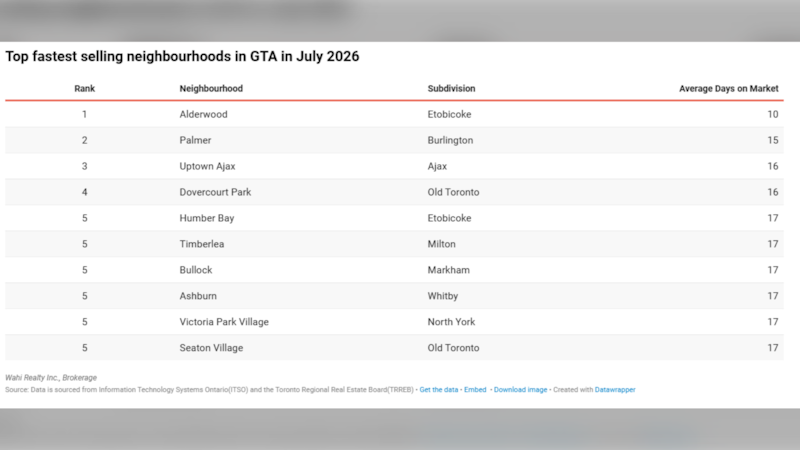
According to Wahi’s analysis of MLS data, Alderwood in Etobicoke was the GTA’s fastest-selling neighbourhood in July, with homes spending an average of just 10 days on the market.
Palmer in Burlington followed at 15 days, while Uptown Ajax and Dovercourt Park in Toronto both averaged 16 days.
Humber Bay in Etobicoke, along with neighbourhoods in Milton, Markham, Whitby, North York and Toronto, rounded out the top 10, with each averaging 17 days or less.
The slowest-selling neighbourhoods
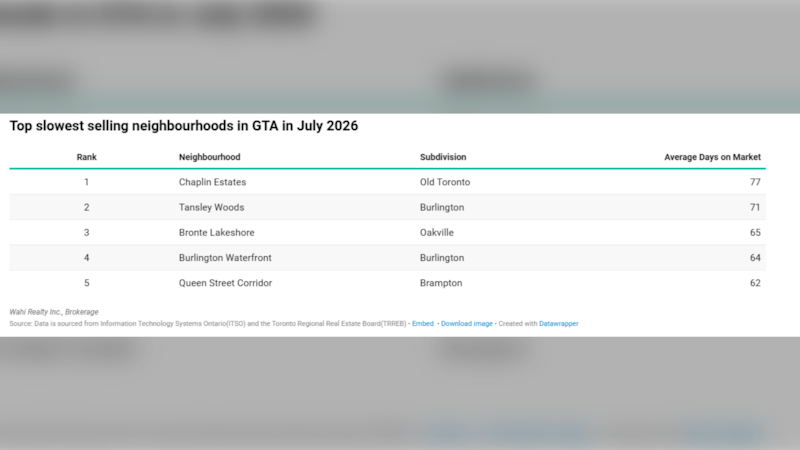
At the other end of the market, homes in Chaplin Estates in midtown Toronto took an average of 77 days to sell.
Tansley Woods in Burlington followed at 71 days, while Bronte Lakeshore in Oakville averaged 65 days.
Burlington waterfront properties spent an average of 64 days on the market, while homes in Brampton’s Queen Street Corridor averaged 62 days.
McLaughlin said the contrast reflects, in part, the types of homes being sold in different neighbourhoods.
“When I look at the ones that are moving quickly, they’re very often neighborhoods that are filled with a certain type of product… family-friendly, ready to move in, either single-family or row homes,” he said.
“Move-in ready… buyers are really looking for the ability just to move in. They don’t want to do renos."
The slowest-selling areas can have a very different mix of properties, including high-end homes and condos.
“The GTA is… being dragged down by the condos,” McLaughlin said, pointing to a large amount of new condo supply coming onto the market.
He said smaller condo units are particularly difficult to sell, describing them as “shoebox apartments” that are “really struggling.”
‘It’s not over yet’
Wahi’s July figures also show the gap between the fastest- and slowest-selling neighbourhoods narrowed significantly from June.
The fastest-selling neighbourhood averaged six days on market in June, while the slowest averaged 126 days.
Wahi only includes neighbourhoods with at least five transactions in its rankings.
McLaughlin said the threshold helps prevent one unusually slow sale from skewing the results.
The data comes as the broader GTA market shows early signs of tightening.
Earlier this month, the Toronto Regional Real Estate Board said fewer homeowners are putting their properties up for sale, a shift that could help move the market closer to balance.
In 2025, the GTA recorded just 62,433 home sales, the lowest annual total since 2000, according to TRREB.
McLaughlin said the housing market could be approaching a turning point, although much will depend on interest rates, inflation and federal policy.
“It’s not over yet for the condos,” he said. “Eventually these things are going to complete… and then maybe you can start thinking about, OK, has this market finally suffered enough?”

