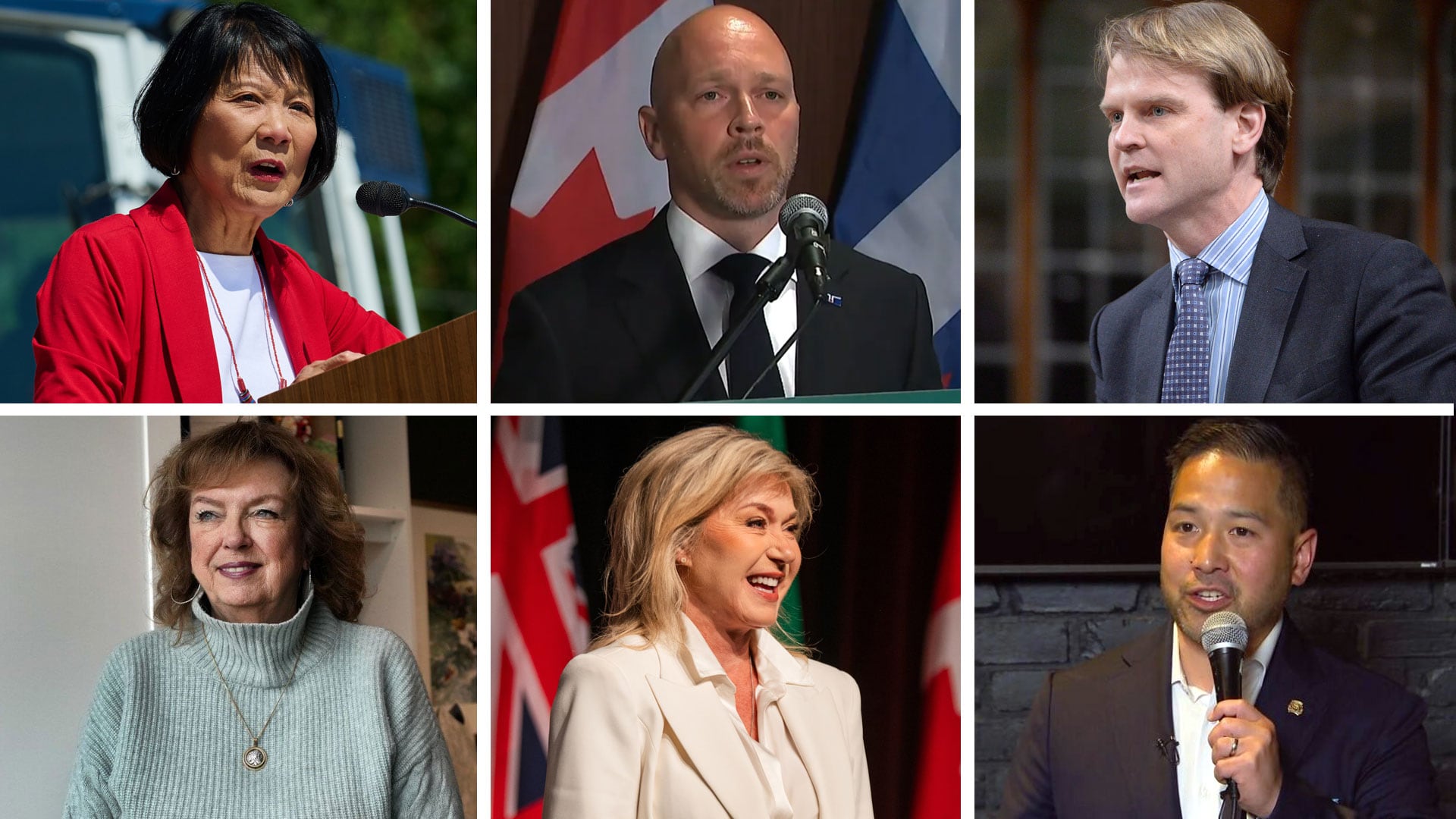
As the trade war deepens, mayoral candidates across the GTA are pitching their plans to protect small businesses, with several measures ranging from tax relief to enhanced “buy local” initiatives.
The proposals come as new U.S. tariffs of up to 50 per cent and looming Canadian counter-tariffs on a wide range of U.S. goods put pressure on exporters and businesses that rely on cross-border trade, creating uncertainty around costs, jobs and access to the American market.
The latest:
- Trump executive order renames Lake Ontario. Live updates here
- A list of items the U.S. is slapping with a 50 per cent tariff
- A list of U.S. goods facing surtaxes from Canada
Here’s a sampling of what some candidates in Toronto and Mississauga are proposing.
City of Toronto
Toronto mayoral candidate Olivia Chow is urging residents to support local businesses and buy Canadian, while pointing to measures already implemented by the city.
“Trump’s trade war is just bad business,” Chow told reporters Thursday morning, warning that continued tariffs could raise grocery prices even higher for Torontonians.
Chow pointed to Toronto’s Economic Development and Growth in Employment (EDGE) program, which provides property tax relief to eligible businesses that expand and create jobs.
Since launching in January 2025, she says the program has approved eight projects representing about $220 million in construction investment, with 583 projected new jobs and 725 retained jobs.
Chow says more than 98 per cent of Toronto’s procurement spending already goes to Canadian companies and that the city increased its small-business property tax reduction to 20 per cent in 2026.
In an email to CTV News, her campaign criticized rival Brad Bradford over past council votes involving American companies, including Uber, Lyft and Tesla.
Bradford, meanwhile, is proposing 25 per cent property tax relief for roughly 3,500 industrial businesses for every year the trade war continues. It’s a plan he says will help business owners “weather the storm and keep people on payroll.”
“Toronto isn’t broken. It’s stuck,” Bradford said, arguing the city needs to move faster on permits, procurement and business support.
He is also proposing a permanent tariff-response table bringing manufacturers, workers and industry representatives together, as well as faster approvals for businesses expanding or modernizing facilities.
Meanwhile, Toronto mayoral candidate Chris Alexander is proposing a seven-step action plan focused on expanding the city’s existing EDGE program, attracting investment, helping existing businesses manage cash-flow pressures.
“We want to expand (the EDGE program) to give back — to reimburse commercial property taxes for business owners that are starting new businesses,” Alexander told CP24 in an interview.
He is also proposing the city establish a “small-business bridge-support program” involving credit unions and the Business Development Bank of Canada to provide financing to businesses facing short-term cash-flow problems because of tariffs.
Alexander says he would cut municipal licensing costs by 30 per cent for street vendors, farmers’ markets and other small businesses, while seeking to lower Toronto’s commercial-to-residential property tax ratio “in the shortest possible timeframe.”
He also told CP24 that he would “definitely not” raise residential property taxes during his first two years as mayor.
“Torontonians have gone through 20 per cent of property tax increases in only three years — that’s too much,” Alexander said.
City of Mississauga
In Mississauga, incumbent Carolyn Parrish says the trade dispute is particularly concerning because of the number of local jobs tied to U.S. trade.
Speaking to CP24 on Wednesday, she noted that about 89,000 Mississauga jobs are connected to U.S. trade, with sectors including automotive, machinery, electronics, plastics, furniture, steel and aluminum among those exposed.
“We’re very concerned,” Parrish said. “It is a huge worry. It’s a big part of our economy.”
Parrish said the city is examining the possibility of providing a property tax subsidy or holiday for small businesses affected by tariffs.
One of her opponents in the Mississauga mayoral race, Bonnie Crombie, released a detailed proposal Thursday morning, calling for “interest-free property tax deferrals” on the city portion of qualifying commercial and industrial taxes for businesses directly affected by U.S. tariffs.
She says her plan would also require the city to pay qualifying local small and medium-sized vendors within 15 days and make Buy Canadian and Made-in-Mississauga procurement permanent and measurable.
“Washington may set the tariffs and Ottawa may negotiate trade agreements, but Mississauga is not powerless,” said Crombie. “City Hall controls hundreds of millions of dollars in purchasing.”
Crombie is also proposing a Mayor’s Tariff Action Team with a 48-hour response commitment when major employers face significant job or investment decisions.
Alvin Tedjo, the Clarkson-Lorne Park councillor and mayoral candidate, released a video this week saying Mississauga should use the trade dispute as an opportunity to diversify its economy.
Tedjo says one in five Mississauga jobs depends on trade with the United States, but argues the city has the workforce, industrial base and supply-chain infrastructure to attract new investment.
His proposed response includes helping businesses navigate existing trade-support programs, encouraging residents to “defend with your dollars” by buying Canadian and using city leadership to attract investment from domestic and international markets.
“I will always stand up for Canada,” Tedjo says in his campaign video.

