
If you’ve looked up at the sky in recent weeks, you might have noticed a familiar insect crowding the airspace.
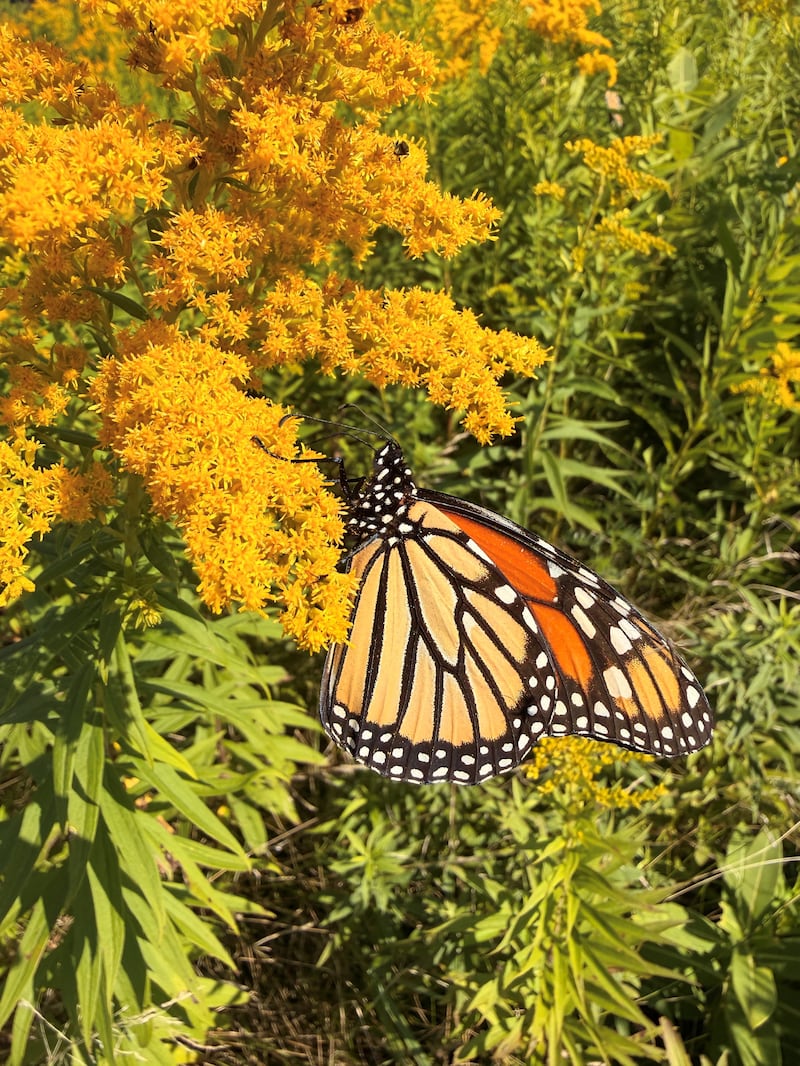
Monarch butterflies are out in full force as the summer winds down and they start to migrate south to the highlands of central Mexico, where the current generation will spend the winter.
But some on social media, including a recent Reddit post, are wondering if there are more monarch butterflies out around Toronto, than in previous years.
One expert confirms that numbers are currently up, but that doesn’t mean it will stay that way.
Ryan Norris is an associate professor in the Department of Integrative Biology at the University of Guelph. He said the reason people are seeing a lot of monarchs is because there happened to be a high production of them this year. But he admits the reason why isn’t clear yet.
“It could be because there were really good spring conditions,” he told CP24.com. “Those spring conditions produced a good crop of first-generation monarchs and that kind of propagated its way through the spring and the summer, and we’ve ended up with a massive last generation.”
Whether those numbers stick depends on how many make the journey south to Mexico, where they are counted by researchers in February.
“The only way to get a really good estimate of all of the eastern North American monarchs is when they’re all together in the same place,” Norris said.
In March research from WWF Mexico that tracked monarch butterflies found a spike in numbers between 2024-2025 and 2025-2026. In 2025 - 2026, scientists found monarchs occupied 7.24 acres of forest versus 4.42 acres the previous winter. That shows a 64 per cent increase of monarchs during the period, compared to 2024-2025.
Ideal conditions in Ontario help numbers
While the numbers may be up this year, they don’t reflect their numbers as a whole species.
As of 2023, Monarch butterflies are listed as endangered in Canada, under the federal Species at Risk Act
The research on monarch migration and their population numbers dates back 40 years, Norris said, which shows that the overall population size is declining. He calls this year’s boom in numbers a “recency bias”, since a few years ago, the numbers were much lower.
“People don’t necessarily remember the number of monarchs that were around 30 years ago,” he said. “As a whole, 30 years ago, there were more monarchs.”
Don Davis is a community scientist who’s been tracking monarchs since 1984. He uses paper tags, which aren’t as advanced as the devices Norris and his students use to track. For Norris’ research, he uses a air tag-like device, which is secured to the insect’s thorax – the body between the wings - that can then be tracked on an app called “Project Monarch”.
Davis suspects that this year’s “great migration” has a lot to do with excellent conditions in the northern breeding range.
“We haven’t had to deal with droughts,” he explained. “We’ve had more than enough moisture, but there’s abundant tender milkweed on which the monarchs lay their eggs, and abundant nectar sources.”
He added that along with Ontario, the monarch population has also spiked in southern Saskatchewan, Manitoba and Quebec.
Davis said that Torontonians can expect to see monarchs out in large numbers for at least the next few weeks.
“It’ll start to decline towards the end of September,” he said. “But in good years I’ve seen monarchs right on into October.”

