


Eyes burning. Throats searing. Heads aching.
Many outdoor workers sweated through the heat and haze on Thursday, clocking hours even while others stayed home amid health concerns as wildfire smoke continued to waft across Ontario.
Environment Canada said the air quality in Toronto was “very high risk,” with warnings in place from Thunder Bay to Windsor and Kingston. An orange air quality warning continued to cover a wide swath of the province, signalling “very poor air quality,” the department said, as dozens of forest fires burn out of control across northwestern Ontario.
Landscaping labourer Andre Carreira says he and seven co-workers at Hi-Rise Garden continued to plant boxwood shrubs in Toronto on Thursday afternoon, working in the shade and wearing respirator masks.
“If any of the workers felt anything, if we had trouble breathing, we were told to stop, collect our breath, go inside, hydrate,” he said, standing beside his boss.
Another four workers were also on the job in another part of the city, he said.
“I wouldn’t say it’s too bad.”
A few hours west near Goderich, Ont., Nick Passmore stood on a ladder staining a wraparound balcony on a large cabin in the late afternoon heat.
“It smells like campfire and it’s pretty smoky here,” he said. “Anything that’s black, you can see ash on it ... I could see it on my truck in the morning — very, very fine particles.”
Passmore, who owns Elevate Paint & Stain, said his throat felt sore after several hours of work the day before.
“I don’t really have a choice,” he said, noting he runs a one-man operation.
Passmore considered wearing a mask, but ultimately opted not to. “It’s hot on your face and annoying to work in all day.”
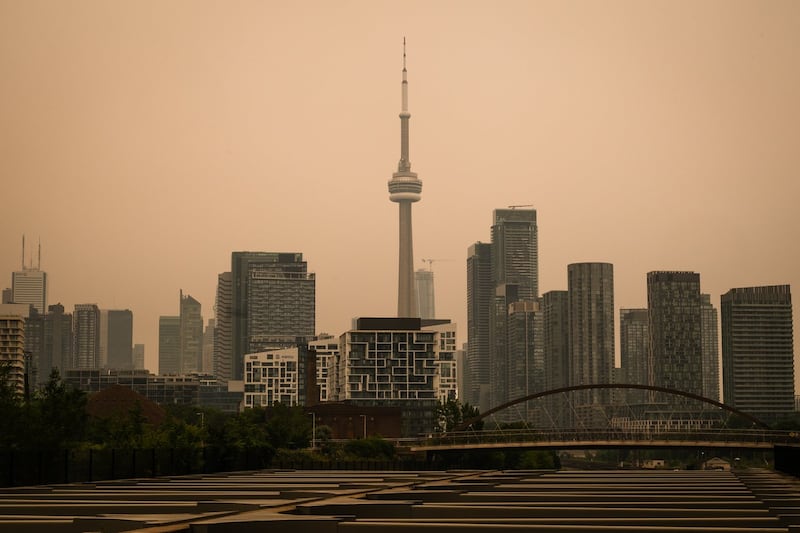
Devastating wildfires have raised health concerns and caused event cancellations in communities across the province as a smoky orange haze lingered in the southern Ontario sky for another day.
Camp counsellors, lifeguards and other staff at many municipal programs and venues stayed home or changed plans mid-week.
The City of Toronto cancelled all municipal day camp field trips Wednesday and moved camp and daycare activities indoors Thursday. Outdoor swimming and wading pools remained closed, with the city’s air quality rating of 10-plus on Thursday afternoon marking the worst possible score Environment Canada can assign.
Windsor closed its sports fields, parks and washrooms, while London postponed or delayed several outdoor events.
Thunder Bay has shuttered its outdoor pools, beaches and splash pads as well as golf courses and marina services, and kept park staff home though the green spaces remain open.
Winds out of the northwest could fan the flames of dozens of forest fires that have already devastated communities, including one fast-moving blaze that damaged and destroyed homes and buildings on Namaygoosisagagun First Nation, also known as Collins First Nation, north of Thunder Bay.
Ontario has asked the federal government to be ready to help evacuate communities by aircraft across northwestern Ontario. Some 15 communities have already started evacuations or begun to consider them, according to a letter from provincial Emergency Preparedness Minister Jill Dunlop to federal Emergency Management Minister Eleanor Olszewski.
Premier Doug Ford has said crews and aircraft are hard at work fighting more than 180 wildfires across northern Ontario, and the province will spare no expense in keeping people safe.
Aircraft marshallers and baggage handlers were among the workers who saw no relief this week. In Toronto, they worked through temperatures that hit 33 C on Wednesday, with the humidex rising to the high 30s.
“The airport is ensuring those working outdoors are staying safe in this weather,” Toronto’s Pearson airport said in a statement on social media platform X.
Downtown, Chris Smith, who runs home building company Woodsmith Construction, said he cancelled work on two of his company’s four projects for the day, calling the weather “brutal.”
“My eyes were burning all day on the job sites yesterday. I had a massive headache at the time I came home,” he said Thursday.
Several workers left the site early on Wednesday, heeding Smith’s instructions: “If you started feeling light-headed in any way, head home or head inside.”
Now, jobs to install siding and build a porch and deck have been pushed back to next week. Employees tasked with indoor work in an air-conditioned space carried on, he said.
“It’s a holdup at the time of year where we’re trying to get the most work done every single day.”
This report by The Canadian Press was first published July 16, 2026.
Christopher Reynolds, The Canadian Press
— With files from Allison Jones and Kathryn Mannie in Toronto

