Barely any of the fentanyl seized in the United States originates from Canada, according to a new report from U.S. think tank the Manhattan Institute.
Published on Canada Day, the study examined thousands of large-scale fentanyl seizures across 80 U.S. counties along the Canadian and Mexican borders.
They found that by weight, about 99 per cent of fentanyl pills, capsules or tablets and 97 per cent of powder, resin or tar gathered in large, land-boundary seizures between 2013 and 2024 were discovered in U.S.-Mexico border counties, and that large Canadian-border seizures were “relatively rare.”
While stark, that percentage is not out of line with existing estimates of illicit U.S. imports.
“New data on fentanyl seizures presented here largely reinforce previous understanding that most (illegally manufactured fentanyl) enters the U.S. from the south,” the report reads.
“These data call into question tariffs and other policies and policy justifications that treat the threat from the northern border as comparably severe.”
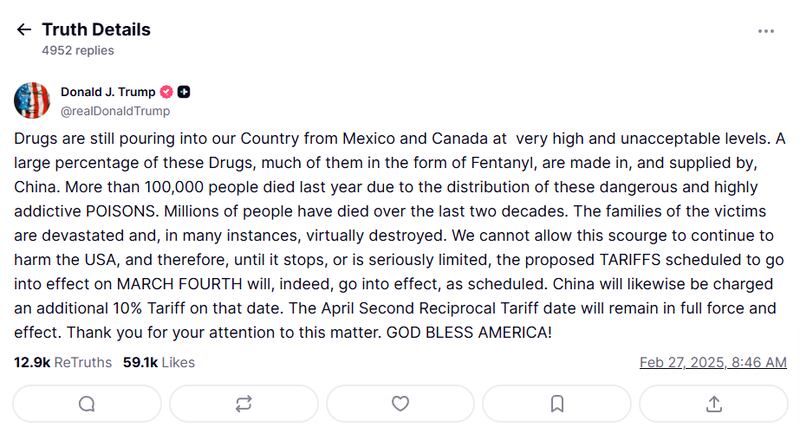
Earlier this year, U.S. President Donald Trump cited fentanyl as one of the justifications for launching a trade war against Canada, describing the southbound flow of drug smuggling as "tremendous," and facilitated by border policies that were responsible for many deaths.
As recently as late April, Trump described Canadian fentanyl imports in fairly even terms with those from Mexico and China.
“Fentanyl continues to pour into our Country from China, through Mexico and Canada, killing hundreds of thousands of our people, and it better stop, NOW!” he wrote in a post to Truth Social on April 24.
Among Canada’s responses to the trade war was appointing former RCMP deputy commissioner Kevin Brosseau as "fentanyl czar," with orders to “detect, disrupt, and dismantle” trade of the drug.
Even so, then-prime minister Justin Trudeau pushed back on Trump’s fentanyl argument.
“The legal pretext (the U.S.) government is using to bring in these tariffs is that Canada is apparently unwilling to help in the fight against illegal fentanyl,” Trudeau said in a press conference March 4.
“Well, that is totally false.”
‘In the same boat’
U.S. Customs and Border Protection (CBP) data show that of the 4,376 total fentanyl seizures counted by CBP between October 2021 and February 2025, just 241 occurred at Canada-U.S. boundaries, and only 162 of those were along the land border between the two countries.
Less than 20 kilograms were seized at the Canada-U.S. border in the year preceding the trade war, according to American border authorities.
For the purposes of the study, a “large” seizure was defined as either a kilogram of powdered fentanyl or more than 1,000 individual pills, which can sell for US$10 each or around their literal weight in gold, the Manhattan Institute says.
Health Canada notes that, given how potent fentanyl is, the risk of overdose is very high, and that “only a few grains is enough to kill.”
Since 2016, more than 50,000 Canadians have died from opioid-related harms, and roughly three in four accidental opioid deaths last year were attributed to fentanyl.
South of the border, more than 70,000 overdose deaths were linked to synthetic opioids like fentanyl in 2023 – the number-one contributor by drug type, which has grown sharply since the early 2010s, data from the U.S. Centers for Disease Control and Prevention show.
“The larger picture is that Canada and the U.S. are in the same boat,” reads the Manhattan Institute study. “Both are final-market countries beset by staggeringly high overdose death rates from synthetic opioids manufactured outside their collective borders.”
While the report acknowledges that measures targeting inflows of fentanyl may form part of a “comprehensive approach” to bringing down the drug’s U.S. impacts, it makes clear that the heightened attention on Canada may be better directed elsewhere.
“Counties along the Canadian border are not an important part of this story,” it concludes.
“Whatever the merits or drawbacks of tariffs on imports from Canada — a question of economics and international relations that goes far beyond our analysis — such actions cannot be justified as part of a pragmatic and data-informed response to the threat of fentanyl to the United States.”

