The aurora borealis is expected to appear over much more of Canada than usual this week, thanks to a potential geomagnetic storm that scientists say could begin by Friday.
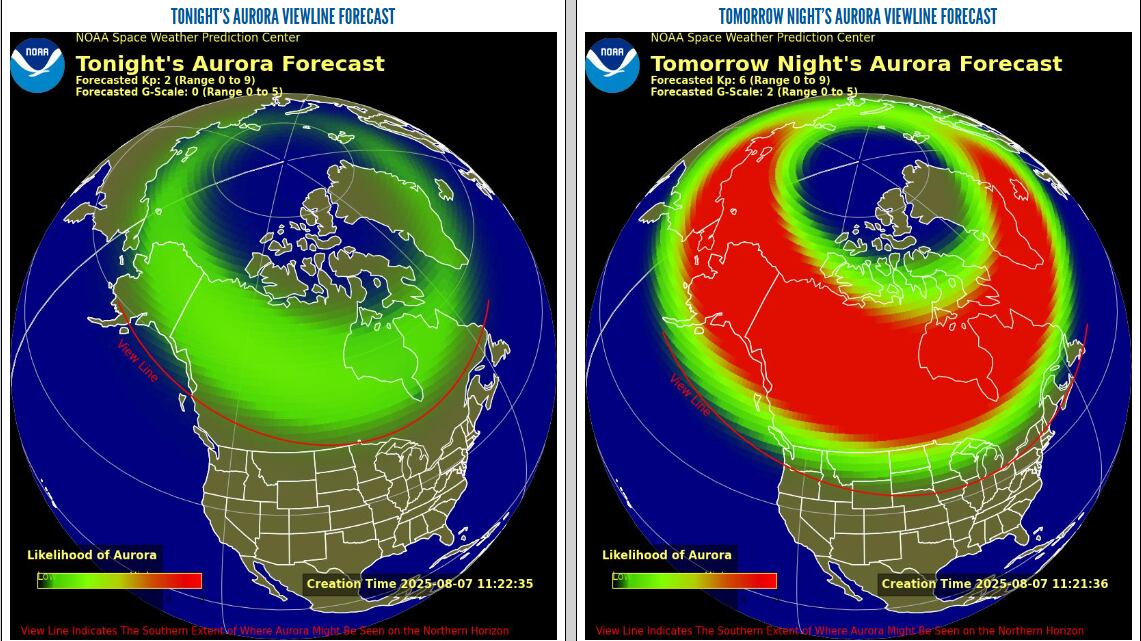
According to the latest forecasts from the U.S. National Oceanic and Atmospheric Administration (NOAA), visible auroras are possible for nearly all of Canada, with only the easternmost shorelines of Nova Scotia and Newfoundland outside the visible range in the south, and some islands in the territories near Greenland too far north.
NOAA diagrams show that much of the Prairies and B.C. Interior, as well as northern Ontario, Quebec and Labrador have the highest likelihood of visible auroras, as of Friday night.
The unusual appearance of the northern lights is linked to what scientists call a "coronal mass ejection‚" (CME) when large amounts of plasma and magnetism are expelled from the sun. These events can involve billions of tons of mass moving between 250 and 3,000 kilometres per second, the agency says.
Though it first emerged on Aug. 5, the effects of the CME take days to travel through space, and are expected to arrive later this week.
On Earth, CMEs may trigger a geomagnetic storm, which can sometimes disrupt technology including power grids, pipelines and GPS. The NOAA has described this week’s event as “mainly manageable,” with the side effect of auroras more visible than normal.
“Watches of this level are not uncommon,” reads an advisory issued Wednesday.
On the NOAA’s geomagnetic activity index, Friday night’s aurora forecast is expected to peak at six out of a possible nine points, or between “moderate” and “active” for auroras.
Any projected storm activity is likewise expected to be “moderate” at most, which the NOAA says may trigger alarms at some power systems and risk damage to transformers, if prolonged.
Friday’s geomagnetic storm is expected to weaken to “minor” by Saturday, with peak aurora scores dropping to five and the visible range shrinking back to more northern latitudes.

