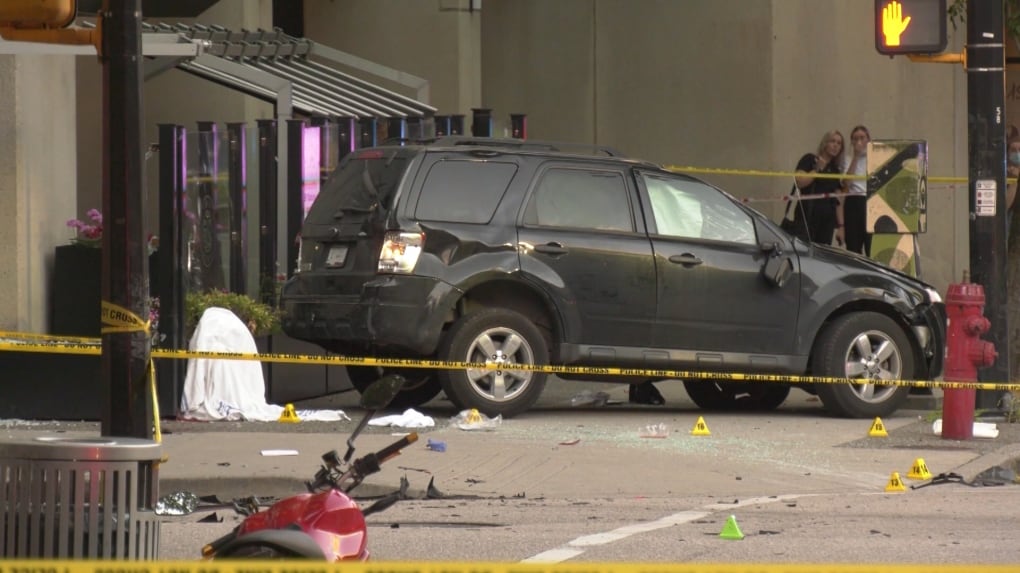
The man acquitted in a downtown Vancouver crash that claimed the life of a two-year-old girl will not face another trial after B.C.’s highest court dismissed an appeal from the Crown Friday.
Seyed Ramin Moshfeghi Zadeh was found not guilty of driving causing death and dangerous driving causing bodily harm at a trial in April 2024.
The charges stemmed from a July 2021 crash at the intersection of Smithe and Hornby streets. Moshfeghi Zadeh ran a red light and caused a crash with a McLaren sports car. The collision pushed his SUV onto the sidewalk, where it hit Michael Hiiva, who was holding his young daughter Ocean.
Hiiva was seriously injured, and his daughter did not survive.
The trial court heard the light at Hornby Street had already been red for approximately 20 seconds when Moshfeghi Zadeh drove through the intersection at 47 km/h without touching his brakes until after he was broadsided by the sports car, which had a green light.
The judge in the case determined that Moshfeghi Zadeh was inattentive and that his manner of driving was dangerous, but that his “momentary lapse” of attention did not constitute a “marked departure” from the standard of care required, and therefore was not a criminal offence.
“In every case where it is a departure but not a marked departure the courts have said it is civil negligence,” said trial Judge Kathryn Denhoff when announcing her decision.
The Crown appealed the case, arguing that Denhoff had “erred in law in multiple respects.”
A three-judge panel of the B.C. Court of Appeal dismissed the Crown’s case, finding that Denhoff had misstated the law at one point in her reasons, but the error was isolated and not fatal to her conclusion.
Two of the three appeal judges – Justice W. Paul Riley, who wrote the decision, and Chief Justice Leonard Marchand – took this perspective and dismissed the appeal.
“The incident that gave rise to the proceedings against the respondent was a tragedy, and the respondent’s driving was unquestionably the cause of that tragedy,” Riley’s majority decision reads.
“His manner of driving — proceeding into an intersection in a busy urban area, on a red light, with no apparent effort to slow or stop his vehicle, in the face of multiple ‘visual cues’ — was a manifest departure from driving norms. The consequences of the respondent’s conduct were catastrophic and heart-breaking.”
However, the central issue for the trial judge to determine was not whether Moshfeghi Zadeh’s conduct constituted civil negligence, but whether the standard for a criminal offence had been met, Riley wrote.
“The case law tells us criminal liability for dangerous driving cannot be visited upon a driver unless the manner of driving is found to be both dangerous, and a marked departure from the standard of care expected of a reasonable person in all of the surrounding circumstances,” the majority decision concludes.
“After a three-day trial, the trial judge carefully considered that question and concluded the requisite mens rea had not been established. The judge made no error of law in reaching that conclusion."
The third judge, Justice Peter M. Willcock, dissented.
“I agree with Justice Riley that the trial judge erred in expressing the view that a momentary lapse of judgment without more cannot establish the mens rea of the offence of dangerous driving," Willcock’s dissent reads, in part.
“However, I disagree with my colleague’s conclusion that the judgment was not tainted by that error. In my opinion, the error was repeated and had a material bearing on the outcome.”
Willcock would have allowed the appeal and ordered a new trial.
With files from CTV News Vancouver’s Ben Nesbit

