Most Canadians don’t have to worry about braving a brutal winter, suggest new long-range forecasts from The Old Farmer’s Almanac.
The country is expected to have above-normal winter temperatures, except for areas in or near southeastern Ontario, those behind the forecast say.
“Overall, we’re calling for almost everywhere in Canada to be a bit milder this winter than normal,” Carol Connare, editor-in-chief of The Old Farmer’s Almanac, said in a video interview with CTVNews.ca on Friday.
General predictions
Connare said the northernmost regions of Canada will see more snow while the southern areas will have wetter precipitation, such as hail, mist, rain, sleet or snow.
“There’s more because of overall warming, there’s more moisture in the atmosphere, and so that means there’s going to be more stuff falling at greater rates than normal,” she said.
Residents will need their umbrellas or jackets the most in Atlantic Canada through Nunavut, Quebec, western Ontario, the northwestern and southern Prairies, the northernmost and the extreme southern portion of British Columbia and southern Yukon. Those places will have above-normal amounts of precipitation such as rain and snow. Other areas in Canada, meanwhile, will have “near to below normal” precipitation.
And the 233-year-old North American weather guide’s predictions about mild temperatures don’t mean Canadians should keep their tuques and thick jackets in the closet.
Connare said the term mild is “relative,” and people should dress based on the conditions.
Connare said the Old Farmer’s Almanac predictions are focused on specific parts of Canada where the majority of the population lives and where forecasters can get the most reliable long-term data.
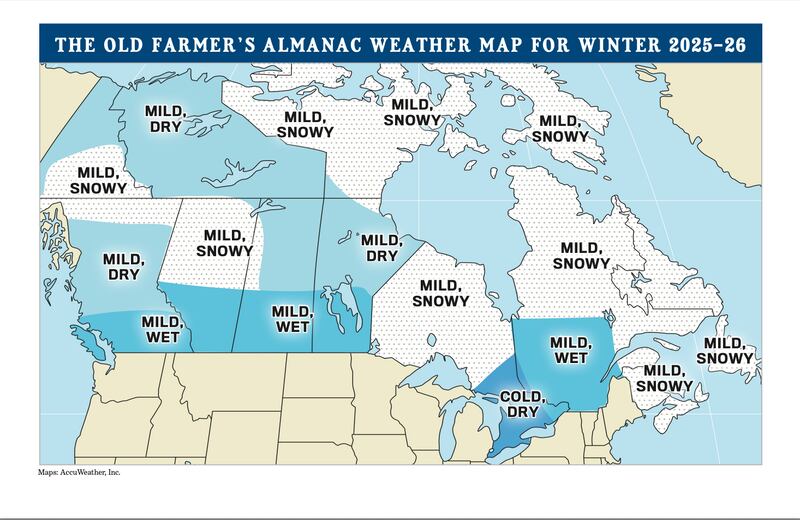
This map provides a general overview of the almanac’s weather predictions.
Northern Canada
In their general weather forecast for winter 2025-26, the almanac’s experts predict that the southern half of Yukon will have a mild and snowy winter, while it will be mild and dry in the north. The Northwest Territories is expected to be mild and dry, and Nunavut will be mild and snowy, the forecast suggests.
Atlantic Canada forecast
Winter will be warmer than normal in Atlantic Canada, with more precipitation and snowfall than usual, according to the almanac. It will be the coldest in the region in early and mid-December and for much of January, the almanac’s forecasters say. Most of the snow is expected to hit in mid-November, mid- and late December, and early to mid-January.
Quebec forecast
Winter will also be warmer than normal in southern Quebec, the almanac’s forecasters predict. Although precipitation is forecast to be above normal, the southern region will have less snow than usual. It is projected to be snowiest in late November, early and late December, and early January.
Meanwhile, northern areas are expected to be mild and snowy.
Ontario forecast
The almanac’s experts predict the southeastern part of the province will have a colder and drier than normal winter, but less snow than usual. The southwestern areas are projected to be warmer with more precipitation and snowfall than normal.
For all of southern Ontario, the almanac projects that it will be coldest in mid- and late December, early and late January and early February. It also predicts that it will be snowiest for the region in late November and early and mid-February.
Meanwhile, the northern chunk of Ontario is forecast to be mild and snowy.
Prairies forecast
The southern Prairies is projected to be warmer than normal this winter. According to the almanac’s forecasts, the region will see more precipitation than usual, with more rain projected than snow. The coldest periods for this area are forecast to be in late November, early December and early February. The almanac’s experts also say it will snow more in late November and early December.
Saskatchewan’s southern half is forecast to be mild and wet, while winter in the northern area is predicted to be mild and dry. The northern half of Alberta is expected to be mild and snowy and the southern half mild and wet.
The northern half of Manitoba will be mild and dry while the southern half will be mild and wet, forecasters predict.
British Columbia forecast
Southern British Columbia is projected to have a warmer-than-normal winter, with cold snaps predicted in late November, early December and early February. The almanac’s experts say the snowiest times are projected to be in late November and early and mid-December. The northern area is forecast see less precipitation than it typically experiences, but the opposite is predicted for the south. The province is forecast to generally have less snowfall than usual, though the snow may fall as early as November.
Some northern areas of the province are forecast to be mild, dry and snowy.
How The Old Farmer’s Almanac predicts weather
The Old Farmer’s Almanac says it predicts the weather from a “secret formula” created by the almanac’s founder, Robert B. Thomas, in 1792, and refined by modern scientific calculations and technology. Thomas believed sunspots, the sun’s magnetic storms, influenced the Earth’s weather, according to the almanac’s authors. Those behind the almanac say the formula compares solar patterns and historical weather conditions with current solar activity.
The almanac’s long-range predictions also consider solar science, solar activity such as sunspots, climatology and meteorology.
The Old Farmer’s Almanac, the authors of which claim its forecasts are 80 per cent accurate, has been published every year since 1792. The 2026 Canadian edition, first published in 1982, will be available in stores starting Tuesday.

