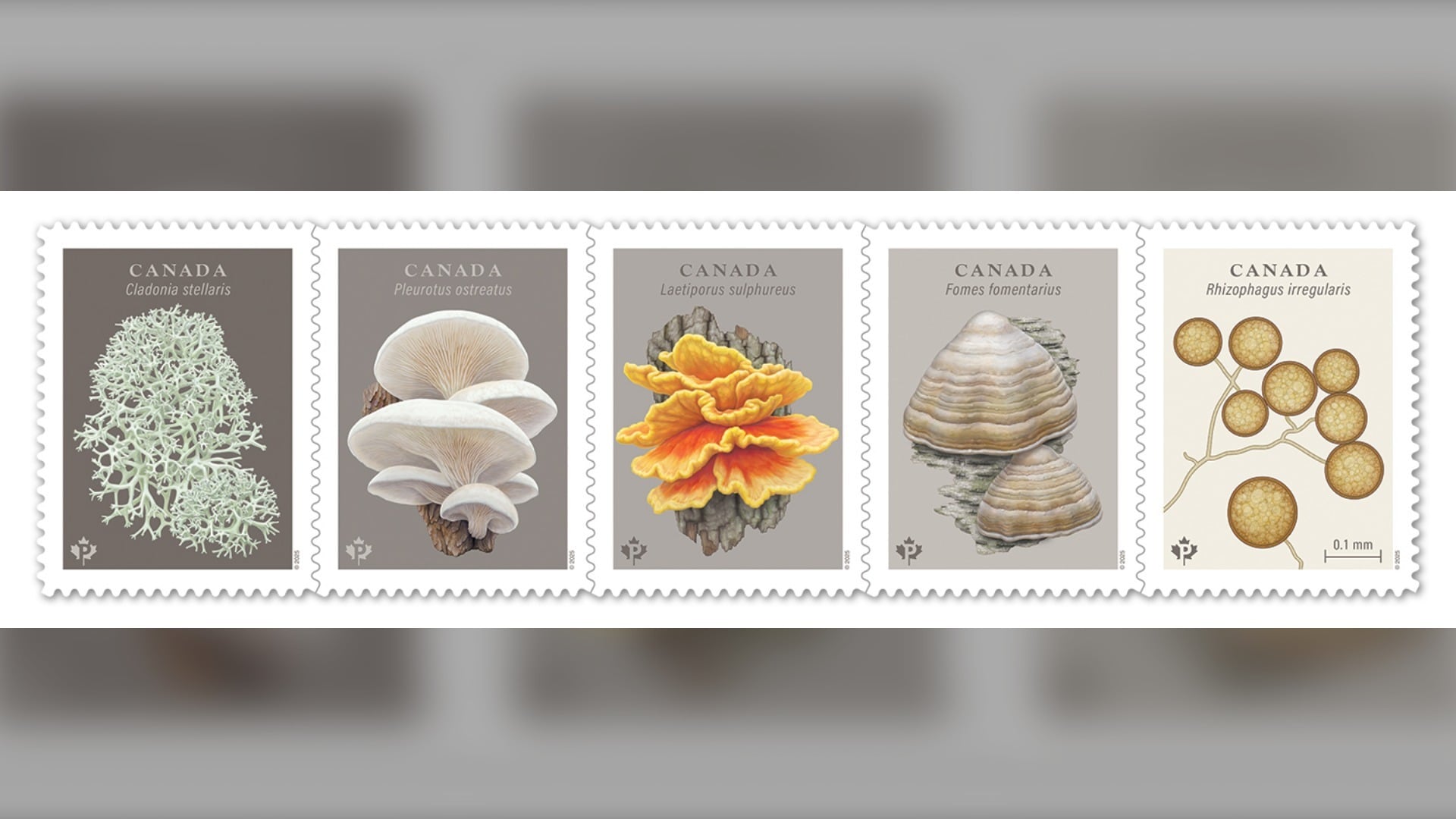
Canada Post has unveiled its new stamp collection Wednesday featuring fungi and lichens found in the country.
The Crown corporation says it made 120,000 booklets of 10 permanent stamps and 5,000 Fungi Official First Day Cover souvenir envelopes, highlighting five species of fungi. They are sold in a booklet of 10 permanent domestic rate stamps for $12.40 and the Fungi Official First Day Cover for $7.20.
Canada Post says on its online store that the collection “celebrates the beauty, diversity and ecological importance of fungi” through a style resembling botanical illustrations.
Jocelyne Saulnier designed the stamps and Emily S. Damstra illustrated them. They’re available at canadapost.ca and certain postal outlets across the country.
The stamps show illustrations of the following five species of fungi found in Canada:
- Star-tipped reindeer lichen, or Latin for Cladonia stellaris: These symbiotic organisms are found in every province and territory, especially flourishing in the North.
- Oyster mushroom (Pleurotus ostreatus): These shell-shaped mushrooms were traditionally part of the Indigenous diet. They are commonly found in many cuisines today.
- Chicken of the woods (Laetiporus sulphureus): They have prominent yellow and orange “shelves.” Many First Nations traditionally used them to smooth and soften their buckskin clothing.
- Tinder fungus (Fomes fomentarius): This fungus forms on trees as hard conks. It was traditionally used as tinder, including by First Nations.
- Rhizophagus irregularis: This microscopic fungus, which doesn’t have a common name, is found in plant roots and can be used like a fertilizer to farming soil.
Fungi play important roles in the Canadian ecosystem, including allowing plants to survive and grow, according to Canada Post’s press release Wednesday. Fungi also break down dead plants and animals, which returns nutrients to the soil.
Fungi have other key functions, including some that can store carbon and decompose pollutants such as plastics and synthetic chemicals.
Indigenous People traditionally used fungi for medicine, pigments or food.
Clarification
This story has been updated to clarify the quantities of stamps issued.

