As the federal government prepares its long-anticipated budget in November, Conservative Leader Pierre Poilievre says he would like to see “billions of dollars” in cuts.
“There needs to be billions of dollars of reductions in the federal bureaucracy,” Poilievre said in an interview with CTV Question Period airing Sunday.
Poilievre also said the federal government “should cut the budget for consultants by at least $12 billion.”
When asked by host Vassy Kapelos about how deep cuts to the federal public service should be, Poilievre didn’t provide a number but said “we should reverse the cost of the bureaucracy back at least five years to the pre-COVID era.”
“How is it that we were able to deliver all these services five years ago with 40 per cent, 30 per cent less bureaucrats and less bureaucratic spending,” he said.
Prime Minister Mark Carney’s upcoming budget, which he has described as one of both “austerity” and “investment,” has prompted some to question whether that “austerity” could result in job cuts, amid billions of dollars in spending commitments.
Last week, when asked about a reduction of the federal public service, Carney said it will “happen naturally through attrition.”
Carney had promised to cap and not cut the public service as a way to rein in spending during the federal election campaign.
The Conservatives, meanwhile, pledged to “streamline” the federal public service through natural attrition and retirement with only two in three departing employees being replaced.
“What we need is private sector employment. We need businesses to hire more people, giving them paychecks, producing things, goods and services that the country needs,” Poilievre told Kapelos.
“Unfortunately, that’s going to be tough. I made the decision to be honest to people during the election. Mr. Carney, once again, pulled a bait and switch.”
Instead, Poilievre said the federal government should be focused on creating jobs in the private sector, through measures like his proposed “Canada First Reinvestment Tax Cut,” that will allow Canadians to defer capital gains tax if they reinvest those earnings in Canada.
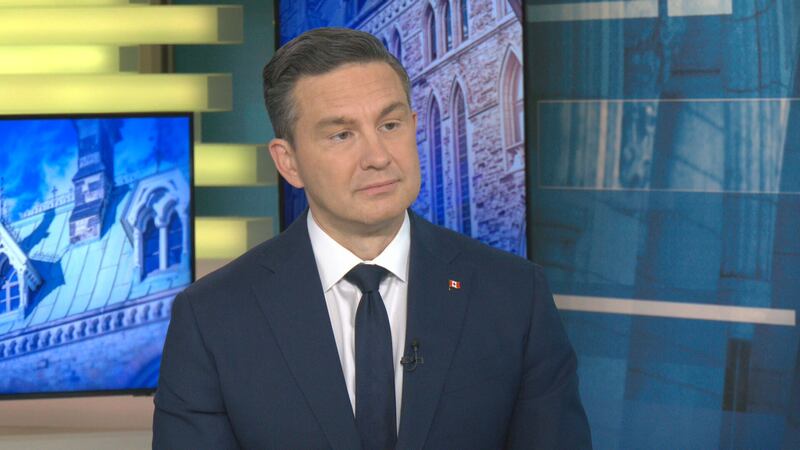
“I’m proposing a boom in job creation. That is what our Conservative plan is, and we encourage the Liberals to adopt it,” Poilievre said.
Pressed again by Kapelos about how many public servants he thinks should lose their jobs, Poilievre wouldn’t answer directly but said there needs to be “a combination” of public service cuts and private sector job creation.
“I can tell you, you’ll have the right answers before you go voting in the next election,” Poilievre insisted.
“Our job right now as the Official Opposition is to signal a direction, which is we need less money for bureaucracy and more money for taxpayers and job creators.”
A report from the parliamentary budget officer, released in August, estimated the federal government would spend $71.1 billion on public service personnel in 2024–25, rising to $76.2 billion by 2029–30.
The size of the federal public service has also grown by more than 100,000 workers over the past 10 years, from 257,034 in 2015 to 357,965 in 2025. However, that number has decreased by nearly 10,000 employees since last year.
In a statement to CTV News on Monday, Public Service Alliance of Canada National President Sharon DeSousa described Poilievre’s comments as “out of touch.”
“We’ve said it before, and we’ll say it again: austerity is reckless, lazy, and dangerous—and it puts people in Canada at risk," the statement says. “Mr. Poilievre’s push for deep cuts is out of touch. Slashing public services hurts workers, seniors, veterans, and families. It’s wrong.”

