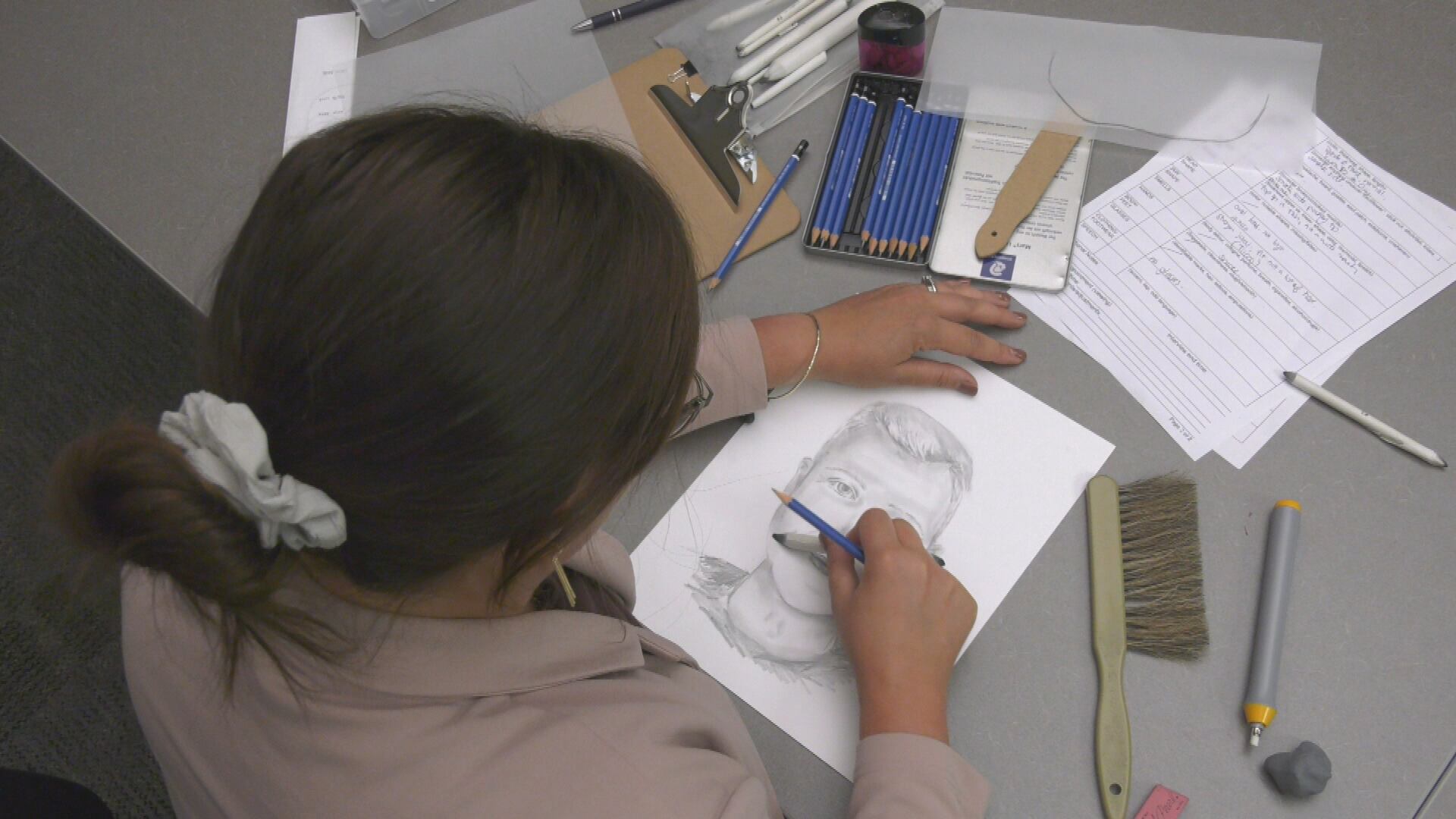
Media outlets and social media alike are still using police sketches in rare cases to identify suspects when other avenues have been exhausted, and the Edmonton Police Service (EPS) does all their sketching in-house.
Sgt. Amanda Ross is one of the officers behind the artwork, one of the handful with the training and talent to translate a person’s description into an image using memory as a guide.
“I was an avid pencil drawer when I was younger, I really liked to spend time in my bedroom and kind of go into my creative imagination,” she told CTV News Edmonton at EPS headquarters last week.
Ross, who studied fine arts in university, applied for one of the limited numbers of positions for sketch artists in the unit. She took a special five-day training course to refine her skills and learn about composite sketch artistry to aid investigations.
“It’s a perishable skill. I think that’s why it’s also important that we continue to do ongoing training,” she added.
Ross added that sketch artists need to be active listeners and good communicators. Interpersonal, interviewing and investigational skills, she explained, are vital to putting a witness or victim at ease.
“Sometimes it’s talking about those things like, ‘What did you smell? What did you hear? What did the environment look like?’ Those things can help trigger memory to come forward,” Ross said.
There are four current sketch artists at EPS, and between them, only a few sketches go out a year. Ross said that’s because sketches aren’t used until other investigative techniques have been attempted.
Det. Megan Blumhagen is also one of the few EPS members able to combine her artistic skill and investigative techniques.
Composite sketches are often used in cases of robberies, sexual assault and sometimes homicide. It’s most effective, she said, when the witness has had some amount of time interacting with the suspect.
“It could be a case where … we’ve tried DNA, we’ve tried fingerprints, all the other avenues that we can to try to identify somebody,” Ross added. “This is a last resort that we’ll attempt.”
Both Blumhagen and Ross said the key is to also be realistic about a witness’s recall abilities after a traumatic event.
“At the end of the day, if they don’t remember, they don’t remember,” Blumhagen said.
The process behind the art
Both officers said computer assistance, like programs that generate a face, can end up too photographic or realistic-looking, which can sometimes lead people to misidentify a suspect.
“Whereas with a sketch, we’re able to complete a likeness of the subject,” Ross said.
After a sketch is drawn, it goes back to the primary investigator, who’s responsible for making the final decision based on evidence.
The sketch, Ross said, isn’t going to lead to an arrest on its own.
“When we put out a media release with a sketch, we’re hoping that it’s going to tweak the memory of someone in the public who’s going to recognize a person that’s similar,” she said. “When that lead comes into the primary investigator, they’re then going to look at all the different factors.
“We really want to be able to help advance files, bring closure to witnesses and victims. It’s a good feeling when you can contribute,” she added.
Blumhagen said the sketches are done in between their usual hours, and in each case, witnesses or victims shouldn’t worry about whether or not their memory recall is accurate to the last detail.
“A lot of times it’s just giving people permission to be honest, and taking that pressure off of them and saying … It’s me. It’s my job to make this look as close as I can to your memory,” she said.
“It’s giving permission and explaining a bit of our background and what [police] do with [the sketch], and that it’s not on their shoulders.”
RELATED STORIES:
- Warren Driechel becomes new Edmonton police chief
- Edmonton police officer honoured for his contributions to Special Olympics Alberta
With files from CTV News Edmonton’s Jeremy Thompson

