Researchers from McMaster University and the Massachusetts Institute of Technology (MIT) have developed a new antibiotic that could change the way doctors treat Crohn’s disease and other forms of inflammatory bowel disease (IBD).
The drug enterololin is the first of its kind and is designed to target harmful bacteria in the gut without wiping out the “good” bacteria that keep the microbiome healthy.
The breakthrough, described this week in Nature Microbiology, is paired with another first: the use of artificial intelligence to predict exactly how the new drug works, a step that normally takes years and millions of dollars to complete.
“This is sort of our first entry into a new way of addressing this burdensome disease,” principal investigator Jon Stokes said in a Zoom interview with CTVNews.ca Thursday. “We don’t have drugs to treat these infections in Crohn’s patients.”
Traditional antibiotics tend to be “broad spectrum,” meaning they are blunt instruments that destroy good bacteria along with bad ones. For patients with Crohn’s disease, this can backfire: when protective gut microbes are wiped out, drug-resistant species like E. coli can rush in and worsen the disease, according to the study.
Enterololin is a narrow-spectrum antibiotic, the study suggests, meaning it goes after a specific group of harmful bacteria known as the Enterobacteriaceae family. This includes E. Coli, while leaving the rest of the microbiome intact.
In mouse studies, the drug cleared infections but also reduced the risk of dangerous, drug-resistant strains taking hold in the gut.
A lucky find
In the lab, Stokes said researchers typically screen tens of thousands of chemicals to see which would kill a bacterium of interest, and which ones won’t.
“We’ll train an AI model to be able to look at the structures of brand new chemicals it’s never seen before and predict which ones could be anti-bacterial,” he added.
They stumbled on enterololin, which proved active against the Crohn’s-linked E. Coli but didn’t attack everything else. “We just got lucky,” Stokes admitted.
The real challenge, he explained, wasn’t finding the chemical compound — it was figuring out how it worked.
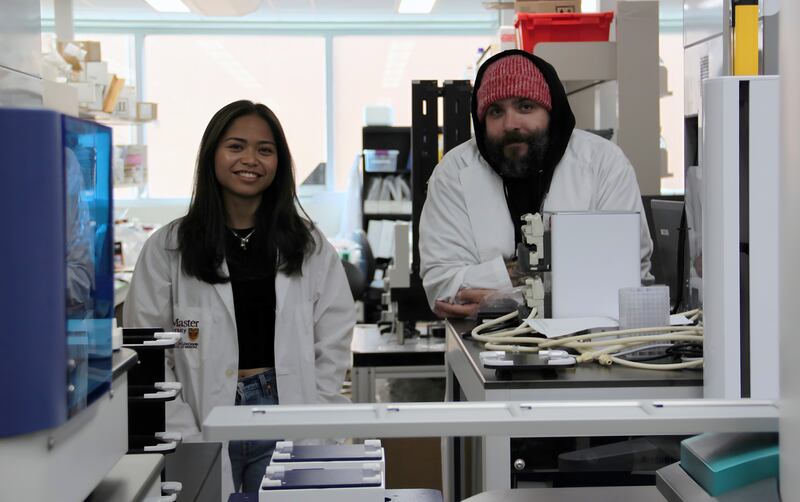
Graduate student Denise Catacutan suggested flipping the script: instead of using AI to just find drug candidates, why not use it to predict how the new drug actually works?
AI speeds up discovery
Beyond the drug itself, the way it was developed marks a leap and first in medical research, the study suggests. Drug developers spend significant time and money figuring out new drug’s “mechanism of action” (MOA), or how it kills bacteria. MOA studies often take up to two years to complete and cost $2 million.
This time, Stokes partnered with colleagues at MIT’s Computer Science and Artificial Intelligence Lab (CSAIL) to test a new AI model called DiffDock. Within 100 seconds, the program predicted that enterololin worked by attacking a microscopic protein complex known as LolCDE, which bacteria need to survive.
“Instead of two years, they made that prediction in less time than it takes me to go get a cup of coffee,” Stokes said.
By using AI, the researched shaved 18 months off their timeline and reduced costs to about $60,000 – a fraction of what MOA studies normally require.
Catacutan ran traditional lab tests for another six months and confirmed the AI model was right.
“It’s like when two puzzle pieces come together. It worked. It was great. The process is more streamlined,” Catacutan, who also sat in on the interview with Stokes, toldCTVNews.ca.
“At least in our proof of concept, we can use AI to help us, guide us through what a molecule could be doing inside cells. We think about it as like a GPS system,” Stokes said.
To put in into perspective, Stokes said the first modern antibiotic, penicillin, was discovered in 1928 by Scottish physician Alexandar Fleming. Nearly a century later, studies are still coming out to describe how the antibiotic works.
“That’s how complicated antibiotics and bacteria are.”
The stakes for Canada’s IBD community
The discovery comes at a time when Canada faces a looming IBD crisis, according to a global study earlier this year.
Published in Nature Portfolio and co-led by researchers from the University of Calgary, the study warned that Canada could face a dramatic rise in IBD over the next two decades.
The study suggested that by 2045, Canada will not only see more diagnoses of IBD, but a sharp increase in the number of people already living with the chronic illness.
In 2025, the prevalence of IBD in Canada is projected to be 0.8 per cent of the population. According to one of the study’s authors, the number is expected to climb to approximately one per cent by the 2030s and into the 2040s.
Canada already has one of the highest rates of IBD globally. The chronic conditions that fall under that category – most notably Crohn’s disease and ulcerative colitis – cause inflammation of the digestive tract, leading to symptoms like abdominal pain, diarrhea, weight loss and fatigue. There is currently no cure.
As for what causes IBD, Health Canada says it’s still unknown.
The standard of care, according to Stokes, is immune management.
“It’s symptomatic treatment as opposed to helping address one of the drivers of the disease.”
The road ahead
Enterololin has been licensed to Stoked Bio, a start-up biotech company founded by Stokes, which is preparing it for possible human trials within the next three years.
“It’s a promising molecule that gives patients who don’t really have that many options, another option,” Stokes explained.
Early lab tests suggest it may also work against other drug-resistant pathogens, including Klebsiella, one of the so-called “superbugs” flagged by the World Health Organization as an urgent health threat.
For Stokes, the implications of AI go far beyond drug discovery.
“Everybody in healthcare is thinking about how to integrate AI to make patients feel better quicker,” he said.
He points to work by MIT collaborator Regina Barzilay, who developed an AI system capable of detecting signs of cancer on mammograms long before they can be visible to the human eye.
“That’s an example of AI improving diagnostics,” Stokes said. “But it can also help with patient management — figuring out the right treatment for the right patient at the right time."
The ultimate goal, Stokes said, is simple: to improve outcomes while reducing costs.
“Healthcare is inherently expensive. If we can diagnose people faster, treat them better and get them out of the hospital sooner so they can live their lives, that’s the goal.”

