
A new report shows preventable harm continues to be a significant issue in Canadian hospitals, affecting thousands of patients and adding pressure to the health-care system.
The Canadian Institute for Health Information (CIHI) and Healthcare Excellence Canada (HEC) have partnered to track and address unintended harm that occurs during acute care stays, or short-term stays.
They define harm as “an unintended outcome of care that may be prevented with evidence-informed practices and is identified and treated in the same hospital stay.”
The latest data from the Hospital Harm Project suggests that between 2024 and 2025, one in 17 acute-care hospital stays involved at least one harmful event. In a quarter of those cases, patients experienced more than one.
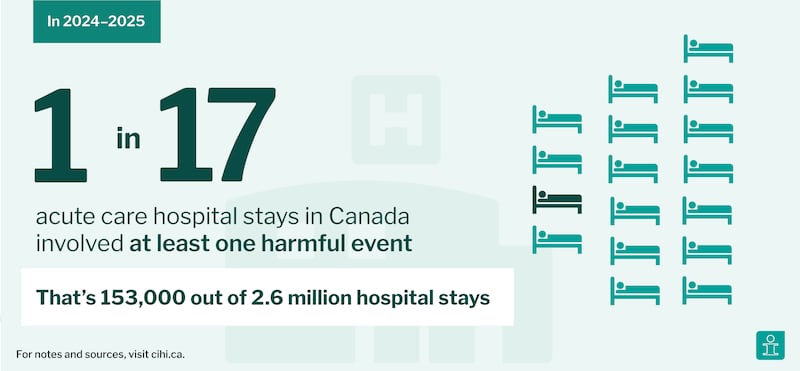
The report tracks 31 types of harm, including infections, post-surgical complications, medication errors and pressure injuries. While overall harm rates have stabilized, CIHI researchers say that progress has plateaued.
“We’ve been monitoring the trend for over 10 years now,” said Mélanie Josée Davidson, CIHI’s director of health system performance, in an interview with CTVNews.ca.
“Prior to the (COVID-19) pandemic, we were making a lot of progress in reducing harms in hospitals. During the pandemic that went up a little bit, and then it’s come back down, but it hasn’t quite made the same progress as before.”
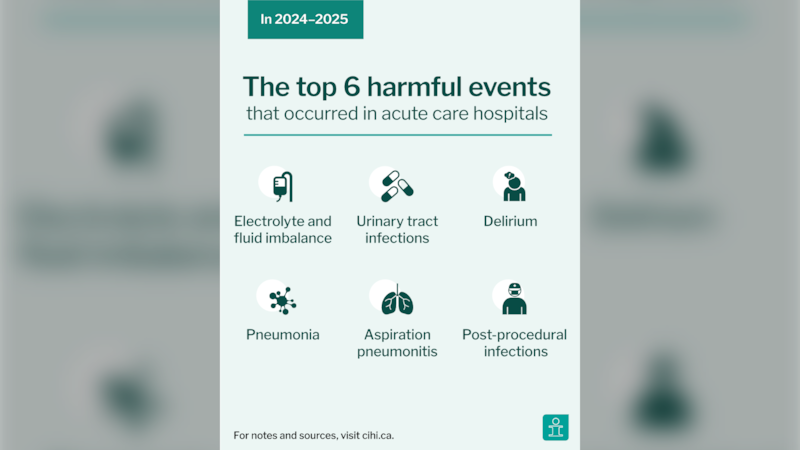
The most common events include electrolyte and fluid imbalances, urinary tract infections, delirium, aspiration pneumonitis, post-procedural infections and pneumonia.
“What we’re seeing is that there are a lot of smaller harms, and in fact, it happens a lot more than people think,” Davidson said. “One in 17 is not insignificant.”
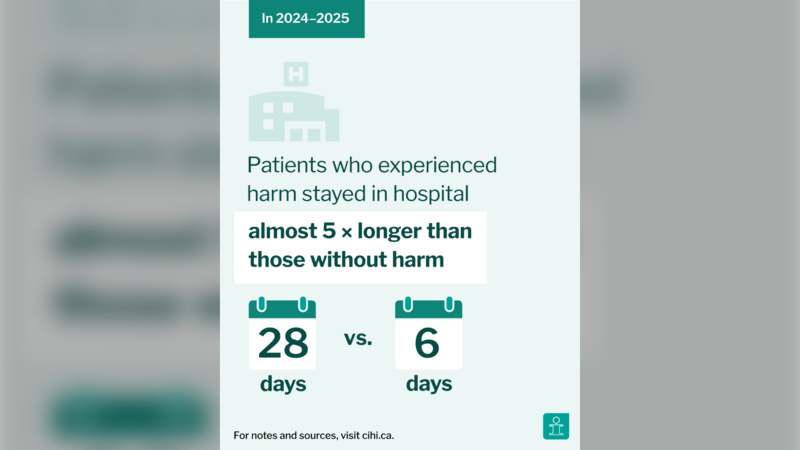
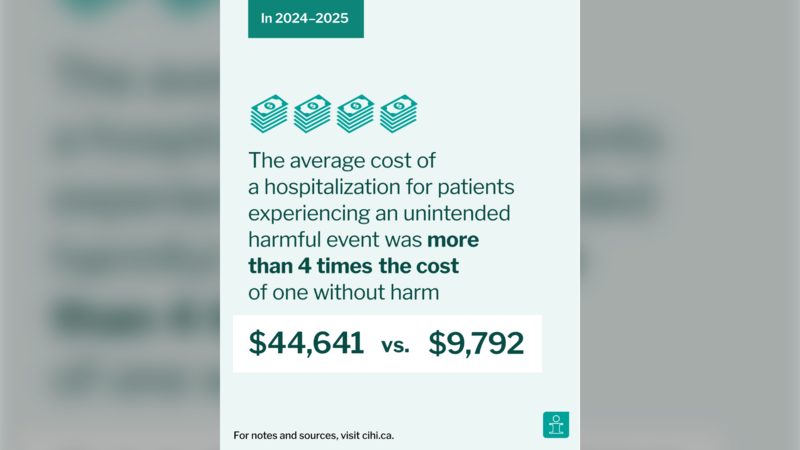
Patients who experience harm stay in hospital almost five times longer, and their care costs more than four times as much.
Davidson says a typical hospitalization costs just under $10,000, but a patient who experiences harm may rack up costs of $45,000 or more.
‘No blame, no shame’
Denise McCuaig, executive director of healthcare transformation and capacity building at HEC, says Canada must adopt more proactive safety approaches, not only to learn from failures, but also study how things go right.
“We need to create that sense of safety in the system so that everyone can say when things have not gone as they should,” she said in an interview with CTVNews.ca. “So, no blame, no shame, and having those safety conversations all the time, not just when there’s an incident.”
That shift requires a cultural reset, said Davidson.
“There is still a sense of responsibility and perhaps shame or guilt that a harm may have occurred,” she said. “In hospitals where there’s a good culture of transparency and learning, we report the harms more systematically than in places where we might be more hesitant.”
‘Incredibly complex places’
Nurses on the ground say they feel the strain.
“I think the most important thing is just to make sure that things don’t fall from in between the cracks,” said Eram Chhogala, a registered nurse in the Greater Toronto Area, in an interview with CTVNews.ca, adding shortages, inexperience, and overwhelming workloads are common contributors to harm.
“You have new hires … in areas where it’s high risk, a high acuity load, very critically ill patients,” she said. “You need someone with more experience.”
Davidson noted that hospital systems are not designed for individual heroics.
“Hospitals are just incredibly complex places,” she said. “We need systems in place so we can’t just rely on a single person to know everything and to be able to deliver the care.”
The Canadian Nurses Association says nurses are doing their best in challenging conditions, but safety is at risk when staff are overloaded.
“When I was a young nurse, I would have had four patients assigned to me,” said Valerie Grdisa, chief executive officer of the Canadian Nurses Association in an interview with CTVNews.ca. “If now nurses are getting six-to-eight patients, then maybe they’re not getting back to their patients enough to properly assess and actually implement the interventions.”
She also pointed to a lack of standardized nursing data as a barrier to systemic improvements.
“We do not actually have standardized data sets for nursing care … so we can evaluate what’s going on in a more systemic way,” she said.
‘You do need to speak up’
The impact of hospital harm is often invisible, until it isn’t.
“If somebody goes in for a hip replacement, they might stay in the hospital for … up to a week,” said Davidson. “Somebody from that same surgery (who) gets an infection might be in the hospital for a month. That’s a bed that’s occupied for a month.”
The ripple effect extends beyond dollars. It ties up beds, delays care and puts more pressure on already stretched staff.
“Sometimes these things just happen,” said Chhogala. “But sometimes it’s because you’re short-staffed, and nurses have so many patients … when you have a lot of stress and pressure, a lot of these errors can happen.”
The solution, she says, lies in improved staffing models, education, and stronger safety culture.
“If society is moving forward and evolving,” Chhogala said, “health care kind of has to catch up with that.”
Better communication, both between care teams and with patients themselves, can also reduce harm, said Davidson.
“A patient who doesn’t speak English or French is 30 per cent more likely to experience a harm,” she said.
“We also found that for patients that are 85 or older, they’re also more likely to receive harm … they don’t hear as well, they don’t communicate as well. And they also are less likely to advocate for themselves.”
Davidson’s message to Canadians is clear:
“You do need to speak up. You need to understand the care. You need to understand what is expected of your care so that you can flag when it doesn’t feel right,” she said. ”Those teams are stretched, so if you can help in any way, that’s welcome.”

