The federal government has a vision for bringing Canada into a new industrial era, Industry Minister Melanie Joly said Thursday, unveiling a new domestic strategy to save jobs, open new employment opportunities and draw in global investment and talent.
The minister detailed Canada’s updated industrial strategy and how the Liberals intend to bolster key sectors, including steel, aluminum, lumber and auto, which are struggling under U.S. President Donald Trump’s unrelenting tariffs.
“My message is basically, we won’t let these industries down, and we will do that for the sake of our workers, of our industries, and for our nation,” Joly said in a speech at the Canadian Club of Toronto.
The strategy has three main pillars: protecting jobs, creating jobs and attracting both investment and talent, all with the aim of unlocking Canada’s economic potential through building up this country’s industrial base.
Joly framed the strategy as a way to solidify Canadian sovereignty at a time of considerable global instability and shifting dynamics around trade, defence, and security.
Protecting jobs through procurement
In terms of what the Liberals are promising when it comes to protecting jobs, the minister said the government will protect the sectors being threatened by tariffs with targeted financial assistance, as well as helping them adapt and pivot to new products and markets.
An example of this is the $400 million loan to Algoma Steel to help the Canadian steelmaker shift towards serving what she anticipates will be growing domestic demand.
Joly also said the intention is to utilize Prime Minister Mark Carney’s pledge to “buy Canadian” to strengthen the domestic market by boosting demand at home.
“We will use the power of procurement to create jobs. Because ultimately, what I’ve learned is companies rather have contracts than subsidies from the government,” she said.
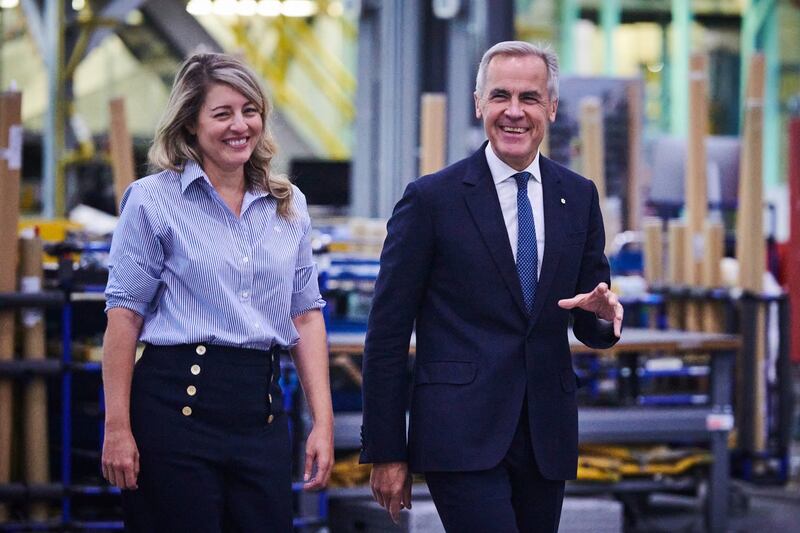
This will include using made-in-Canada steel, cement and lumber products to fulfill the “Build Canada Homes” plan to accelerate housing starts, as well as ensuring Canadian aerospace and shipbuilding companies secure defence contracts under an incoming defence industrial strategy.
“We know that we can build the best ships, the best planes, the best drones, and have very strong supply chains across the country. We can have researchers, engineers, and welders at work,” Joly said.
Leveraging tech, energy to create jobs
These housing and defence plans will also be key to the second “create jobs” pillar of the industrial strategy, Joly said.
Beyond that, the federal government’s intention is to leverage this country’s artificial intelligence strengths to make Canada more competitive and capable, and vowed to fund local innovation and emerging industries such as semiconductors.
The prime minister’s Major Projects Office (MPO) will also play a role in this element of the strategy, she said, suggesting tapping into more Canadian natural resources and critical minerals will fuel industrial growth.
Joly estimated that the MPO and the plan to fast-track massive nation-building projects will generate “$60 billion in private investments” and create thousands of jobs.

Aiming to ‘win’ global talent race
The minister said the final prong will be a push to “win” the global race for talent, vowing to attract “the best talent on earth” and make Canada the destination for top minds through supporting science and research at universities.
The federal government, according to Joly’s prepared remarks, will soon present a new “Talent Attraction Strategy” focused on AI and other emerging technologies, while also pitching Canada as an open and ambitious society. In her speech, Joly just said to “stay tuned” for more in the coming weeks.
Her draft speech included more unspecific commitments to invest in Canadian companies wanting to “go global,” enter new markets, develop new partnerships and compete beyond North America.
“We need bigger Canadian companies, and we need to make sure that these companies become bigger,” Joly said. “Why? Obviously to create jobs here at home, obviously to create jobs around the world, but in a much more complicated world, what do we need?
“We need to increase our influence. We need more soft power, and that is why building strong Canadian companies is important,” she added.

