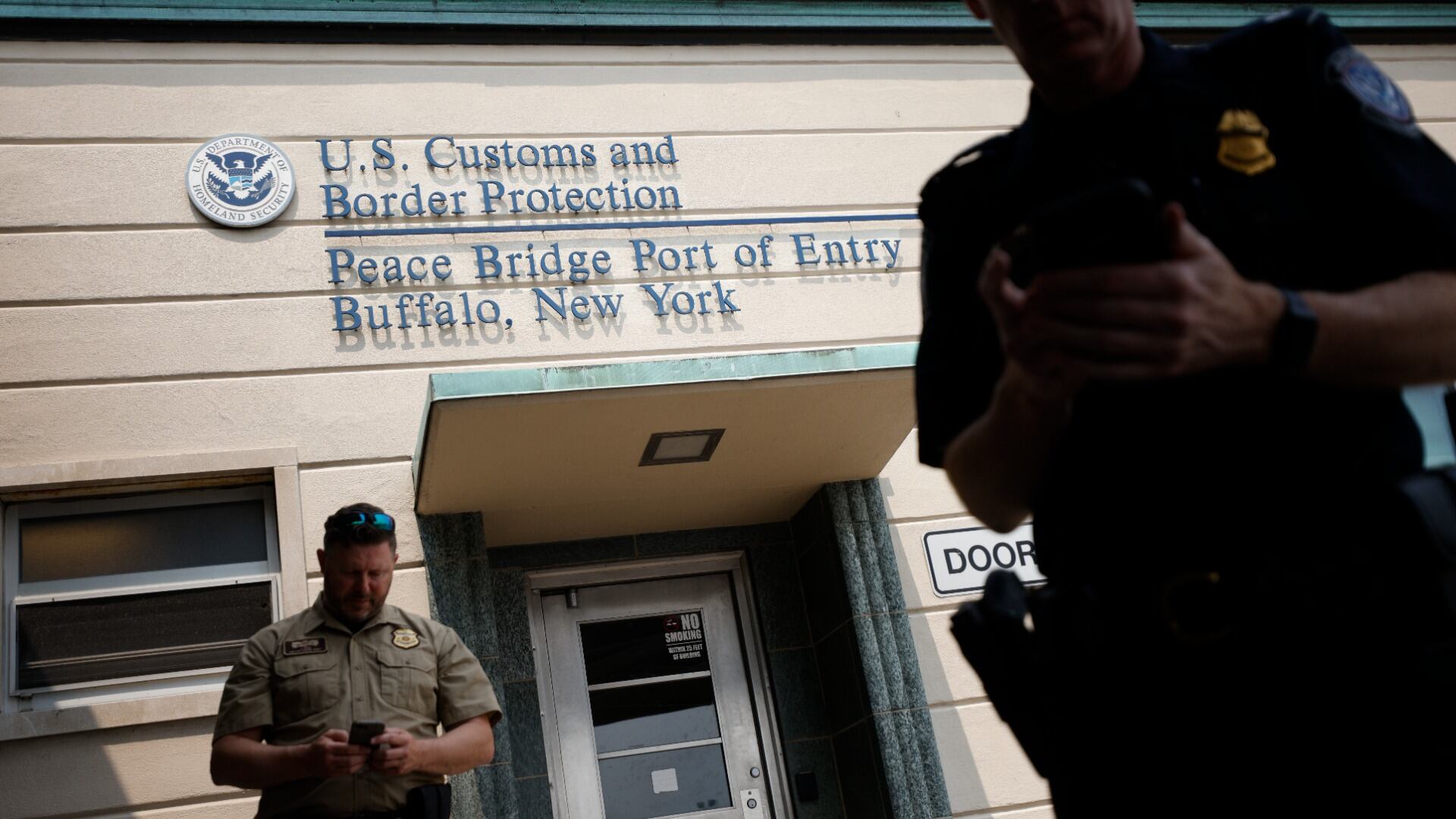
Canadian snowbirds visiting the United States for more than a month are now required to provide fingerprints when crossing the border, CTV News has confirmed.
As of last April, according to U.S. Customs and Border Protection (CBP), some Canadians planning to visit the U.S. for more than 30 days are required to complete an alien registration form known as Form G-325R. The application asks for personal and biographical details and requires biometric data collection, such as fingerprints.
“This measure is in compliance with statutory alien registration and fingerprinting provisions,” wrote a CBP spokesperson in an email to CTV News, adding the rule does not apply to those vising for less than a month or who have NEXUS clearance.
The requirement — as laid out in an executive order entitled Protecting the American People Against Invasion and signed by U.S. President Donald Trump on the first day of his second term last January — requires anyone over the age of 14, and hoping to stay in the U.S. for more than a month, to register.
Those who register, and are fingerprinted, must carry the document on them at all times, according to the U.S. Citizenship and Immigration Services.
The development was first reported by CBC News.
“The Department of Homeland Security fully supports this rule, which aligns with the Trump Administration’s ongoing efforts to enhance the safety and security of the United States,” the CBP spokesperson also wrote to CTV News.
‘Inconsistent experiences’
It appears the new fingerprinting policy is not being universally implemented.
According to the Canadian Snowbird Association, its members have been reporting “inconsistent experiences” at different land border crossings.
“The application of this process appears to vary depending on the individual border officer and location,” the group said in an online statement.
The Canadian Snowbird Association advises travellers who have not been issued what’s known as an I-94 form to contact U.S. Citizenship and Immigration Services (USCIS) within 30 days of entry in order to complete Form G-325R. The I-94 form is essentially a record of arrival and departure for non-U.S. citizens.
“However, there have been instances where U.S. border officers require the I-94 form to be completed at the time of entry,” the association explained. “In such cases, travellers may be directed to secondary inspection, where they may be fingerprinted and photographed, and charged a US$30 processing fee for the I-94.”
In emails to CTVNews.ca, many readers also reported that it was business as usual during recent border crossings.
Brian Asher said he crossed into the U.S. from Windsor, Ont. with his wife on October 18 with all the forms they needed. The border officer only wanted to see their passports and did not ask for fingerprints.
“We are happy to be in Florida for the winter, but confused as to what is legally necessary when we have a different customs officer next time,” Asher told CTVNews.ca.
Sheldon Gravelle says he drove his parents to the U.S. via Niagara Falls on October 20 and they did not have to fill out any forms or have their fingerprints taken.
“Customs asked how long they would be in U.S.A. and we indicated 5.5 months,” Gravelle said. “The border officer then asked if [my parents] owned a house in Florida and we indicated yes. He then waves us through.”
Juanita and Gordon Hawkins had a similar experience crossing into the U.S. today from Cardston, Alta. while on their way to Arizona.
“We were not even asked for the I-94 form that we had downloaded and printed,” they couple said. “No extra fees. No unusual questions, comments or requests. No fingerprints or eye scans. Didn’t even look closely into our car. No lineup. We voluntarily surrendered two oranges from a lunch cooler.”
Theresa Laturnus, however, said she recently had to undergo an eye scan when disembarking a cruise ship in San Francisco.
“No one could reboard until they cleared the ship,” she said.
Kevin Larson of Kincardine, Ont. says he told U.S. Customs and Border Protection (CBP) officers that he was attending a non-violent protest – the “No Kings” rally - scheduled for Oct. 18 in Port Huron.
Despite his explanation, Larson says the CBP officers searched his car, and removed three pages listing maps and a printed email. They also discovered a Canadian flag in the vehicle.
In an email to CTVNews.ca, Larson shared a copy of his withdrawal of application document, CBP Form I-275, which cited “insufficient evidence provided for intended purpose of entry to the U.S,” as the reason for his denial of entry. The form also contained his fingerprints.
Managing lawyer Sabrina Molinari-Mountain at Toronto-based Border Law says the uneven rollout of biometric checks at U.S. land borders is less about agents acting independently and more about a “staggered rollout,” of the U.S. entry-exit system.
In an email to CTVNews.ca., Molinari-Mountain said while fingerprinting authority has existed for years, logistical challenges have slowed consistent enforcement across all ports.
As a result, officers apply biometric screening at their discretion based on factors like citizenship, travel, history and length of stay, she added.
‘Heightened scrutiny’
Al Parsai is a Toronto-based immigration consultant and an adjunct professor at Queen’s University.
“The uneven rollout is predictable with new policies,” Parsai told CTVNews.ca by email. “Officers have discretion and training timelines vary. Systems and staffing differ by port.”
Parsai says that Canadians visiting the U.S. for more than 30 days should be ready to complete forms on arrival and provide biometrics like fingerprints.
“Do not pre-file forms unless an officer instructs you,” he added. “Expect inconsistency for a while. Be polite, answer questions clearly and keep notes on your crossing. Check official guidance before travel, since rules can change fast.”
Partner Suraj Johal of Vancouver-based Border Solutions Law Group says the confusion some Canadians are experiencing at the U.S. border crossings likely stems from a “heightened scrutiny being applied by CBP to Canadian travellers,” and traveller misunderstanding about what new entry requirements mean.
Johal said in an email to CTVNews.ca that the Form I-94 is typically issued automatically by CBP when Canadians enter the U.S., so travellers don’t need to fill out paperwork in advance.
He said completing one of these forms beforehand can create more confusion.
Johal also clarified that most Canadians who are issued an I-94 at land crossing or through airport preclearance are not subject to the new fingerprint registration requirement for trips longer than 30 days.
He recommends travellers confirm their I-94 information online after each entry to ensure it reflects the correct status and duration of stay.
“For extended trips as a visitor, such as snowbirds, it may be helpful to have some documents showing that the travellers maintain sufficient ties to Canada (such as proof of residence, return airfare, etc.),” he said.
Are you a snowbird planning your trip south for the winter, or have you experienced delays at the border while completing alien registration requirements?
We want to hear from you. Share your story by emailing us at dotcom@bellmedia.ca with your name, general location and phone number in case we want to follow up.
Your comments may be used in a CTVNews.ca story.

