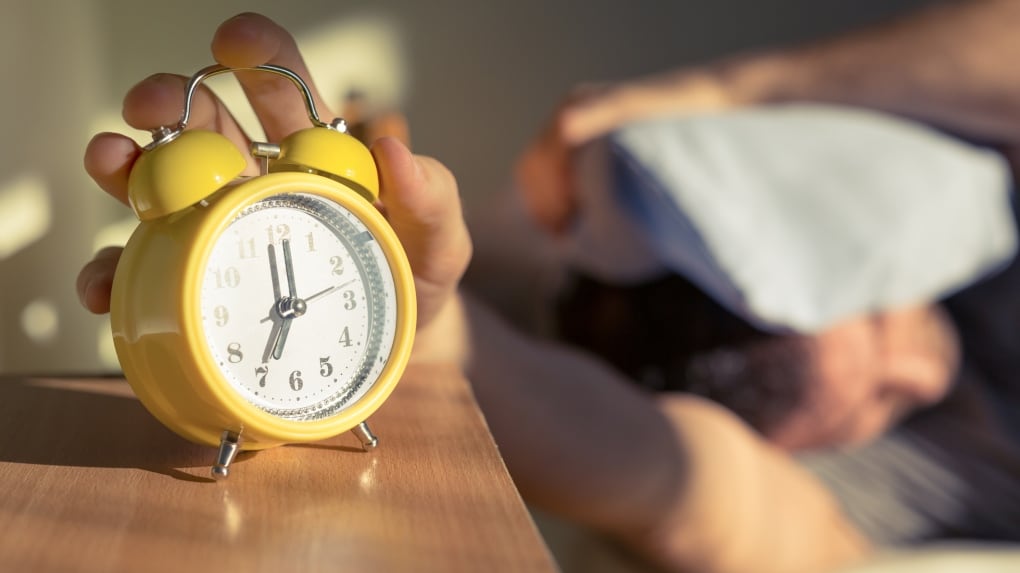
As Canadians prepare for clocks to dial back an hour on Sunday, critics of the decades-old practice have voiced their concerns.
Liberal member of Parliament Marie-France Lalonde introduced a private member’s bill last month, calling for a halt to the biannual ritual of changing time.
Bill C-248, which had its first reading on Oct. 6, calls on the federal government to hold a pan-Canadian conference with provincial, territorial and Indigenous authorities to construct an agreement that will both put an end to daylight time and establish one set time across the country, Lalonde told CTVNews.ca on Thursday.
“I would like to bring in experts and sectors that are most impacted, and Canadians to come and speak on this practice – parents, young persons, we need to talk about it,” Lalonde said.
“We can hopefully come to a consensus to have an agreement that we stop changing our time twice a year. If a province chooses a certain one versus the other, it’ll be based on the evidence that will have been presented.”
The bill aims at highlighting the impact of this convention on professionals in fields such as health care, farming and other 24-hour shift workers, she added. Businesses acknowledge the costs and disruptions this biannual change causes, making it difficult to set a routine.
What are the effects of a time switch on health?
According to the Canadian Encyclopedia, Ottawa first introduced daylight time in 1918 to increase production during wartime.
Dr. Patricia Lakin-Thomas, a professor of biology at York University, told CTVNews.ca on Wednesday there are three possibilities for time zones: year-round standard time, biannual switching and year-round daylight time.
Year-round standard time is when the clocks remain the same throughout the year, even during summer when daylight time would usually be enacted, making it the least disruptive option for health reasons, Lakin-Thomas said.
Biannual switching is what many Canadians currently experience, with clocks jumping an hour ahead during spring and resetting during fall.
Year-round daylight time is when the clocks are permanently set to an hour later than standard time for a region.
“When you move your social clock even by an hour, you’re putting yourself in a one-hour jet lag,” she said. “You’re going to have some physiologically negative effects from being disorganized while you try to adapt to that.”
There is a “complex system” in the human body, Lakin-Thomas explained, adding that there is a central clock in the brain, at the base of the hypothalamus – the part of our brain that acts as a control centre, which is directly connected to light pathways through the eyes. This central clock regulates the body’s sleep-wake cycles and sends that information to the rest of the body and organs, which she says can be easily disrupted by changes in waking times, similar to flying across multiple time-zones.
The switch also disrupts our body’s circadian rhythms – a natural 24-hour cycle that regulates key functions like appetite, mood and sleep, which largely rests on the amount of light exposure we get.
“Morning light advances our clocks so we’re in step with the day, and we can go to bed at the right time and get up the next morning,” she added.
Acute effects of this switch include sleep deprivation in spring, increased risk of heart-related incidents, car accidents and more workplace injuries, according to Lakin-Thomas. These effects usually resolve within a few days or a few weeks, she added. However, the long-term effects could include higher rates of obesity, diabetes, cardiovascular disease and more.
According to a recent study published in Proceedings of the National Academy of Sciences of the United States of America (PNAS), the biannual shift between daylight time and standard time can lead to many “negative societal health consequences.”
“They found that either one of those was better than twice yearly changing (the clock), but year-round standard time was better than year-round daylight time,” Lakin-Thomas said. “On a public health basis, the whole population would be a little bit healthier if we went to year-round standard time. They particularly saw changes in obesity and stroke, so cardiovascular disease and obesity metabolic disease.”
‘Provincial and a territorial decision’
Meanwhile, Lalonde’s bill does not sway the decision in one way or another. She says Bill C-284 aims at regulating the time across Canada, without directing it towards either a standard time or daylight time.
“It is not my place to agree on one. This is a provincial and a territorial decision,” she said.
daylight time has been discussed across Canada for decades, while the regulation of clocks falls under the jurisdiction of provinces and territories, independently.
Most follow and observe the time switch, except for Saskatchewan and Yukon. Saskatchewan passed legislation in 1966 making the time permanent for the province, while Yukon ended the same practice in 2020 after a public consultation.
In 2020, the Ontario government passed a bill to end the switch, making daylight time permanent, but only if New York and Quebec followed the same switch.
Two years later, Atlantic Canada’s premiers adopted a “wait-and-see” approach on changing to permanent daylight time, saying it would only make sense if neighbouring jurisdictions adopted the move.
Irene Shone of Brampton, Ont. , created a petition to end daylight time six years ago due to her personal frustration with the switch, which has now garnered nearly 90,000 signatures.
“My original thinking was, ‘Oh, we just need to stop changing clocks.’ That’s all I thought. And I didn’t care whether it was standard or daylight. I just didn’t want the clocks to keep changing,” Shone told CTVNews.ca on Thursday. “That was my goal. But, as I investigated further, I realized it does matter where you land the clock, and that’s ideally in standard time, because that’s what our bodies crave and want.”
Shone added that the popularity of the petition was attributed to how concerned people were about the change in time. The goal of the petition was to create public awareness about what she thinks is a negative impact.
“People get hurt because of this. It’s costing our system a lot of money. Let’s talk. Let’s talk about this, and let’s stop the practice,” Lalonde said.
Correction
This article has been updated to clarify information on Saskatchewan and Yukon.

