A friendship centre in Fredericton has been teaching people how to build a traditional Wolastoqey birchbark canoe to ensure skills and knowledge dating back generations are maintained for the future.
“I’ve always wanted to build a birchbark canoe,” said Rodney Bear, one of the builders on the canoe, which was prepared for launch on Wednesday.
His ancestors would’ve built these vessels regularly at a time when rivers were highways and canoes were the common vehicles.
But until now, he had never had the chance to craft one. And at every step of the process, he’s been studying how it’s done.
“The more I can soak up, the more I can teach so that our culture isn’t lost forever,” Bear said.
Since May, a team has been gathering about two to three days a week to work on the birchbark canoe.
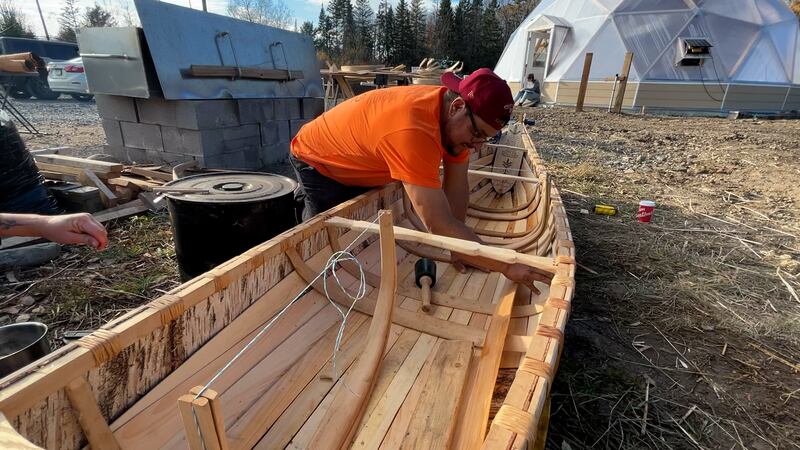
Under One Sky Friendship Centre is behind the project thanks to funding from TD Bank.
“For me, it’s like revitalization of culture,” said Amber Hawkins, the Wabanaki Wellness Coordinator at the friendship centre. “I grew up off-community, I never really had that connection to, culture or indigenous artwork. So this has been extremely transformative.”
The Friendship Centre brought in artist Shane Perley-Dutcher, a distinguished Wolastoqiyik artist, to lead the build. He doesn’t consider himself a “master builder” but this was his sixth birchbark canoe he’s worked on and the second build he’s led.
Starting in May, Perley-Dutcher led the group into the woods to gather materials for the canoe’s construction: birchbark for the base, cedar wood for the planks, and ash wood for the thwarts—the bars that go across the canoe. They also dug up spruce root for the lashings, which had to be boiled, stripped of its bark removed and split.
“All these little elements kind of have to work together in order to make a nice, strong, canoe,” said Perley-Dutcher.
To harvest the birchbark, Perley-Dutcher invited his friend Gabriel Frey, a Passamaquoddy canoe builder from Maine to join. Instead of cutting a birch tree down, Frey climbed nearly 10 metres up the tree to shave the bark off without killing the tree.
“It was a such a great learning experience for us to,” said Perley Dutcher.
Candy Paul, the lead of Under One Sky’s Wabanaki Land Based program, noted at first, it was hard to see the canoe building process.
“But once it started to form, it was like, wow,” she said. “It was pretty amazing.”
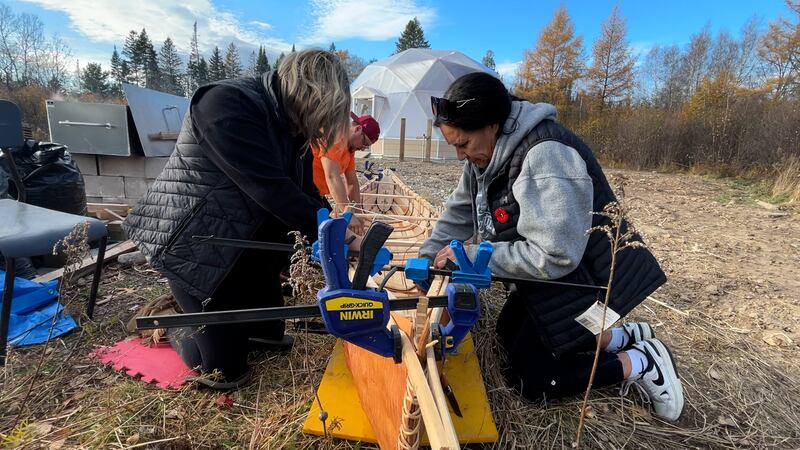
To the builders, this birchbark canoe has been a vehicle to learn more about Wolastoqey culture, craftsmanship and identity.
“It’s something that we need to continue to do to pass down to our future generation of students and people that want to learn the tradition to keep this alive,” said Charlie Gaffney, the project lead whose role is Strategic Enrollment and Community Engagement with One Sky Friendship Centre.
Gaffney notes how traditionally, these canoes were built all the time.
“This was, part of our culture, our understanding of how to navigate the rivers and to portage from one place to another,” he said.
“Our life depended on these beautiful canoes.”
On Wednesday at 11 a.m., the newly crafted canoe will be launched into the Wolastoq River, also known as the Saint John River.
“I’m really looking forward to the end result and seeing the actual, canoe touch water,” said Perley-Dutcher.
After that, the traditional Wolastoqey birchbark canoe will be used by participants of the Wabanaki Land Based Program at the Friendship Centre but also displayed at Under One Sky’s new Centre that’s opening in late 2026.

