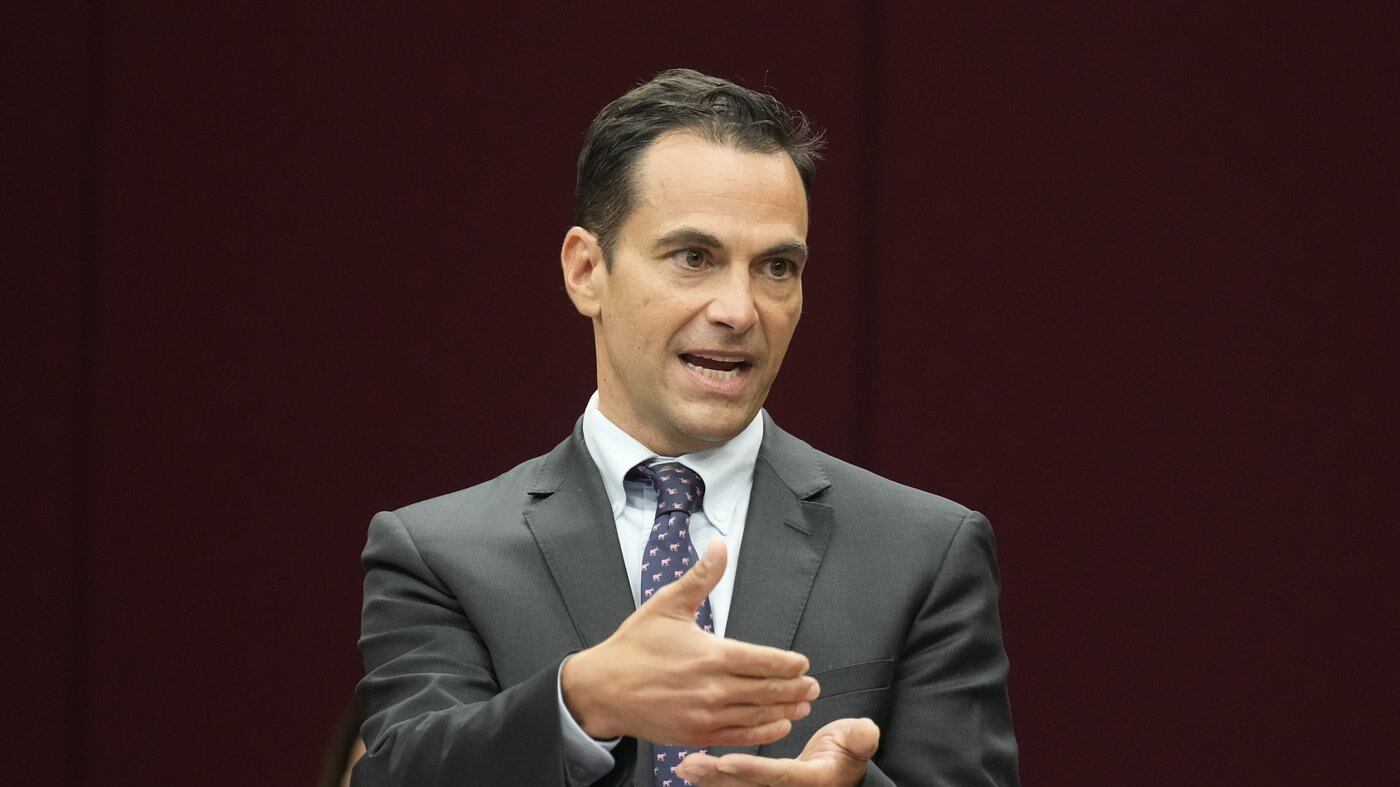
Interim parliamentary budget officer (PBO) Jason Jacques says he will be applying for his job on a permanent basis, now that the posting is officially up.
“Oh absolutely,” Jacques said in an interview with CTV Question Period airing Sunday. “From my own perspective, having worked in the office since the beginning, I think it’s important that parliamentarians have the choice.”
Jacques, who has worked in the office for years, took the job on a six-month interim basis in September. He has been critical of the federal government’s spending plans, saying prior to the federal budget release on Nov. 4 that Canada is on an “unsustainable” fiscal path.
Earlier this week, the Government of Canada issued a job posting for the position, which lists personal attribute requirements, including being “tact” and having “discretion.”
When asked by host Vassy Kapelos whether he thinks the insertion of those qualities in the job posting is aimed at him, Jacques said: “I hope it is.”
“I have a lot of experience, probably more experience than most people around town do, in dealing with parliamentarians across political parties who come from different cultural backgrounds, different linguistic backgrounds,” Jacques said.
“Tactfully and discreetly working with political parties around the platform promises that they want to make, even in situations where they don’t necessarily like the numbers that we’re giving back to them, I absolutely think it’s an essential part of the character the individual that should occupy the permanent post of PBO,” Jacques added.
Jacques said he will “respect” the federal government’s decision “regardless of the outcome.”
“If the prime minister decides he wants to go in a different direction, along with members of Parliament, I certainly respect that,” he said.
‘Overly expansive’
On Friday, the PBO released its federal budget assessment — ahead of the Nov. 17 confidence vote on the budget — which called the government’s accounting into question.
Prime Minister Mark Carney provided a new financial presentation in the federal budget by separating capital and operational spending, with a path to balance the operational budget within three years.
But the PBO says the federal government’s definition of capital investments is “overly expansive,” by including measures like investment tax credits, which countries like the U.K. do not do. Based on the PBO’s definition of capital investments, that spending would total $217.3 billion over the next five years, which is $94 billion lower compared to the federal budget projection of $311 billion.
“The biggest risk with all of this is: If you’re not spending on productive capital investments, if you have an overly broad definition, then you’re not going to get the investment impact and the growth in the economy that the government expects,” Jacques told Kapelos.
The budget watchdog also recommends the federal government create “an independent expert body to determine which federal spending categories and measures qualify as capital investment(s).”
‘Certainly not transparent’
The federal government, meanwhile, laid out two new fiscal anchors in the federal budget: balancing day-to-day operating spending by 2028-29 and maintaining a declining deficit-to-GDP ratio.
According to the PBO report, the operating budget would remain in a deficit position over the next five years, based on its own definition of capital and operational spending, while the deficit-to-GDP has a 7.5 per cent chance that it will decline in every year over 2026-27 to 2029-30.
Speaking to Kapelos, Jacques described the debt-to-GDP fiscal anchor — which has previously been used for years — as “the most important medium-term indicator of fiscal sustainability.”
“It’s certainly not our place to judge which fiscal anchors the government uses,” Jacques said. “At the same time, the way in which the government went about this was certainly not transparent.”
“We’ve had this fiscal anchor for over 30 years,” he added. “Other jurisdictions look at the debt-to-GDP anchor and a declining level-of-debt to GDP as being the mainstay of fiscal anchors. It’s something that the Liberal Party of Canada campaigned on in April. It was in their platform, and without any discussion whatsoever, this fiscal anchor was eliminated.”
Debt-to-GDP is a measure of a country’s total accumulated debt relative to its economic output, while deficit-to-GDP is a measure of the government’s annual shortfall as a percentage of its economic output.
Despite the criticism, the report also differs to Jacques’ comments of sustainability in September, saying the government’s finances are sustainable over the long term, but tight.
Finance Minister Francois-Philippe Champagne’s office responded to the report, saying while it respects the assessment, “the report in question takes a narrow outlook of Canada’s fiscal and economic policy trajectory, looking at Canada’s budget in isolation — absent longer-term considerations and knock-on-effects.”
“Budget 2025 addresses the broader growth and productivity challenges Canada has long faced. The budget takes a sustainable, long-term outlook that balances ambition with responsible governance,” the statement goes on to say, later adding that “the PBO itself has noted that the fiscal plan presented in Budget 2025 is sustainable over the long term.”
You can watch the full interview with interim PBO Jason Jacques on CTV Question Period on Sunday at 11 a.m. ET / 8 a.m. PT.

