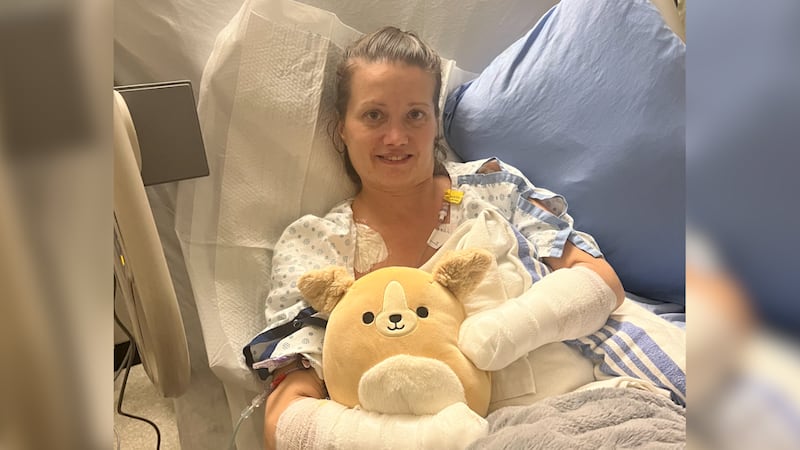
An Alberta woman is learning to live life all over again after a rapid and devastating infection led to the amputation of both her hands and feet.
Jane Haley told CTV News it began as mild neck pain, thinking it was a flare-up of her temporomandibular joint disorder, or TMJ. But it quickly spiralled into a medical emergency.
“The left side of my neck started hurting, and then the left side of my chest started hurting … that was all different,” Haley said. “In my flare-ups, I’ve never had my chest hurt.”
Haley, a 41-year-old native of Grande Prairie, Alta., went to the emergency room at the local hospital on Aug. 24. When she arrived, her condition deteriorated rapidly.
“My blood pressure dropped, (my) oxygen dropped,” Haley said. “I was rushed to the (intensive care unit) and put on life support. I was put in an eight-day, medically induced coma.”
‘Life or limbs’
When Haley woke up, she noticed her hands had turned black. Doctors told her invasive Group A streptococcus (iGAS) had entered her bloodstream, progressing to septic toxic shock syndrome — a rare but severe infection that can lead to organ failure and tissue death. Eventually, her feet started to turn black, as well.
“It came down to life or limbs,” Haley said. “They chose life, and I’m very grateful for that.”
Group A strep bacteria typically cause mild illnesses, such as strep throat. But when the bacteria invade deeper tissues or the bloodstream, they can trigger life-threatening complications, including sepsis and death.
Health Canada data shows cases of iGAS have climbed steadily over the past decade, with more than 5,000 reported in both 2023 and 2024 — the highest totals on record.
“There isn’t always a clear risk factor to predict who will develop severe disease,” said Dr. Donald Vinh, an infectious diseases specialist at the McGill University Health Centre in Montreal.
“We have seen invasive Group A strep in otherwise healthy children and otherwise healthy adults.”
Vinh says there are more than 250 distinct strains of Group A strep, and that some are naturally more virulent or aggressive than others.
“It’s really hard to get an idea of how to protect yourself. Sometimes these infections will start with a cut, or a wound, or chickenpox, shingles, or lesions,” Vinh said.
“If you have fever or pain, and then rapidly spreading redness, you’ve got to get that checked out as soon as possible.”
‘Know your body’
For Haley, the source of her infection remains unknown.
“I had no idea that I was sick,” she said. “I would just tell people to know your body and listen to it.”
Now transferred to the Glenrose Rehabilitation Hospital in Edmonton, Haley has begun the lengthy process of adapting to life with limb loss. She has already been measured for prosthetics for both her arms and legs.
Inside her hospital room, Haley demonstrates a special device that allows her to send text messages. It’s a small, but meaningful sign of the independence she is determined to regain.
“I don’t want to dwell on what could’ve been. It brings me down, and it brings other people around me down, and it interferes with what I’m doing to get back to normal,” she said.
Throughout her ordeal, Haley’s mother, family and friends have stayed by her side, helping her navigate her new reality. She credits their support for her optimism and hope.
“I’m just positive, because that way, good things happen and productive things happen.”
With files from CTV News’ Kristen Yu

