A new report is casting doubt on whether Canada’s immigration policy is able to retain the global talent required to bolster the economy on the home front.
Statistics from the “Leaky Buckets” report from the Institute of Canadian Citizenship show that one in five immigrants leave Canada after 25 years. The biggest exits happen within five years and the most likely to leave are the immigrants who are the most highly skilled and educated.
Daniel Bernhard, the institute’s chief executive officer, said the federal government needs to shift its resources from keeping people out to “retaining talent, which is in the national interest.”
He used the Toronto Blue Jays to make his point.
Only one player on the team, Vladimir Guerrero Jr., is Canadian.
“They went on this great World Series run, and we didn’t invite Alejandro Kirk and George Springer and Bo Bichette to come to Canada to do them a favour. They weren’t down on their luck. We invited them so that our team would be as strong as it could be… We called them Canada’s team, and we love them for it. I think a little bit of that same thinking would be very beneficial if we applied it more broadly across economy and society,” Bernhard said at a news conference.
The reaction to the report was swift, prompting dozens of responses.
In less than 24 hours, more than 100 people responded to a CTV News appeal looking for permanent residents who would speak about their experiences in finding work in Canada.
Many of the immigrants have been in Canada between ten and twenty years and cite several reasons for leaving Canada to work overseas. But the most common reason they pointed to is a feeling of unfulfilled potential in themselves. They want to give the best of themselves professionally and do not see the opportunity to do that in Canada. Here is a small sample of the immigrant experience.
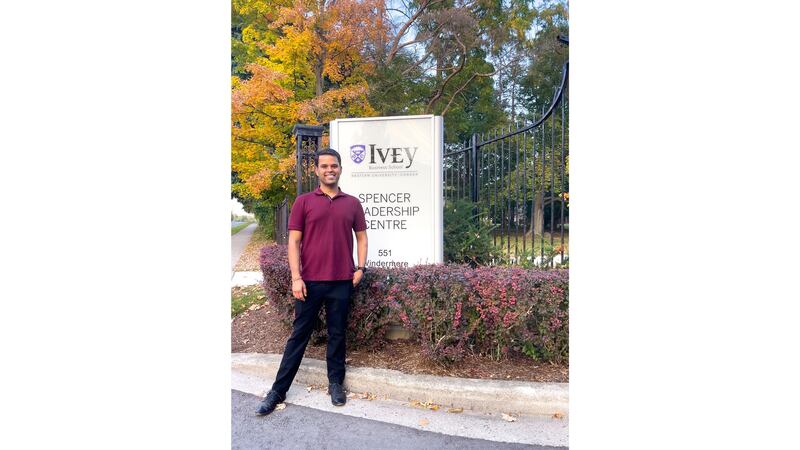
‘Fluency isn’t native enough’
Ankit Mishra, 37, first moved to Canada in 2006 on a student visa to study mathematics at York University. Since then, he has acquired three degrees, including an MBA from Western University’s Ivey Business School. He’s a trained economist and has worked for the Organization for Economic Co-operation and Development (OECD). Mishra has also studied and worked in France yet has found that when he has applied for jobs in Canada, he is “overlooked for roles for the most minor reasons as possible.”
Mishra became a Canadian citizen in 2011 and expected to lay down roots.
He said when applying for work in Montreal, he’s been told that his “fluency isn’t native enough.” He’s also been frustrated that potential employers often don’t value or understand the breadth of his international experience. He said that during one interview, the potential employer did not know what the OECD was. Mishra previously worked in San Francisco but returned to Canada during the pandemic. Currently unable to find steady work, he’s now thinking of returning to the United States.
“It’s not just playing out in Canada as I thought it would, and largely because the type of jobs and the hiring processes and the actual skills needed (Canadian companies) just want a simpler individual,” Mishra said in an interview with CTV News.

‘I’m choosing to say goodbye’
After living in Canada for more than a decade, Kelly Boyi, 31, moved to San Francisco this past January. The Nigerian-born engineer described himself to CTV News as “an ambitious immigrant with even bigger aspirations.”
Boyi first came to Canada in 2013 to study mechanical systems engineering at Conestoga College in Kitchener, Ont. After getting his degree, he worked in the nuclear industry and on the development of electric vehicle technology.
In 2021, he sponsored his parents to Canada, and since then his two younger brothers have arrived in Ontario to continue their education.
But Boyi said frustration has been building in recent years, when he realized that his friends working in the United States were “getting ahead” faster than he was.
“At the end of the day, I was tired of making less than my less-experienced counterparts across the border while also paying high taxes and dealing with a terrible housing market,” Boyi wrote in an email.
Boyi wants to start his own company one day and feels that that venture capital is more accessible in the U.S. but says he will always value his Canadian experience.
“Canada has been home away from home. It gave me my first real job, my first car, my first real relationship, my first property and a lifetime of memories. In 2023, I proudly became a Canadian citizen. And now, in 2025, I’m choosing to say goodbye — because I know it’s time for the next chapter in my life.”
‘Look for greener pastures’
Angie Perez has a master’s degree and a PhD and didn’t pay a cent for her education thanks to scholarships and grants in Canada, totalling over $200,000 by her account. Even with her higher education, Perez said it has been a struggle finding a good-paying job as an immigrant Latina Mexican in a system she described as rife with racism and discrimination.
“If it wasn’t for my husband that is Canadian and has a stable job with less qualifications than me, I would have already left,” she wrote in an email.
As an immigrant, Perez said she will never have the same network as someone born in Canada.
“And then when I finally compete for jobs, your credentials don’t get recognized and you … are getting paid the same as a undergrad or you are overqualified,” she said.
This is the story of many who are overqualified or not paid well enough, she wrote, “until we get fed up and look for greener pastures.”
Perez, 39, is now working as a clinical trials manager for cancer research, but still does not feel that she is working to her potential.
She left Mexico 15 years ago for Canada with hopes of using her data analysis skills to help find answers to medical challenges, but has yet to find a job that fulfills that dream.

